How to Do Your First Tarot Reading (Even If You're Not Sure You Believe in It)
A practical, no-ceremony guide to your first tarot reading — with a physical deck or a digital one. What to do, what to ask, and how to make it useful.
Aurora @ Liminal Tarot
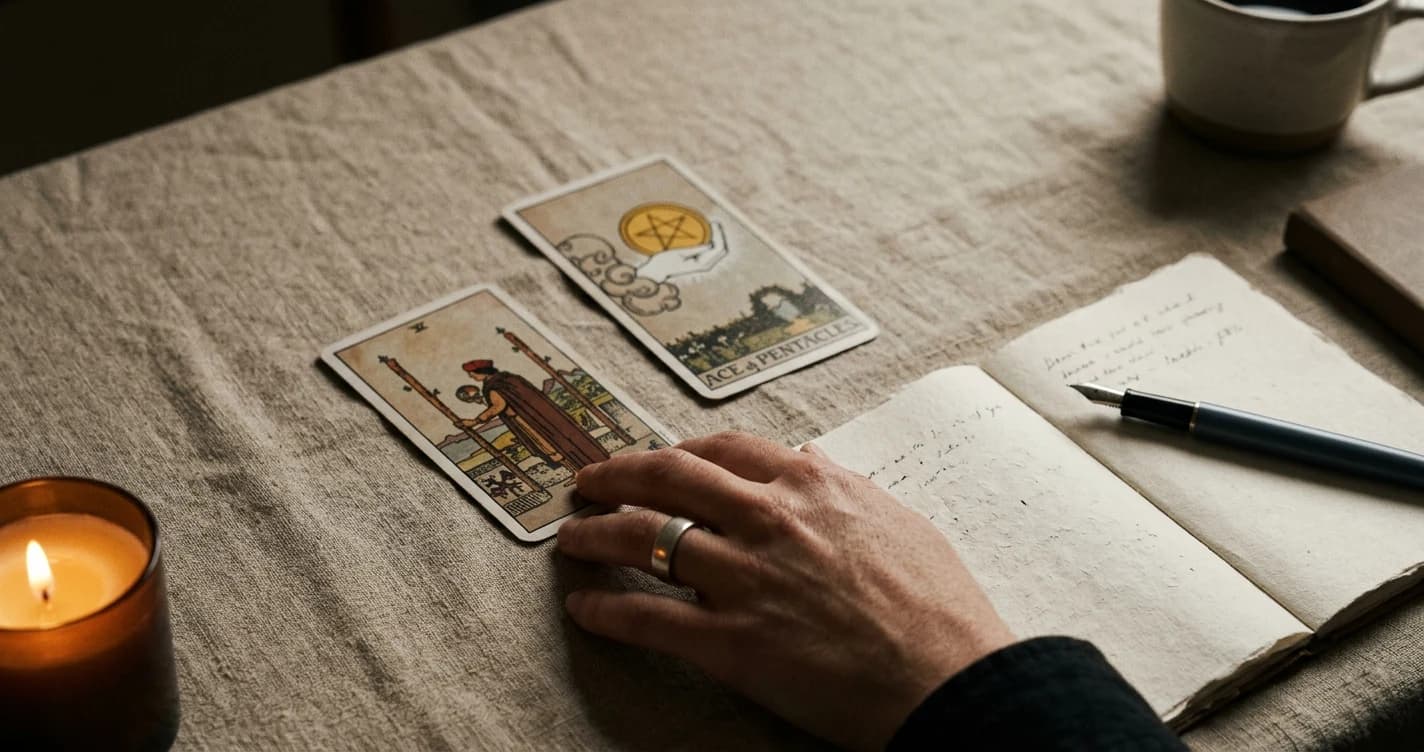
Most guides to your first tarot reading assume you're already sold on the practice. They open with instructions on how to cleanse your deck, set intentions with candles, and tune into your intuitive flow. If that's where you are, great. But if you're the kind of person who Googled "how to do a tarot reading" out of genuine curiosity and mild skepticism, that framing is probably not helping.
Here's a more practical starting point: you don't need to believe in tarot to benefit from it. You need a real question, a few minutes without interruption, and some tolerance for sitting with ambiguity. The rest is just process.
This guide walks you through your first tarot reading from start to finish — what to ask, what spread to use, how to actually engage with the cards when they're in front of you, and what to do with the reading afterward. Both options covered: physical deck and digital.
Start With the Question, Not the Cards
The single most important thing you do in a tarot reading happens before you touch a card. It's getting the question right.
Most people come to tarot with a situation in mind — something they're working through, uncertain about, or stuck on. The instinct is to ask: "Will this work out?" or "What should I do?" Those questions don't give you much to work with, because they're asking the reading to make a decision for you rather than help you think.
Better questions are specific and oriented toward understanding rather than outcome. Some examples of the shift:
- "Will I get the job?" → "What am I bringing to this application that I haven't fully acknowledged?"
- "Should I end this relationship?" → "What am I avoiding seeing about where this relationship is going?"
- "What does my future look like?" → "What's most present for me right now that I'm not fully examining?"
The question doesn't have to be perfect. But it should feel like yours — not generic, not borrowed from a tarot guidebook. If you can write it in one sentence and feel a mild discomfort about how specific it is, you're probably in the right territory.
Exercise: Write your question down before you start. Not in your head — on paper or in a notes app. Read it back. If it sounds like something you'd ask a fortune teller, rewrite it as something you'd ask a thoughtful friend who knew you very well.
Choose a Spread That Matches the Question
A spread is a pattern of positions — each position in the spread represents a different angle on your question. The cards you draw go into those positions, and their meaning shifts depending on where they land.
You don't need a complex spread for your first reading. In fact, starting simple makes it easier to actually sit with the cards rather than managing ten positions at once.
Three formats to start with:
One card. Not a throwaway. A single card drawn for a single focused question is often more useful than a sprawling spread, because you're forced to go deeper with one thing rather than surfing across many. "What do I most need to consider right now?" is a complete question for a one-card draw. Try the one-card spread if you want a clean structure for this.
Three cards in a simple sequence. The classic layout: something in the past that's shaping the present, where you are now, and what's emerging. It gives you enough context to see movement without overwhelming you.
A purpose-built spread. Once you have some familiarity with the cards, spreads designed for specific situations — decisions, relationships, career moments — can be remarkably focused. But not yet.
For a first reading, use one card or three cards. Seriously.
Drawing the Cards: Physical Deck vs. Digital
If you have a physical deck
Shuffle your cards while holding your question in mind. The method doesn't matter — overhand, riffle, spreading them face-down across a table and selecting intuitively. What matters is that you're not rushing. The shuffle is the moment you commit to the question. It's worth twenty seconds of your full attention.
When it feels right, draw. One card per position, face-down, placed in order. Then flip them one at a time.
If reversals are part of your practice, keep them. If you're not sure yet, it's fine to set all cards upright for your first reading — you can add reversal interpretation later once you have more familiarity with the upright meanings. The reversal question is a real debate among practitioners, and there's no universally right answer.
If you're using a digital deck
The process is the same in terms of what matters: hold the question, make your draws with intention, and don't rush the reveal. A digital interface can support the ritual if you let it — or you can blow through it in thirty seconds and get nothing. The quality of attention you bring is the variable.
On Liminal Tarot, you enter your question before you draw, and the cards are interpreted in the context of your spread and your intention. You can use a physical deck and enter the cards position by position if you want to keep your own draw and use the AI interpretation alongside it. That workflow — use your own tarot deck with an app — is worth understanding if you have a physical deck you care about.
Reading the Cards: What to Actually Do
The cards are in front of you. Now what?
First, look before you read. Before you check any card meaning, look at the imagery and notice what you notice. What's your immediate reaction? Not what the card "means" — what does it make you feel, or think of, or want to avoid? That response is data.
Then bring in the traditional meaning. Every card carries an established interpretive tradition — not a fixed decree, but a framework developed over centuries of use. That framework exists because the symbolism is dense enough to be generative. The traditional meaning gives you a starting point; your reading is what happens when that starting point meets your specific question and situation.
A few things to watch for:
What surprises you. If a card lands in a position and your first response is "that doesn't fit," sit with it before dismissing it. "Doesn't fit" sometimes means "I don't want to look at this."
What feels uncomfortably accurate. This is usually where the reading is doing something useful.
What creates more questions. A good reading doesn't close things down — it opens them up. If you finish and have better questions than the one you started with, that's a success.
Scenario: Marcus did a three-card draw about a project he'd been procrastinating on. The first card — representing what's in the past — was the Nine of Cups, a card traditionally associated with satisfaction and getting what you wanted. His reaction was immediate frustration: "That's wrong, I'm not satisfied." He sat with it for a moment, then realised the card might be pointing at the satisfaction he'd already gotten from planning the project — and that actually executing it risked disrupting that feeling. The reading didn't tell him anything. It gave him a surface to find something against.
What to Do After the Reading
The reading ends when you put the cards down. What you do next is where the practice either takes root or evaporates.
The most important thing is to record it — even briefly. Write down the cards, the positions, your question, and one or two sentences about what stood out. This doesn't have to be long or eloquent. The purpose is to create a record you can return to.
Here's why that matters: a reading you can't remember two weeks later becomes a reading that didn't happen. And the value of tarot compounds over time. When you look back at three months of readings during a particular period, you start to see things that weren't visible in any single session — themes that kept appearing, questions that kept returning in different forms, shifts you didn't notice while they were happening.
If you're in Liminal Tarot, your reading is saved automatically. You can attach it to a Chapter — a named thread for an ongoing situation — which lets you group readings over time and come back to them. That's not a feature you need on your first reading. But it's worth knowing it exists, because the moment your second or third reading connects to your first, you'll want somewhere to put that.
Your first reading is a beginning, not a result. Start simple, pay attention, write it down.