When You Regret Ending a Friendship: A Grounded Tarot Reflection
Regret after ending a friendship can coexist with good reasons for distance. Use a grounded tarot reflection to review the boundary and decide what, if anything, comes next.
Aurora @ Liminal Tarot
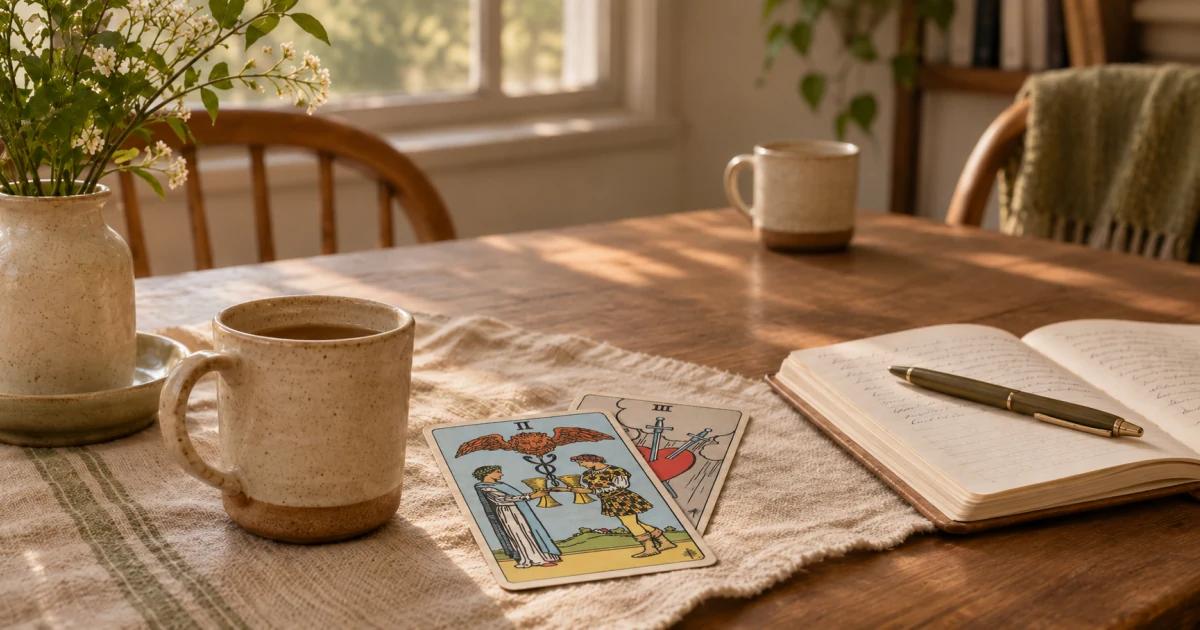
You were the one who ended the friendship. Now you miss the person, and the decision that once seemed necessary feels harder to explain.
Perhaps a familiar song brings back an easy conversation. Perhaps you remember how they helped you through a difficult time. You start wondering whether you were too harsh, whether enough time has passed, or whether an apology might open a door. Yet the reasons you stepped away do not disappear simply because the good memories are easier to reach now.
Tarot can give this conflict a structure. It cannot tell you if your former friend misses you, has changed, or would welcome a message. Those questions depend on real information and the other person's choices. The useful task is closer to home: revisit your own boundary fairly, identify what has actually changed, and choose a next step you can stand behind. That next step may be no contact at all.
Key points
- Name whether you regret the loss, the way you ended the friendship, or a possible misunderstanding before considering contact.
- Review what your earlier boundary protected alongside changes you can actually verify; missing someone does not establish new circumstances.
- Honor no-contact and safety limits; where contact is welcome and safe, any message should allow silence or refusal.
Missing someone does not settle the earlier decision
Regret can refer to several different things. You may regret losing a valued friendship, regret the wording of your last conversation, or believe new facts now cast the original conflict in a different light. You may want to reconnect without having any evidence that the conditions that hurt the friendship would be different.
Those experiences deserve different responses. Missing the routine of a weekly call is not the same as discovering that a misunderstanding shaped the ending. Regretting a cold farewell does not necessarily mean the distance it established was wrong. And wanting a second chance says nothing certain about whether another person wants one too.
Try completing this sentence before touching a deck:
What I regret most is ______.
Be specific. “I miss our jokes,” “I wish I had spoken more clearly,” and “I may have misunderstood what happened” lead to different questions. If more than one fits, write them separately. You do not need to turn a complicated ending into one verdict.
This is also a different situation from noticing that a friendship is changing when you did not initiate the distance. Here, the decision under review is your own. That gives you something concrete to examine, but it does not give you authority over the other person's response.
Give your earlier boundary a fair hearing
The easiest version of the past to remember may be the one that hurts least today. Before drawing cards, reconstruct the decision from what you knew then. Think about the specific events, any conversations you had already tried, and what continued contact was costing you. Did you end the friendship, pause it, reduce how often you spoke, or ask for a different kind of relationship? Those are not interchangeable choices.
Suppose the friendship had become a cycle of cancelled plans. You had explained why it was difficult, made room for adjustments, and still found yourself carrying the same responsibility. Missing the person three months later does not erase that sequence. Equally, if the ending followed one confusing exchange and you have since learned what was misunderstood, there may be something new to weigh.
A small note can keep the two moments apart:
- Then, I knew: what happened, what I asked for, and why I needed distance.
- Now, I know: what I can actually verify has changed since then.
Keep assumptions out of the second column. “I feel less angry” describes a real change in your own experience. “They must have learned their lesson” does not describe a verified change in theirs. If the only new entry is “I miss them,” that is worth writing. It just cannot answer every question by itself.
You may find that your earlier boundary still makes sense. You may also discover that you would now make a narrower decision. The point is to examine it without demanding that your former self knew everything or that your present self defend every word.
A four-card reflection for boundary and regret
Once the circumstances are written down, you can draw four cards or use the same prompts in a journal. Give each position its role before drawing. Read the images as invitations to examine your own experience, not as facts about someone who is absent.
- What am I missing? Name the part of the friendship you valued: companionship, support, shared history, ease, or something more specific. The card does not describe what the other person misses.
- What did my boundary protect? Return to the actual concern or limit. What would be lost if you ignored it now? A card cannot prove that someone was safe or unsafe; your experience and material facts take precedence.
- What has truly changed? Separate observable changes from hopes and guesses. If you have no reliable new information about the other person, write unknown rather than using a symbol to fill the gap.
- What is a proportionate step within my control? Consider keeping distance, reflecting privately, seeking appropriate clarity, or offering a single limited invitation where welcome and safe. The card is not permission to cross anyone's boundary.
There is a useful fifth question that needs no card: What would make me stop or reconsider this plan? It keeps a reflective exercise from becoming an indefinite search for a more reassuring answer.
Avoid assigning a card the job of telling you “Do they forgive me?” or “Will they answer if I text?” The spread cannot establish those private states or future events. A hopeful card can be meaningful to your reflection without being evidence of consent.
What the same cards can mean under different facts
Consider this fictional example. Mara ended a long friendship with Ellis after repeated last-minute cancellations and conversations that failed to produce a workable arrangement. Months later, Mara misses their old familiarity. She also regrets how cold her final message sounded.
Mara draws Four of Cups, Justice, Two of Wands, and Page of Pentacles in the four positions above. These are one possible set of symbolic associations, not fixed meanings or a report of anyone's experience.
With the Four of Cups, Mara notices how much attention she is giving the absence of the friendship. She also remembers Ellis's practical support during a difficult move. Under Justice, she returns to the repeated pattern and to her own request for consideration. Both memories belong in the account; neither cancels the other.
The Two of Wands invites her to imagine a different arrangement. But her “Now, I know” column still has no evidence that Ellis wants or can sustain one. The Page of Pentacles draws her attention to the smallest realistic action. One possibility is to leave the friendship alone and write an unsent apology for the harsh tone, without abandoning the reason she stepped away.
A different path might be available if Ellis has not asked for no contact, there is no safety concern, and Mara is prepared to accept no response. She could consider one brief acknowledgment of her own wording. That would not be a demand to restore the friendship.
Now change one fact: Ellis explicitly told Mara not to contact them again. The same cards do not authorize a message. The no-contact request settles that part of the decision regardless of how hopeful the reading feels. Real-world boundaries govern the action; the cards remain part of Mara's private reflection.
Decide what, if anything, to do next
By this point you may have a clearer account of the regret without having a clear reason to reconnect. That is a valid result. The practical choices are narrower than “try again” versus “forget them forever.”
Keep the distance. This fits when the original concern still matters, there is no reliable evidence of changed conditions, or contact has been refused or would create a material safety risk. You can care about someone and leave a boundary in place. An unsent note may be enough to clarify what you wanted to say without involving them.
Seek clarity from what is already available. You might reread your own messages or compare your current account with notes you made earlier. A trusted person can help you test your reasoning without being asked to contact or pressure the former friend. Clarity does not mean checking their accounts repeatedly, using mutual friends to investigate them, or bypassing blocks. Sometimes the missing information is simply not yours to obtain.
Consider one bounded message. This is an option only when there has been no request for no contact, no blocking or harassment, and no coercion or material safety concern. Before sending anything, be able to say why you are writing and what you will do if there is silence or refusal. Owning a hurtful line you used is different from requesting renewed access to the person's life.
For example, a brief message might say:
I've been thinking about how our friendship ended. I still understand why I needed some distance, but I regret how abruptly I said it. I'm sorry for that part. You don't need to reply. I won't follow up unless you want to talk.
This is an illustration, not an instruction to send it. Do not use it where contact would violate a boundary or be unsafe. Silence is not an invitation to try again, and even a kind reply does not itself establish a workable new friendship. Any different relationship would need willing participation and clear expectations from both people.
When a card seems to insist on reconciliation
A card associated with reunion, forgiveness, or renewal can be difficult to read when you miss someone. It may feel more definite than the evidence you have. Instead of treating the symbol as a decision, ask what part of your experience it illuminates. Can repair mean taking responsibility privately? Can forgiveness be a personal choice without reopening contact? Are you overlooking a concrete limit you already recorded?
A useful test is whether you could defend the same next step without having drawn that card. If the explanation depends on claiming your former friend has changed, forgiven you, or wants you back, the reading has gone beyond what you know.
Tarot is not a substitute for judgment about abuse, coercion, threats, stalking, harassment, or stated no-contact boundaries. There is no requirement to reopen unsafe contact, justify distance to a card, or prove that the original boundary was severe enough. Where safety is at stake, prioritize the boundary and appropriate real-world support rather than a reconciliation exercise.
Leave with an honest next step
At the end, write four lines in your own words:
- The boundary protected: the specific concern or need that mattered then.
- What I regret: the loss, the decision, the manner of ending it, or some combination.
- What I can verify has changed: a concrete fact, or nothing yet.
- What I will do for now: one bounded action or deliberate no-action, and the condition that would make me reconsider.
You can keep this note with your tarot journal or alongside a reading in your ongoing practice. It gives you something real to return to if your circumstances change, without making repeated cards responsible for the decision.
A friendship can have mattered deeply and still have needed distance. It is also possible to revisit an earlier choice when the facts genuinely change. The reading helps you hold both possibilities in view. The decision remains yours, and any renewed relationship would have to belong to two people.