How to Revisit an Old Tarot Reading Without Rewriting the Past
A practical way to revisit an old tarot reading without letting hindsight rewrite what you asked, knew, or interpreted at the time.
Aurora @ Liminal Tarot
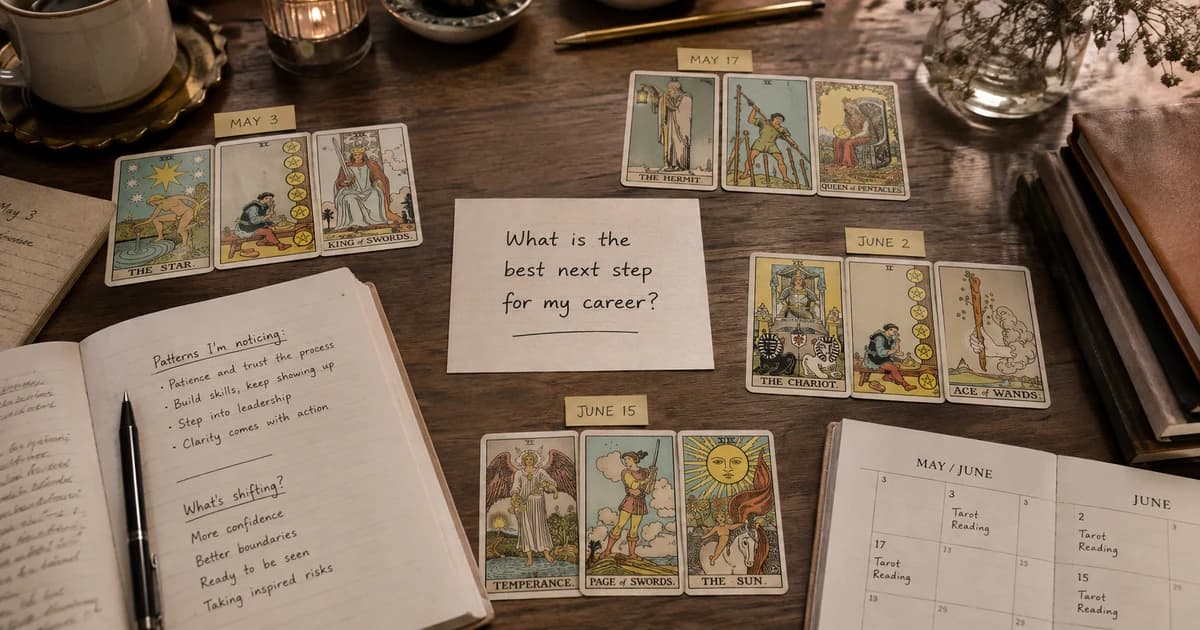
An old tarot reading can look strangely obvious once you know what happened next. A sentence that felt broad at the time suddenly seems precise. A card you barely noticed appears to fit the later event. The temptation is to read the old entry as though that meaning had been clear all along.
That is where a useful retrospective review can quietly turn into a rewritten memory of the reading.
The better approach is simple: preserve the first record, then annotate it. Let the original question, interpretation, uncertainty, and misses remain visible. Add what happened later as a new layer. Then compare the two without asking the old reading to become more certain than it actually was.
The point is not to dismiss hindsight. Hindsight can make an old reading more interesting. It just should not be allowed to edit the evidence it is looking back at.
Keep three moments separate
A retrospective review becomes much clearer when you treat it as three related records rather than one story that keeps being revised.
The original reading is what existed at the time: the question, spread, cards, first interpretation, notes, and any uncertainty you recorded.
The later update is what happened after the reading: what changed, what resolved, what new information appeared, and what remained open.
The present reflection is what you can see now: what still feels relevant, what reads differently, what did not fit, and what you understand differently today.
The present reflection can reinterpret the original reading. It should not replace it.
That distinction is what gives an old tarot record its value. If every entry is silently cleaned up after the outcome is known, the record stops showing what you actually noticed at the time. It becomes a polished story about what the reading supposedly meant all along.
A useful archive keeps the rough edges.
Read the old entry before you read the outcome into it
Start with the question exactly as you asked it.
A reading about whether to apply for a role can later be remembered as a reading about an entire career transition. A spread about one difficult conversation can later feel as though it was "about" the eventual end of a relationship. That expansion is understandable, but it changes the target.
Before interpreting anything again, reread the original question and ask what was actually inside its frame. What were you trying to understand? What were you worried about or hoping for? Which later events had not happened yet?
Then read your first interpretation before making a new one.
This matters most when a card now seems obvious. The useful comparison is not only, "What can I see in this card today?" It is also, "What did I see in it then?"
Those answers may be different. That difference is part of the record.
You may find that you were focused on one concern and barely noticed another. You may have named a possibility without giving it much weight. You may also find an interpretation that simply did not fit. None of that needs to be repaired after the fact.
The aim is to reconstruct the boundary of the earlier moment: what was known, what was unresolved, what had not happened, and what assumptions you were bringing to the reading. Later knowledge belongs in the review, but it should arrive later on the page too.
Add what happened later without editing backward
Once the original reading is clear, add the later event or changed context as a separate note. A date helps because it makes the sequence visible.
Suppose an earlier work reading included this note:
Original note — March 12
I read this as a conflict between staying with the safe option and wanting more room to move.
Two months later, the role ends. A retrospective entry might say:
Retrospective note — August 29
The role ended two months later. I did not read the spread as predicting that. What still feels useful is that I had already recorded how constrained the "safe" option felt before the external situation changed.
The later event changes the context around the old reading. It does not prove that the reading announced the event in advance.
That difference leaves room for hindsight without turning it into a prediction claim. The old note can still matter because it preserved something you were already noticing: discomfort, attachment, uncertainty, a tradeoff, a question you could not yet resolve. Its usefulness does not depend on having secretly contained the future.
Keep the misses beside the matches
Retrospective review becomes less trustworthy when only the apparent hits survive.
When you revisit an old reading, it helps to sort what you find into four simple categories:
- Still useful: something in the reading continues to feel relevant.
- Changed meaning: the same card or sentence reads differently now because the context changed.
- Did not fit: an interpretation or expectation was not borne out, or no longer seems useful.
- Still unclear: the material never became specific enough to evaluate, and you do not need to force it into a conclusion.
These categories are not a scorecard. They are a way to keep the record proportional.
A later event can make one part of a spread feel sharply relevant while another part remains ordinary. An interpretation can be thoughtful and still turn out not to match what happened. A card can remain ambiguous indefinitely. Preserving those outcomes keeps one striking match from swallowing everything else in the reading.
There is also no need to broaden a vague meaning until it can describe whatever happened. If the original interpretation was broader than the later event, leave it broad. If the event was outside the scope of the original question, say so.
The reading does not become less useful because you can see its limits.
Ask what the reading preserved about your attention
One of the more useful things an old reading can show is not the event that came later, but the version of the situation you were living with at the time.
What were you paying attention to? What seemed urgent? What possibility barely registered? Which part of the question now feels less important? Which concern stayed present even as the circumstances changed?
That is where a saved reading can become more than a record of cards. It can preserve the shape of your attention before later events simplified the story.
Imagine looking back at a relationship reading from six months ago. The outcome may now be settled, but the earlier note shows that you were preoccupied with whether the other person would choose you. Today, the more interesting detail may be how little space the original question gave to what you wanted. That observation does not require the spread to have predicted anything. The historical value is in seeing the frame you were using then.
The same is true when nothing dramatic happened. An old reading can still show what you were trying to name, what you thought mattered, and what eventually stopped mattering.
A retrospective review is not a second reading
Looking back at one old spread and doing a new spread are different actions.
A retrospective review asks: What did this reading mean to me then, and what can I learn from the record now?
A new reading asks a new question in the present.
You can do both on the same day, but keeping them separate protects the history of the first reading. If the retrospective review leaves you with a fresh question, record it as a fresh question rather than folding it back into the old spread.
This matters especially when the same life situation is still active. If you want to read on it again, it helps to first ask what has genuinely changed around the question. The same distinction is explored in When You Keep Asking Tarot the Same Question: a new reading is more useful when it has a clear job in the present rather than being treated as a correction of the previous one.
The old spread can remain what it was. The new reading does not need to overwrite it.
A compact retrospective note
You do not need a complicated system. A useful review can fit into ten lines:
Original date:
Original question:
What I knew then:
Original interpretation:
What happened later:
What now feels relevant:
What did not fit:
What I understand differently now:
What remains unresolved:
New question, if any:
The order matters more than the medium. You can use a paper journal, a document, a spreadsheet, or a tarot app with saved history and notes. In Liminal Tarot, a saved reading and later notes or Chapter context can hold those layers; on paper, a dated annotation does the same job.
The practical rule is the same: append rather than overwrite.
Some readings simply stay ordinary
Not every old reading needs to reveal a hidden pattern after enough time has passed.
Sometimes the original interpretation no longer feels useful. Sometimes the later event is too far outside the original question for comparison to add much. Sometimes the reading remains vague. Sometimes the best retrospective note is simply: This did not become especially meaningful, but it shows what I was concerned about at the time.
That is a complete result.
A record does not have to become prophetic to become valuable. Its value may be quieter: it shows what you asked, what you noticed, what you missed, and how your understanding changed after life supplied information the reading did not have.
Preserve the earlier layer. Add the later one. Let the difference between them remain visible.