Minor Arcana — Swords
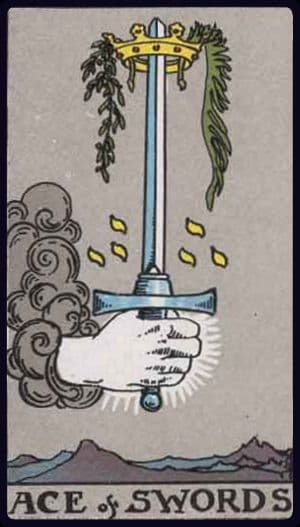
Ace of Swords
The Ace of Swords is the card of sharp arrival — a thought finally clean enough to act on.
Upright
Reversed
Ace of Swords Meaning
Upright
The Ace of Swords points to a breakthrough that begins in the mind before it shows up anywhere else. It often appears with new ideas, mental clarity, or the sudden success of seeing what has been obscured. This card is not about having every answer. It is about the moment the confusion breaks and something true becomes sayable. What matters here is precision: the sentence you can finally form, the decision that becomes obvious, or the thought that cuts through all the softer evasions around it.
Reversed
Reversed, the Ace of Swords often points to inner clarity that is still forming but not yet stable enough to trust. You may be re-thinking an idea, circling back over the same reasoning, or struggling with clouded judgement that makes every option feel less solid than it should. This card suggests the problem is not a lack of intelligence. It is interference. Something is distorting the signal, and the task now is to separate what you know from what stress, pride, or urgency keeps adding to it.
Ace of Swords as a Daily Card
The Ace of Swords is mental power at its sharpest. Today, use that clarity wisely — truth without compassion can wound.
Lean toward
A clean decision at last.
Watch for
Keeping it complicated to avoid choosing.
How can you be honest today while remaining kind?
In Different Situations
Relationships
There is a point in a relationship when another careful hint will not say what needs saying. The Ace of Swords brings the possibility of a clean sentence: what happened, what matters, what you need to understand. Clarity may feel uncomfortable because it removes the shelter of vagueness. It does not automatically mean a breakup, a confession, or a happy resolution. The sharp edge of this card matters too. Speaking precisely is different from using the truth as a weapon. An honest conversation can clear confusion without settling everything in one exchange.
Career
A new idea at work sometimes arrives as the ability to name the actual problem. Meetings, effort and good intentions may have accumulated around it, yet one precise description changes what can be discussed. The Ace of Swords points to that intellectual opening: a sharper question, a clearer proposal, a distinction that was being missed.
It is not a guarantee that the idea will succeed or be welcomed. The same sharpness can turn rigid or dismissive when it leaves no space for other evidence. The value is in making thought usable, then allowing it to be tested.
Decisions
When every option seems crowded with exceptions, the Ace of Swords looks for the distinction that changes the question. Perhaps a fact and a fear have been given the same weight. Clarity is not a prediction; it is a more accurate way to describe what you are deciding.
The danger is falling in love with the first clean answer because it feels so much better than confusion. A sharp thought can open the decision without making further listening unnecessary.
Burnout
When you are worn down, every request can start to arrive with the same urgency. The Ace of Swords is useful here because it separates what is actually required from what pressure has made feel compulsory. A precise word for the problem may reveal that several tasks are competing for one limited stretch of attention. But mental sharpness has a harsh edge when it turns inward. Seeing your limits clearly is not another reason to criticize yourself for having them. The card offers discrimination rather than a productivity trick: clarity about the load is different from the energy needed to carry it.
Feeling Stuck
The stuck feeling may have lasted so long that it now seems like a fact about who you are. The Ace of Swords interrupts that blur with a possibility: one accurate sentence can make the situation more specific. “I do not know what I want” and “I know what I want but fear the cost” are not the same impasse.
The card does not promise that naming it will produce momentum. It gives thought a firmer edge, so that a vague, heavy state can be examined as something with parts rather than accepted as a permanent condition. That distinction can change the shape of the question even if the situation remains unchanged for now.
New Beginnings
Sometimes a beginning starts with a sentence rather than a dramatic leap. The Ace of Swords marks the arrival of a clear idea, a truth finally spoken, or a question that cuts through vague possibility. It can make the first step imaginable because you can now say what the step is for. Clarity is only the opening: the new idea still needs contact with reality, and the sword's sharpness can become impatience with details that complicate it. A fresh direction has weight even before its outcome is known.
Grief and Loss
Loss sometimes leaves you repeating a sentence you can hardly bear to say. The Ace of Swords concerns the hard clarity of naming what is absent or how life has changed. Words can draw an outline around something that still feels impossible to take in; they cannot make it simple.
The sharpness has a risk here. A clear account of what happened may be mistaken for an obligation to understand it, justify it or move past it. This card allows truth to be spoken without turning grief into a problem that a sufficiently precise explanation should solve.
Recurring appearance
What does it mean when Ace of Swords keeps appearing?
Something may need to be named more plainly. Clarity keeps cutting through the noise.
Spreads that work well with Ace of Swords
Decision
3 cardsNot a binary answer. Three cards to illuminate what each choice carries — energy, cost, and consequence.
View spread →Horseshoe
7 cardsA broad arc covering past, present, and future with attention to hidden influences, your attitude, and external forces at play.
View spread →The Fog
4 cardsFor moments when the path ahead is unclear and the old answers no longer hold. This spread doesn't offer direction — it offers orientation.
View spread →Begin your practice
Draw Ace of Swords in a reading
Context transforms a card's meaning. A full reading weaves your question, your spread, and your cards into a coherent reflection.