Minor Arcana — Cups
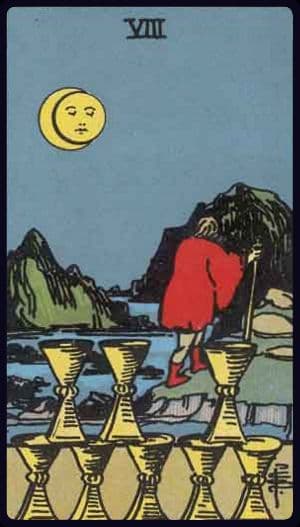
Eight of Cups
The Eight of Cups is the card of leaving what no longer reaches you — even when leaving costs something.
Upright
Reversed
Eight of Cups Meaning
Upright
The Eight of Cups points to disappointment that has become too steady to ignore. It often appears when abandonment, withdrawal, or escapism are part of the emotional weather, but beneath that is a more difficult truth: something once meaningful no longer satisfies at the depth it used to. Walking away may be less dramatic than it sounds. It can be the quiet decision to stop forcing yourself into a version of life that has gone emotionally vacant. This card names the moment departure begins internally, long before it becomes visible.
Reversed
Reversed, the Eight of Cups can reflect indecision about whether to leave, stay, or try one more time. Sometimes the issue is aimless drifting: moving without commitment because committing would make the loss real. Other times, walking away is already overdue but still resisted out of habit or hope. This card suggests the back-and-forth is becoming its own form of exhaustion. The question is not only whether the situation can improve. It is whether your reluctance to choose is keeping you tied to something you've already outgrown.
Eight of Cups as a Daily Card
Today asks about emotional courage. The Eight of Cups leaves behind what's familiar in search of something more meaningful.
Lean toward
Disappointment you no longer need to decorate.
Watch for
Mistaking loyalty for self-abandonment.
Where are you staying comfortable when your soul is asking for more?
In Different Situations
Relationships
You can still care about someone and feel that a connection no longer meets you where you are. The Eight of Cups sits with that difficult mismatch. Its movement away from something once meaningful isn't proof that the feeling was false, or that leaving is the only answer. It names the cost of trying to stay emotionally present when part of you has already withdrawn.
Sometimes the distance reflects a necessary change; sometimes it is a way to avoid a conversation. The card offers no verdict about the other person's intentions. It makes the quiet withdrawal harder to ignore.
Career
There is a particular disappointment in becoming good at work that no longer feels like yours. The Eight of Cups speaks to that loss of connection, especially when the role is still respectable from the outside. Wanting something more meaningful doesn't erase what the work gave you or what leaving might cost.
The card is not an instruction to resign. Staying can provide room to change the terms; departure can also be an escape from difficulty that follows you elsewhere. What it brings into focus is the difference between temporary frustration and the deeper feeling that your investment has already begun to move on.
Decisions
The Eight of Cups complicates a choice between staying and leaving. Something may no longer satisfy you, yet it may still hold people, promises or practical support that matter. Walking away has a cost; continuing has one too. Neither cost automatically makes a choice wrong.
At times the most important part of the decision has already happened inwardly, and the outward choice is struggling to catch up. At other times, the urge to leave is a way of escaping the discomfort of deciding. The card doesn't settle that distinction. It gives the emotional cost of each option a place alongside the practical one.
Burnout
A task can become exhausting long after you've stopped believing in its purpose. The Eight of Cups makes room for that kind of depletion: continuing to give yourself to something that no longer gives much back. The urge to withdraw may be a clear signal that the terms have changed. It might also be sharpened by temporary fatigue.
This card doesn't diagnose burnout or prescribe an exit. It asks what is being sustained through effort alone, and what you would lose as well as regain by stepping away. Staying and leaving both deserve a truthful account of their cost.
Feeling Stuck
Sometimes what looks like inertia is the space between no longer belonging somewhere and knowing where else to go. The Eight of Cups understands this uncomfortable middle. You may have loosened your attachment to a role, habit or relationship without finding a convincing alternative. That can feel less like freedom than like standing still.
The card also allows another possibility: imagining departure has become a substitute for making any change at all. It does not demand a leap. It names the difference between being unable to move and being reluctant to acknowledge what you've already outgrown.
New Beginnings
A new chapter may start with the quiet recognition that the old one no longer fits. The Eight of Cups makes that departure part of the beginning, not a shameful footnote. You can be grateful for what once sustained you and still feel a need to leave its shape behind. The loss involved doesn't make the movement meaningless.
Nor does this card promise that what comes next will be more satisfying. It distinguishes moving toward a deeper fit from simply trying to outrun discomfort. A beginning can be honest about what it is leaving, even before it knows what it is entering.
Grief and Loss
Grief sometimes includes leaving a place, habit or role that still holds the shape of what was lost. The Eight of Cups can reflect how painful that movement is, especially when stepping away feels like abandoning a memory. Its departure is not a judgment that what came before was empty. It may have mattered enough to make change difficult.
There is also no rule that leaving is necessary. Some people stay near familiar reminders; others find those reminders too heavy. This card gives attention to the cost of carrying something forward in a different form, without calling that cost a failure.
Recurring appearance
What does it mean when Eight of Cups keeps appearing?
Departure can begin long before anyone names it. Something may already feel too emptied out to stay.
Spreads that work well with Eight of Cups
Past, Present, Future
3 cardsThe classic three-card arc. Where you've been, where you are, and where the energy is heading.
View spread →Relationship
5 cardsFor any relationship — romantic, familial, professional. Explores the dynamic between you and another person.
View spread →The Circle
5 cardsFor reflecting on a friendship or connection — what holds it together, what's being tested, and what it asks of you.
View spread →Begin your practice
Draw Eight of Cups in a reading
Context transforms a card's meaning. A full reading weaves your question, your spread, and your cards into a coherent reflection.