Minor Arcana — Pentacles
Eight of Pentacles
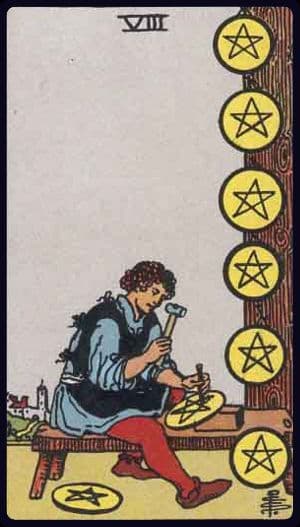
The Eight of Pentacles is the card of practice — repetition that slowly turns effort into skill.
Upright
Reversed
Eight of Pentacles Meaning
Upright
The Eight of Pentacles points to apprenticeship, repetitive tasks, and the kind of work that builds mastery through steady repetition. It often appears when skill development matters more than recognition, and when progress depends on showing up for the unglamorous parts. This card respects craft, routine, and the discipline of implementation over performance. It suggests that something worthwhile is being built piece by piece, with improvement coming not from talent alone but from sustained attention to the work itself.
Reversed
Reversed, the Eight of Pentacles can reflect perfectionism, misdirected activity, or a private sense that all this effort is not actually deepening the right thing. Sometimes the issue is self-development pursued so rigidly that it stops being alive; sometimes it's busyness mistaken for progress. This card asks whether your repetition is creating mastery or merely keeping you occupied. It can also point to standards so unforgiving that learning becomes harder instead of clearer.
Eight of Pentacles as a Daily Card
The Eight of Pentacles asks about investment in yourself. Today, consider what you're learning and whether it serves your growth.
Lean toward
One more pass done properly.
Watch for
Rushing because it's familiar now.
What are you currently learning, and how is it shaping who you're becoming?
In Different Situations
Relationships
Trust is sometimes built in ordinary repetitions: following through, paying attention, learning how to disagree without making every difference a threat. The Eight of Pentacles sees relationship effort as a practice rather than one grand gesture.
Still, the worker's concentration has a shadow. You can spend years trying to become the perfect partner, friend, or family member while a bond remains one-sided. Skill and care can deepen a connection, but they cannot be performed on another person's behalf. The question here is whether the work is shared and making room for two imperfect people.
Career
There is a particular satisfaction in getting better at work you once found difficult. The Eight of Pentacles belongs to that quiet craft: doing the task again, noticing where it falters, making the next attempt more exact. It gives dignity to learning that happens outside the spotlight. But repetition alone is not mastery. A job can keep you busy without letting you grow, and perfectionism can make each improvement feel insufficient. In a career reading, this card points toward the difference between accumulating hours and developing a skill you can genuinely call your own.
Decisions
Not every choice can be settled by asking which path feels most promising today. The Eight of Pentacles looks at what each option would ask you to practice over and over. A direction that sounds impressive may contain daily work you don't want to learn; a modest beginning may offer room to develop real competence. There's also a trap in choosing the option where you can already perform perfectly. This card shifts attention from the imagined outcome to the lived process, including mistakes, repetition, and the kind of attention you're willing to give.
Burnout
You may still be doing the work well, even as the pleasure of doing it disappears. The Eight of Pentacles shows a person absorbed in repeated craft; in burnout, that concentration can turn into a standard you never let yourself leave. One more revision, one more attempt to get it exactly right, one more day of proving you care. Competence can conceal depletion. The card doesn't condemn dedication, but it notices when practice stops teaching you anything and becomes a test you can never finish. The quality of the work and the condition of the worker are separate facts.
Feeling Stuck
There may be no single breakthrough waiting to make you feel capable again. The Eight of Pentacles works through small repetitions, the kind that gradually make a difficult action familiar. In a period of flatness, that can be reassuring: movement needn't arrive as sudden certainty.
Yet this card also knows the dead end of repeating a routine that no longer asks anything of you. Practice creates momentum when you can notice what is changing. Otherwise it can become a way to stay occupied without moving. The distinction is quieter than a dramatic turning point, but more useful.
New Beginnings
Starting over often means becoming a beginner in public or in private. The Eight of Pentacles removes some of the drama from that moment. Its craftsperson improves by working on one piece and then another, not by arriving fully formed. A first attempt can be rough and still teach you something precise. The caution is that a demand for perfect preparation can keep the beginning permanently out of reach. This card values a practice you can return to, with room for mistakes and adjustment. What grows here is skill, not certainty about the outcome.
Grief and Loss
Some forms of remembering happen through repetition: preparing something familiar, returning to a place, learning to do a task someone else once did. The Eight of Pentacles sees the care inside these ordinary acts. A routine can steady a day without answering the larger absence.
It can also become an exacting rule about how faithfully you must remember, as though doing it perfectly could protect what has gone. The craftsperson in the card makes another piece, then another. That image may reflect how living with loss involves many small acts that carry meaning without repairing what happened. There is no flawless way to do that work, and no finished piece that proves grief is complete.
Recurring appearance
What does it mean when Eight of Pentacles keeps appearing?
A craft you keep coming back to even when it's slow. The work is asking for more patience than you'd like.
Spreads that work well with Eight of Pentacles
Past, Present, Future
3 cardsThe classic three-card arc. Where you've been, where you are, and where the energy is heading.
View spread →Career Path
4 cardsFor questions about work, purpose, and professional direction. Not job-search advice — a mirror for your working life.
View spread →Horseshoe
7 cardsA broad arc covering past, present, and future with attention to hidden influences, your attitude, and external forces at play.
View spread →Begin your practice
Draw Eight of Pentacles in a reading
Context transforms a card's meaning. A full reading weaves your question, your spread, and your cards into a coherent reflection.