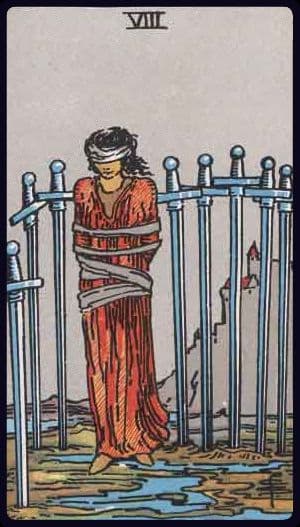
Minor Arcana — Swords
Eight of Swords
The Eight of Swords is the card of mental confinement — feeling caught between restrictive thoughts and difficult circumstances.
Upright
Reversed
Eight of Swords Meaning
Upright
The Eight of Swords points to negative thoughts, self-imposed restriction, and the feeling of imprisonment that follows when fear starts presenting itself as fact. It often appears with an inner narrative of helplessness, where every option seems blocked before it is even tested. This card does not deny that circumstances can be difficult. It highlights the way the mind can intensify those difficulties by treating its own worst conclusions as settled truth. Some constraints are imposed by circumstances or other people. The useful distinction is between those real limits and conclusions that may be open to testing, without blaming yourself for either.
Reversed
Reversed, the Eight of Swords suggests the first signs of release. Self-limiting beliefs are becoming more visible, the inner critic is losing some of its authority, or negative thoughts are beginning to be recognized as thoughts rather than verdicts. This card rarely indicates instant freedom. It indicates a crucial shift in authorship. The prison starts to weaken when you can see the bars as constructed rather than permanent. What matters now is not forcing confidence. It is continuing to separate what is actually impossible from what has only been repeated long enough to feel inevitable.
Eight of Swords as a Daily Card
The Eight of Swords feels trapped — but the bindings are loose. Today, examine what's actually holding you back. It may be less than you think.
Lean toward
The story that's boxing you in.
Watch for
Treating fear like a fixed fact.
What limitation do you believe you have that might not be as fixed as it seems?
In Different Situations
Relationships
You can care about someone and still feel that there is no room to speak freely. In the Eight of Swords, the blindfold and surrounding blades make that sense of confinement visible. Some limits in a relationship are real: another person's actions, the circumstances you share, or what has happened before. Others may be conclusions you have stopped testing, such as believing that one difficult conversation can only end badly. This card does not assign blame or promise an easy exit. It asks for a more accurate view of where the limits actually are.
Career
When a role has become too small, the list of reasons you cannot move may sound definitive: the skills you lack, the opportunities that seem closed, the people who would be disappointed. The Eight of Swords does not dismiss practical constraints. Its image of a bound figure among swords asks whether every barrier belongs to the outside world. At work, the difference between a genuine restriction and an untested assumption can alter the range of possibilities you can even imagine. Competence is hard to recognize when you have already decided your next step is unavailable.
Decisions
When all the available choices look wrong, it can seem as though there is no decision to make at all. The Eight of Swords captures that narrowed field of view.
Its surrounding blades represent restrictions, but the blindfold also matters: fear and repeated assumptions can make some possibilities hard to see. This does not mean the obstacles are imaginary. A decision may genuinely involve loss, limited resources, or obligations to others. The card offers no preferred answer. It asks whether the list of options is complete, and which limits have been verified rather than rehearsed.
Burnout
The Eight of Swords can describe the frightening sense that slowing down is impossible, even when continuing at the same pace has become difficult. Some demands may be non-negotiable; others have acquired that status because saying no has felt too risky for too long. The blindfold in this image is not a rebuke. It shows how hard it can be to assess limits while already under pressure. This card offers no simple instruction to rest. It makes the distinction between external demands and internal rules visible, especially when both are using up the same finite energy.
Feeling Stuck
The Eight of Swords is almost a portrait of stuckness: a figure standing still, blindfolded, with a ring of blades defining the space around her. The scene holds both genuine constraint and a limited view of it. That is why the card is more useful than a command to be brave. You might not have a clear next step, and some restrictions may be beyond your control. Yet the thought that every direction is closed deserves a closer look than the thought that one direction is difficult. Stuckness can persist when those two statements become indistinguishable.
New Beginnings
A new beginning can arrive before you feel free enough to enter it. The Eight of Swords captures the old restrictions that travel with you: familiar doubts, warnings you learned to repeat, the assumption that this attempt must end like the last. Some practical barriers may still be present, and confidence cannot remove them. But the blindfold asks whether an earlier map is being used to describe a situation that has already changed. You do not have to feel fearless for a beginning to be real. You do need room to notice what is different from before.
Grief and Loss
Loss can narrow the imaginable future. The Eight of Swords depicts a person surrounded by barriers, unable to see clearly beyond them. In grief, those barriers may include very real changes in daily life alongside thoughts about what you are now allowed to want, enjoy, or become. The card does not treat those thoughts as a failure or suggest there is a quick way out. It gives form to the way absence can change the boundaries of a life. Some limits are facts; others may remain unexamined because looking past them feels disloyal to what was lost.
Recurring appearance
What does it mean when Eight of Swords keeps appearing?
Constraint keeps appearing around the same issue. The trap can feel airtight even when it isn't.
Spreads that work well with Eight of Swords
Decision
3 cardsNot a binary answer. Three cards to illuminate what each choice carries — energy, cost, and consequence.
View spread →Horseshoe
7 cardsA broad arc covering past, present, and future with attention to hidden influences, your attitude, and external forces at play.
View spread →The Fog
4 cardsFor moments when the path ahead is unclear and the old answers no longer hold. This spread doesn't offer direction — it offers orientation.
View spread →Begin your practice
Draw Eight of Swords in a reading
Context transforms a card's meaning. A full reading weaves your question, your spread, and your cards into a coherent reflection.