Minor Arcana — Wands
Five of Wands
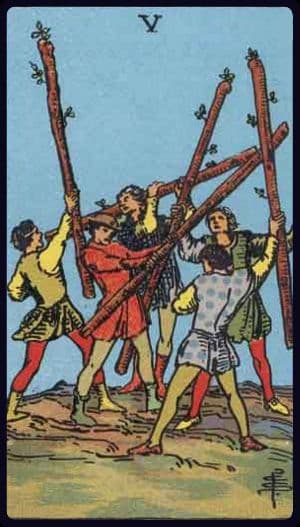
The Five of Wands is the card of friction — the noise, heat, and pushback that come with competing agendas.
Upright
Reversed
Five of Wands Meaning
Upright
The Five of Wands points to conflict that may be messy but not necessarily malicious. Competition, tension, rivalry, and disagreements can all appear under this card, especially when too many people are trying to lead, defend a position, or be heard at once. It often reflects a situation where the heat is real, even if the stakes are still being worked out. The challenge is not to pretend harmony exists, but to recognize what the conflict is actually revealing about ambition, ego, or pressure.
Reversed
Reversed, the Five of Wands often shows the wish to move around conflict instead of through it. Conflict avoidance can keep the peace on the surface while leaving the actual issue untouched. At its best, this card points to respecting differences and finding common ground without insisting on total agreement. At its worst, it reflects everyone trying to be agreeable while resentment goes underground. The question is whether peace is being built, or merely performed.
Five of Wands as a Daily Card
The Five of Wands is also about inner conflict. Today, which parts of yourself are competing for attention?
Lean toward
The messy draft before coherence.
Watch for
Expecting group effort to feel graceful.
What internal debate are you having that needs resolution?
In Different Situations
Relationships
Not every disagreement means a relationship is failing. The Five of Wands describes the strain of several needs, opinions or ways of doing things pressing against one another. There may be genuine care alongside irritation; the trouble can come from competing to be heard rather than from anyone wanting harm. Silence is not always a solution either. When people keep smoothing things over, the same friction can return in quieter forms. This card makes the argument itself worth examining: what is being defended, and what keeps getting lost in the noise?
Career
Work can become noisy when capable people want different things from the same effort. The Five of Wands captures competition, clashing ideas and the wear of having to defend your contribution. Some friction sharpens the work; some simply consumes the time that should go into it. The card does not make every colleague an opponent. It brings the shape of the disagreement into view, including the possibility that too many people are trying to steer at once. Agreement reached by avoiding a difficult conversation may leave the underlying contest untouched.
Decisions
Several arguments can all be reasonable and still leave you unable to choose. The Five of Wands catches the crowded debate, including disagreements between priorities you genuinely care about. Friction may expose a trade-off you have not named; it may also be noise from people who want different things from your decision. Not every objection deserves equal weight. The card makes room for disagreement without turning the choice into a contest to win. An option that nobody questions is not necessarily an option that fits.
Burnout
Sometimes exhaustion comes from the argument around the work rather than the work itself. The Five of Wands is full of competing demands and crossed intentions, the kind of friction that requires constant adjustment before anything can move. Even small disagreements accumulate when no one can settle who is doing what or why. Avoiding conflict may spare one difficult exchange while prolonging the strain. This card notices the energy spent navigating noise, defending choices and keeping different pressures from colliding. It does not turn tiredness into a diagnosis; it makes one possible source of the drain easier to see.
Feeling Stuck
There can be plenty of motion and still no progress. The Five of Wands describes that frustrating kind of activity: ideas competing, priorities jostling, energy spent reacting rather than moving in one direction. If the arguments are mostly internal, every possible step may be met by an equally loud objection. Avoiding the disagreement does not necessarily create clarity. This card gives the stuck feeling a restless shape. It may be less about having no options than about having too many competing claims on the same attention, none able to settle long enough to develop.
New Beginnings
Early friction can make a fresh start feel more difficult than you expected. The Five of Wands does not treat every disagreement as proof that the beginning was wrong. New roles, unfamiliar people and competing ideas often have to find their shape, and that can be noisy. Some resistance is useful because it reveals what was assumed but never discussed. Other conflict is merely distracting. This card keeps those possibilities separate. A beginning does not need flawless harmony, but it does need enough room for differences to be heard without every step turning into a contest.
Grief and Loss
Loss does not always bring people into agreement. The Five of Wands can reflect different ways of remembering, speaking or making sense of what happened, and the strain those differences put on people who are already carrying something heavy. There may also be an argument within yourself between wanting to speak and wanting to withdraw. This card does not sort grief into right and wrong responses. It recognizes friction without assuming cruelty, and it leaves open the possibility of understanding that does not require everyone to feel the same thing at the same time.
Recurring appearance
What does it mean when Five of Wands keeps appearing?
Competing pulls may be crowding the signal. Friction keeps shaping the atmosphere.
Spreads that work well with Five of Wands
Past, Present, Future
3 cardsThe classic three-card arc. Where you've been, where you are, and where the energy is heading.
View spread →Career Path
4 cardsFor questions about work, purpose, and professional direction. Not job-search advice — a mirror for your working life.
View spread →Decision
3 cardsNot a binary answer. Three cards to illuminate what each choice carries — energy, cost, and consequence.
View spread →Begin your practice
Draw Five of Wands in a reading
Context transforms a card's meaning. A full reading weaves your question, your spread, and your cards into a coherent reflection.