Minor Arcana — Swords
Four of Swords
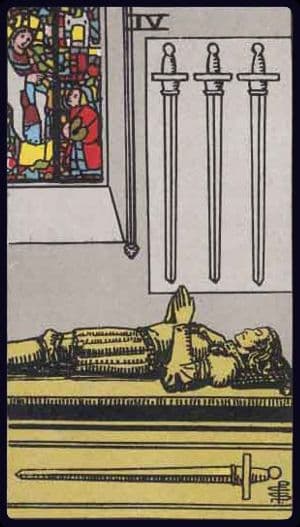
The Four of Swords is the card of necessary stillness — rest taken before the mind frays further.
Upright
Reversed
Four of Swords Meaning
Upright
The Four of Swords points to rest, recuperation, and the kind of withdrawal that actually restores. It often appears after conflict or strain, when contemplation is more useful than reaction and the system has clearly had enough. This card values quiet not as avoidance, but as repair. Meditation, relaxation, or even a temporary pause in effort may be the most intelligent response available. The mind is not built for endless output. What this card names is the interval where recovery becomes part of the work rather than a delay from it.
Reversed
Reversed, the Four of Swords can suggest exhaustion that has already crossed into burn-out. Sometimes it points to deep contemplation that never resolves into movement; other times to stagnation dressed up as recovery. This card asks whether you are actually replenishing yourself or simply lying still while the same thoughts continue unchecked. The need for rest is real, but so is the risk of becoming trapped in the mood of depletion. What matters now is whether the pause has a healing quality, or whether it has started hardening into inertia.
Four of Swords as a Daily Card
The Four of Swords is the warrior's meditation. Today, remember that your strength depends on your ability to recover.
Lean toward
An empty stretch in the day.
Watch for
Filling every gap to avoid yourself.
What would intentional rest look like for you today?
In Different Situations
Relationships
A little distance can give a relationship room to breathe. The Four of Swords holds the kind of quiet in which a conversation need not continue simply because it has begun. After tension, taking time to understand your own response may be more useful than another immediate explanation. But its stillness has a difficult edge: silence can also become a place to hide from what needs saying. The difference lies in whether the pause restores the possibility of contact or leaves both people stranded in uncertainty. Rest and avoidance can look remarkably similar from the outside.
Career
Good work sometimes depends on a period when nothing visible is produced. The Four of Swords gives thought, recovery and perspective a place in the working life, especially after pressure has made every task feel urgent. It can point to a deliberate interval before a new responsibility or direction. Yet a long pause can also become uncertainty about returning, with the mind circling the same plans without testing them. The distinction is whether quiet is restoring the ability to think and make work, or simply extending the feeling of being unable to begin.
Decisions
The pressure to decide immediately can make every option seem louder than it is. The Four of Swords introduces an interval in which urgency and importance can be separated. Rest may help the mind notice a detail that endless comparison has obscured. But this card has an uneasy reverse: a pause can go on long after it has stopped bringing clarity. It doesn't offer a universal instruction to wait. Instead it distinguishes time that changes the quality of your thinking from time spent hoping a choice will somehow disappear.
Burnout
The Four of Swords has an unusually literal place in a period of overextension: the need for genuine rest. Its still figure is not failing to keep up. An interval of reduced demand may be part of making any further effort possible. The card also sees how difficult rest can become when the mind continues working in private, replaying tasks and anticipating the next demand. Simply stopping movement is not always the same as recovering capacity. This is a reflection on the cost of continuing at the same pace, not a diagnosis or a prescribed recovery plan.
Feeling Stuck
Stillness can begin as shelter and slowly become a room that is hard to leave. That is the tension in the Four of Swords when life feels stuck. A pause might have been necessary after too much noise or effort, and nothing is gained by dismissing that need. But the card also holds the restlessness of thinking about movement without finding a way back into it. Not all inactivity is avoidance; not all rest restores. The useful distinction is whether this quiet has given you more room inside yourself, or whether the same thoughts are taking up all the space.
New Beginnings
Some beginnings arrive quietly, before there is anything visible to announce. The Four of Swords gives preparation and contemplation their own place in a fresh chapter. Time spent recovering from a demanding period may change what you want to build next, and there can be wisdom in not filling every new space immediately. Still, the card carries the possibility of staying on the threshold because actual participation feels uncertain. The point is neither to rush nor to wait indefinitely. A beginning can need a pause, but eventually its shape is learned through contact with the new life.
Grief and Loss
After a loss, quiet may be welcome one day and unbearable the next. The Four of Swords holds the need for shelter from demands while also acknowledging how restless a mind can become when the world grows silent. Its resting figure does not set a timetable for returning to ordinary activity. Withdrawal can offer privacy for memory, or it can begin to feel like being cut off from everything else. The card leaves those experiences distinct rather than prescribing one correct way to grieve. A pause may be part of loss without being its resolution.
Recurring appearance
What does it mean when Four of Swords keeps appearing?
A pause may matter more than another push. Rest keeps becoming part of the answer.
Spreads that work well with Four of Swords
Decision
3 cardsNot a binary answer. Three cards to illuminate what each choice carries — energy, cost, and consequence.
View spread →Horseshoe
7 cardsA broad arc covering past, present, and future with attention to hidden influences, your attitude, and external forces at play.
View spread →The Fog
4 cardsFor moments when the path ahead is unclear and the old answers no longer hold. This spread doesn't offer direction — it offers orientation.
View spread →Begin your practice
Draw Four of Swords in a reading
Context transforms a card's meaning. A full reading weaves your question, your spread, and your cards into a coherent reflection.