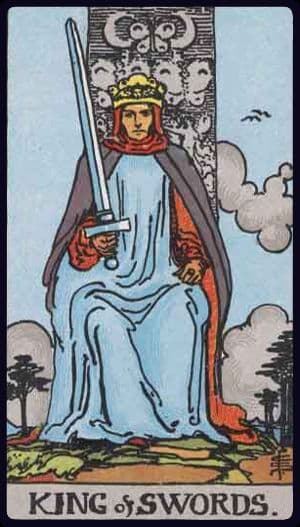
Minor Arcana — Swords
King of Swords
The King of Swords is the card of disciplined truth — authority built on thought, language, and judgment.
Upright
Reversed
King of Swords Meaning
Upright
The King of Swords points to mental clarity, intellectual power, and authority grounded in reason. He values truth not as decoration but as a working standard, and often appears when clear judgement is needed more than emotional immediacy. This card can describe a person, but also a demand within you: think cleanly, speak accurately, and do not let convenience rewrite the facts. His strength is structure in the mind. What makes that structure valuable is not superiority, but the ability to remain coherent when the situation invites distortion or panic.
Reversed
Reversed, the King of Swords can point to manipulation, misuse of power, or a style of intelligence that dominates more than it clarifies. Sometimes this card turns inward and suggests quiet power or inner truth that has not yet found a stable expression. Other times it reflects a mind using logic selectively, as a tool of control rather than discernment. The issue is not intelligence. It is what intelligence is being used to protect. When truth becomes subordinate to status, self-image, or leverage, the authority this card represents begins to hollow from the inside.
King of Swords as a Daily Card
The King of Swords rules through intellectual integrity. Today, make decisions based on principles, not popularity.
Lean toward
The judgment that holds under pressure.
Watch for
Mistaking authority for correctness.
What principle guides your most important decisions?
In Different Situations
Relationships
Who gets to define what is reasonable between two people? The King of Swords draws attention to the standards used in a relationship: whether an explanation is consistent, whether both people can speak, and whether the rules change depending on who is upset. His strength is fairness supported by clear thought. His shadow appears when calm language is used to claim the final word or make another person's feelings seem inadmissible. This card doesn't appoint either person the judge. It asks what happens to trust when reason becomes a shared practice, or a form of control.
Career
The King of Swords places a demanding question at the centre of work: can your decisions be explained by a standard you would apply to anyone? He represents disciplined expertise, especially where other people depend on your judgment. Clear expectations and honest reasoning can make authority trustworthy. Titles and certainty alone cannot.
His difficult side appears when an elegant argument is used to defend a convenient decision or silence someone with less power. For a career, the card points toward the responsibility that accompanies knowing your subject well enough to lead with it.
Decisions
A choice can sound convincing when argued one way and equally convincing when argued the other. The King of Swords asks for a steadier measure: what principles or facts would you still stand by once the immediate pressure passes? His authority lies in applying a standard consistently, even when the conclusion is inconvenient. The risk is constructing an immaculate case for the option you already prefer. This card works on the integrity of the reasoning rather than the outcome. It leaves the decision with you, while making selective logic harder to mistake for certainty.
Burnout
An orderly schedule can still be impossible to live inside. The King of Swords examines the rules behind a punishing pace: the targets, standards and assumptions that make overwork seem rational. His gift is the ability to test whether a system is coherent rather than relying on whoever can endure it longest. His shadow is the cool argument that everything is manageable on paper, therefore the strain must be an individual's failure. Burnout under this card raises a question of fair judgment. A sound plan has to account for actual human capacity, not only its own neat logic.
Feeling Stuck
You may have a plan detailed enough to explain every step and still find yourself unable to take the first one. The King of Swords is skilled at constructing order: reasons, rules, a sequence that makes sense. In a stuck period, that ability can be useful if confusion is the real obstacle. It becomes less helpful when the plan must eliminate every unknown before life is allowed to move. Rational control has limits, and admitting them is different from abandoning thought. The card draws attention to the point where a framework stops guiding you and starts guarding you from uncertainty.
New Beginnings
Beginnings often run on energy long before they have a shape. The King of Swords brings the value of a clear foundation: what you mean to do, what you can stand behind, and which promises should be made carefully. A new role or undertaking may benefit from that seriousness.
Yet building rules too early can make uncertainty seem like a flaw rather than part of beginning. His judgment is most useful when it creates enough structure for honest choices, while allowing facts to change the plan. An opening needs principles it can rely on, not an argument that everything is already settled.
Grief and Loss
There may be facts about a loss that you understand perfectly, while its meaning remains difficult to live with. The King of Swords represents the mind's wish for an account that holds together: a sequence, an explanation, a fair way to speak about what happened. Such clarity can matter when confusion adds to the hurt. But grief rarely follows the rules of a well-reasoned argument. This card distinguishes facts that can be established from feelings that cannot be settled by proving a point. Neither needs to cancel the other.
Recurring appearance
What does it mean when King of Swords keeps appearing?
Reason keeps taking a central role. Logic can become rigid when too much depends on it.
Spreads that work well with King of Swords
Decision
3 cardsNot a binary answer. Three cards to illuminate what each choice carries — energy, cost, and consequence.
View spread →Horseshoe
7 cardsA broad arc covering past, present, and future with attention to hidden influences, your attitude, and external forces at play.
View spread →The Fog
4 cardsFor moments when the path ahead is unclear and the old answers no longer hold. This spread doesn't offer direction — it offers orientation.
View spread →Begin your practice
Draw King of Swords in a reading
Context transforms a card's meaning. A full reading weaves your question, your spread, and your cards into a coherent reflection.