Minor Arcana — Swords
Nine of Swords
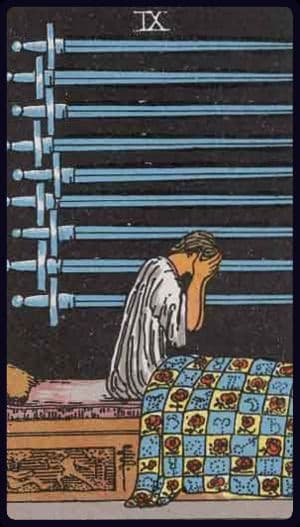
The Nine of Swords is the card of private torment — fear magnified in the hours with no witness.
Upright
Reversed
Nine of Swords Meaning
Upright
The Nine of Swords points to anxiety, worry, nightmares, or the kind of fear that becomes most convincing when there is nothing external to interrupt it. This card often appears when the mind has turned against rest, replaying worst-case scenarios until even small uncertainties take on enormous weight. Its imagery can also resonate with experiences of dread or exhaustion, but it cannot identify depression or explain the cause of distress. What gives this card its edge is isolation. The suffering is not always visible, but it is very real. Thoughts that would seem manageable by daylight can become absolute in the dark.
Reversed
Reversed, the Nine of Swords can suggest inner turmoil that is still active but becoming more speakable. Deep-seated fears, secrets, or longstanding worry may be moving closer to the surface, where they can finally be addressed rather than merely endured. Sometimes this card points to releasing worry in imperfect increments, not through sudden peace but through less total identification with the panic. The mind may still be loud, but it is no longer the only voice in the room. That shift matters. It creates the first distance from what once felt fused to you.
Nine of Swords as a Daily Card
Today, anxiety may visit. The Nine of Swords asks you to be gentle with your worried mind. Acknowledge the fear, then question it.
Lean toward
What shame keeps repeating.
Watch for
Believing the harshest version first.
What is the worst case you're imagining, and how likely is it really?
In Different Situations
Relationships
A silence, a delayed reply, or something you wish you had said can take up far more space in your mind than it does in the relationship itself. The Nine of Swords pictures worry at its most private, when there is no one beside you to check the story your mind is building. The worry is real; it is not evidence that the worst fear is true. The difference between what happened and what keeps replaying deserves attention.
Career
A mistake at work can keep working on you long after the day ends. The Nine of Swords is familiar with the mind that revisits a conversation, imagines consequences, then treats those imagined consequences as already real. This is not a verdict about your ability or job security. It names the private cost of carrying professional uncertainty without a clear place to set it down. A concrete problem may need addressing. One error does not settle your worth at work.
Decisions
The Nine of Swords often turns up in the hours after you think you have settled a choice, when every possible consequence starts arguing with every other one. Its subject is not indecision alone but the way fear can give imagined outcomes the force of facts. There may be real stakes, and care is warranted. Still, a decision cannot be made on the assumption that every worst-case possibility is equally likely. This card makes a useful distinction between the information you have, the uncertainty you must live with, and the punishment your mind adds for not being certain.
Burnout
Being exhausted does not always mean being able to rest. The Nine of Swords shows a person upright in bed, still occupied by what the day has left behind.
In a burnout reading, the image can draw attention to the second shift that begins when work or responsibility is technically over: replaying mistakes, anticipating tomorrow, staying alert to problems that have not happened. The card cannot diagnose what is causing sleeplessness or distress. It does, however, make visible a strain that ordinary accounts of workload often miss. Even unspent hours can be claimed by worry.
Feeling Stuck
There is a kind of stuckness made of too much thinking rather than too few ideas. The Nine of Swords shows what happens when each possible move is immediately followed by an imagined regret. You remain in place, but the mind travels through every mistake you might make. This card does not identify the right action or imply that worry is the only obstacle. It notices how relentless anticipation can leave little attention for what is actually changing around you. The question may be less about finding another answer than about how much authority the feared consequences have been given.
New Beginnings
Excitement about a fresh start can live beside the fear of spoiling it. With the Nine of Swords, anticipation turns toward everything that might go wrong, often in the private hours when there is little new information to test those fears. This card does not mean the beginning is doomed. Nor does it require you to silence worry and be optimistic. It recognizes the pressure that comes from treating a new chance as something you must get entirely right. What is actually beginning may be smaller, less final, and more open to adjustment than the imagined failure allows.
Grief and Loss
Grief can grow loudest when the world is quiet. The Nine of Swords is an image of solitary wakefulness, of thoughts that return without asking permission. A memory can bring comfort and regret in the same hour. The card offers no explanation for suffering and no message from someone who has died. It recognizes how private and exhausting remembering can become, particularly when the mind keeps searching for a different version of what happened.
Recurring appearance
What does it mean when Nine of Swords keeps appearing?
Worry can make everything feel more final than it is. A thought loop may still be stealing air from the room.
Spreads that work well with Nine of Swords
Decision
3 cardsNot a binary answer. Three cards to illuminate what each choice carries — energy, cost, and consequence.
View spread →Horseshoe
7 cardsA broad arc covering past, present, and future with attention to hidden influences, your attitude, and external forces at play.
View spread →The Fog
4 cardsFor moments when the path ahead is unclear and the old answers no longer hold. This spread doesn't offer direction — it offers orientation.
View spread →Begin your practice
Draw Nine of Swords in a reading
Context transforms a card's meaning. A full reading weaves your question, your spread, and your cards into a coherent reflection.