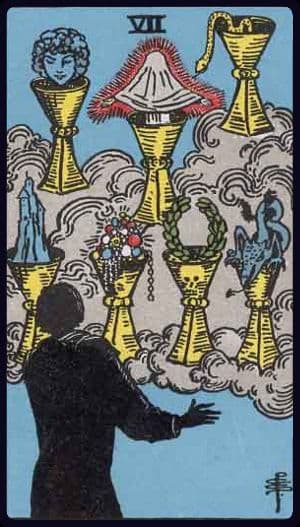
Minor Arcana — Cups
Seven of Cups
The Seven of Cups is the card of too many possibilities — desire, illusion, and the trouble of choosing.
Upright
Reversed
Seven of Cups Meaning
Upright
The Seven of Cups points to opportunities that multiply faster than your clarity. It often appears when choices are abundant but not equal, and when wishful thinking makes it easy to confuse what dazzles you with what is actually viable. This card does not condemn imagination; it questions what happens when imagination outruns discernment. You may be standing in front of several futures at once, each carrying some appeal. The task is less about having options than about seeing which ones are real and which ones only flatter a fantasy.
Reversed
Reversed, the Seven of Cups often appears when being overwhelmed by choices has become unsustainable. It points toward clarity through elimination: coming back to personal values, narrowing the field, and letting preference become more honest. Sometimes the confusion has already taught you what matters by showing you what doesn't. This card suggests that clarity is possible, but only if you stop trying to keep every option alive. The deeper question is not which path looks best. It is which one you can live with without having to keep pretending.
When several meanings seem possible, read a looked-up meaning against your question and known facts.
Seven of Cups as a Daily Card
The Seven of Cups presents many options, not all real. Today, distinguish between fantasy and actionable possibility.
Lean toward
The option that still holds up plainly.
Watch for
Falling for what only glows at a distance.
Which of your current options are genuine, and which are distractions?
In Different Situations
Relationships
It's possible to be drawn to the idea of a relationship more strongly than to the relationship in front of you. The Seven of Cups is crowded with imagined possibilities: the person someone might become, the future a new connection might offer, the different lives you could have chosen. Desire can make each image feel convincing.
There may be genuine promise among those possibilities, but they aren't all evidence. In relationships, this card calls attention to the distance between what has actually been shared and what hope has supplied. That distinction matters without making hope itself foolish.
Career
A career can look full of paths while none feels solid enough to enter. The Seven of Cups holds the appeal of different titles, identities, ambitions and imagined versions of success. Each one offers something. Some offer mostly the feeling of having escaped the uncertainty of the current role.
Imagination is useful here; it helps you see beyond the obvious options. But a convincing image of a future job is not the same as knowing its daily work, compromises or demands. This card gives the contrast between possibility and reality room to become clearer before either is dismissed.
Decisions
Every option looks different when you imagine only its best version. The Seven of Cups is especially pointed in a decision because it recognizes how choice can become an endless exercise in keeping attractive futures alive. More possibilities may feel like more freedom, even as they make a real commitment harder.
Some options will lose their shine when you look at the ordinary days they would require. Others may become more appealing once the fantasy settles. The card doesn't supply a winner. It exposes the difference between choosing a life and choosing the image of one.
Burnout
Exhaustion doesn't always look like having too much to do. Sometimes it looks like keeping too many possible futures in your head, each one promising that life will feel better once you reach it. The Seven of Cups names the strain of imagining, comparing and revising paths when very little attention remains for the day you're actually living.
Some possibilities deserve space. Others are appealing mainly because they seem to offer instant relief. The card neither dismisses the wish for change nor demands greater productivity. It notices the energy spent trying to inhabit several imagined lives at once.
Feeling Stuck
You may have imagined so many different ways forward that ordinary movement begins to seem disappointing. The Seven of Cups reflects a stuckness full of activity: planning, comparing, revising the picture, starting over before anything has been tested. In the imagination, no option needs to lose its promise.
There is no shame in wanting more than one future. But the card notices how an endless supply of possible lives can keep the actual one suspended. Clarity may begin in recognizing which pictures remain attractive only while they are safely unreal.
New Beginnings
At the beginning, possibility can be intoxicating. The Seven of Cups captures the moment when every direction seems to offer a different, attractive version of who you might become. That imaginative abundance is part of what makes starting feel alive. It can also keep the first ordinary step from happening.
An opening doesn't have to live up to every picture you've made of it. Some hopes will change once real conditions appear; others may prove worth following. The card places a gentle limit on fantasy without asking you to become less curious about what could begin.
Grief and Loss
Loss often leaves more than one imagined life behind. With the Seven of Cups, grief may fill with versions of what could have happened: the conversation you might have had, the turn events might have taken, the future that seemed available before it wasn't. Those possibilities can be deeply felt even though none can be checked against reality.
The card recognizes imagination as part of longing, without making every imagined version a hidden truth. It offers no neat way to stop wondering. It simply keeps the difference between what happened and what you wish had happened visible.
Recurring appearance
What does it mean when Seven of Cups keeps appearing?
Possibilities keep multiplying faster than clarity. Imagination can crowd out what is actually workable.
Spreads that work well with Seven of Cups
Past, Present, Future
3 cardsThe classic three-card arc. Where you've been, where you are, and where the energy is heading.
View spread →Relationship
5 cardsFor any relationship — romantic, familial, professional. Explores the dynamic between you and another person.
View spread →The Circle
5 cardsFor reflecting on a friendship or connection — what holds it together, what's being tested, and what it asks of you.
View spread →Begin your practice
Draw Seven of Cups in a reading
Context transforms a card's meaning. A full reading weaves your question, your spread, and your cards into a coherent reflection.