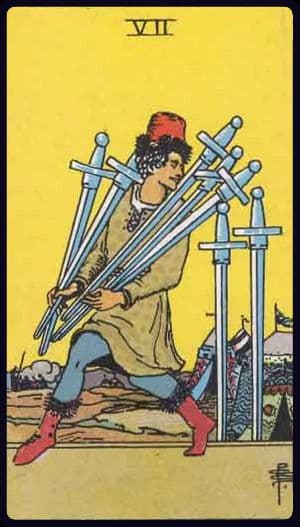
Minor Arcana — Swords
Seven of Swords
The Seven of Swords is the card of strategic concealment — truth bent by fear, advantage, or self-protection.
Upright
Reversed
Seven of Swords Meaning
Upright
The Seven of Swords points to deception, betrayal, stealth, or the sense that someone is trying to get away with something. These are possible symbolic readings, not evidence that someone has deceived you. Examine observable withholding, inconsistencies, or avoidance before assigning a motive. This card is concerned with what happens when transparency feels too risky. Strategy may be necessary in some situations, but the atmosphere here is one of mistrust. What matters is not only the hidden action itself, but why honesty has become harder to tolerate than the consequences of concealment.
Reversed
Reversed, the Seven of Swords often turns the question inward. Imposter syndrome, self-deceit, or the burden of keeping secrets may be more relevant than outright betrayal. You may be managing an image that no longer fits, or quietly telling yourself a version of events that protects you from a harder admission. This card suggests that the hidden material is becoming more expensive to carry. The issue is not always malice. Sometimes it is fear wearing the clothes of cleverness. What is avoided now may eventually demand far more from you than honesty would.
Seven of Swords as a Daily Card
The Seven of Swords can indicate feeling like an outsider. Today, notice if you're keeping yourself separate by choice or by habit.
Lean toward
A plan with fewer moving parts.
Watch for
Managing impressions instead of the actual problem.
Where do you hold back from full participation, and why?
In Different Situations
Relationships
Sometimes the hardest part of closeness is admitting what you have been keeping to yourself. The Seven of Swords holds that uneasy line between protecting your privacy and concealing something because honesty feels costly.
It does not prove anyone is lying or acting behind your back. It may bring attention to evasive conversations, carefully edited versions of the truth, or a need for space that has never been spoken plainly. Trust can be strained by secrecy, but it can also be strained by expecting complete access to another person's inner life. The distinction matters.
Career
There are times at work when saying less is sensible: an idea is unfinished, a negotiation is delicate, or you are protecting time to think. The Seven of Swords complicates that instinct. Strategy can serve your work, but constant concealment can leave you guarding every move and unsure who knows what. This card also raises the possibility of being less than candid with yourself about an ambition or a compromise.
It is not proof that colleagues are plotting. Its sharper question concerns the kind of work you can do when so much effort goes into managing what is visible.
Decisions
An attractive option can depend on leaving part of the story out. Perhaps you are counting on a shortcut, avoiding a difficult conversation, or presenting a choice more neatly than it really is. The Seven of Swords brings strategy into view without calling every careful move dishonest. Decisions sometimes require discretion. The useful tension is between planning wisely and arranging the facts so you do not have to face a cost. If the choice only feels possible while one consequence remains unspoken, that omission belongs in the picture alongside the potential advantage.
Burnout
Overextension can become something you work hard to hide. You keep the visible tasks moving while concealing how much effort it takes, perhaps because admitting a limit feels like giving someone an advantage over you. The Seven of Swords makes that private calculation part of the cost. It is possible to be genuinely resourceful and still lose energy maintaining an appearance of ease. This is not an accusation of dishonesty, nor a diagnosis of burnout. It draws attention to the gap between what others can see of your capacity and what you are carrying out of sight.
Feeling Stuck
Sometimes nothing moves because naming what you want would make it real. The Seven of Swords can describe that quiet avoidance: circling a problem, gathering more reasons to wait, or acting as though a private wish does not matter. Its figure moves stealthily, but not necessarily freely. Strategy that once protected you may now be keeping you at a distance from your own intentions. The card does not demand a confession or a dramatic action. It offers a more uncomfortable possibility than simple lack of motivation: the effort to avoid being seen, even by yourself, may be taking up the energy movement needs.
New Beginnings
Starting again often involves deciding what to reveal and what to keep private until it has had time to take shape. The Seven of Swords gives that caution an edge. There is a difference between protecting an unformed plan and building a new chapter around a story you cannot fully stand behind. The card does not make every quiet beginning suspicious. It asks how much of your attention is going into preparing the work itself, and how much into managing appearances or avoiding a conversation. A beginning built with care can still include honest uncertainty.
Grief and Loss
Grief has a private life. You may choose what to share, avoid certain conversations, or hold back a memory because other people's responses feel difficult to manage. The Seven of Swords can illuminate that protective distance without treating privacy as deceit.
It also leaves room for the cost of what remains unspoken: a regret, a difficult feeling, or a version of events that feels too complicated for the people around you. This card does not claim the lost person concealed anything. Its focus is the delicate, sometimes exhausting work of deciding what can be said about an absence.
Recurring appearance
What does it mean when Seven of Swords keeps appearing?
What stays unsaid may be shaping more than expected. Something partial or withheld keeps returning.
Spreads that work well with Seven of Swords
Decision
3 cardsNot a binary answer. Three cards to illuminate what each choice carries — energy, cost, and consequence.
View spread →Horseshoe
7 cardsA broad arc covering past, present, and future with attention to hidden influences, your attitude, and external forces at play.
View spread →The Fog
4 cardsFor moments when the path ahead is unclear and the old answers no longer hold. This spread doesn't offer direction — it offers orientation.
View spread →Begin your practice
Draw Seven of Swords in a reading
Context transforms a card's meaning. A full reading weaves your question, your spread, and your cards into a coherent reflection.