Minor Arcana — Wands
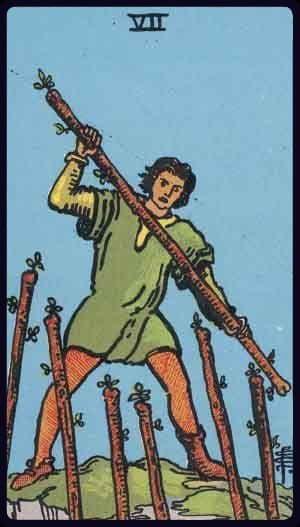
Seven of Wands
The Seven of Wands is the card of holding your ground — pressure met with refusal to back down.
Upright
Reversed
Seven of Wands Meaning
Upright
The Seven of Wands points to challenge that requires active defense. Competition may be real, but so is your position, and this card often appears when perseverance matters more than ease. You may need to protect something you've built, state a boundary more clearly, or keep going while others question your right to stand where you are. Its energy is tiring but focused: not endless battle, just the insistence that what matters to you is worth defending.
Reversed
Reversed, the Seven of Wands often shows what happens when defense becomes depletion. Exhaustion, overwhelm, or retreating from conflict may not mean you were wrong to care; it may simply mean you have been bracing for too long. Sometimes this card marks giving up before the situation is fully lost, because your resources are already stretched thin. It asks whether you still need to fight this battle, or whether stepping back is the wiser way to protect yourself now.
Seven of Wands as a Daily Card
Today may feel like swimming upstream. The Seven of Wands asks: is this resistance a sign to push harder or a sign to reconsider?
Lean toward
The conviction underneath your no.
Watch for
Living in permanent counterattack.
Where are you fighting for something — and is it still worth fighting for?
In Different Situations
Relationships
You can care about someone and still feel worn down by having to defend a boundary. The Seven of Wands belongs to that exposed feeling: standing your ground matters, but repeated arguments can turn protection into a permanent posture. It cannot tell you whether the relationship will hold or what another person intends. Its sharper question is whether the line you are holding makes room for a more honest connection, or whether the fight for that line has taken over the connection itself.
Career
There are moments at work when competence is not enough; you also have to defend the judgment you have earned. The Seven of Wands speaks to that exposed position, where challenge can sharpen your thinking but repeated challenges can also make every conversation feel like a test. Not all disagreement is an attack, and not every stand needs to become a campaign. This card can help separate the work or principle you genuinely want to protect from the pressure to prove yourself to everyone. Holding a line has value when you can still remember what the line is for.
Decisions
A choice feels different when you have already spent so much energy defending it. The Seven of Wands recognizes how hard it can be to hear criticism without feeling that you must surrender everything you believe. Some objections expose a real weakness; others simply come from people who would choose differently.
The card does not tell you to stay the course at any cost. It offers a distinction between conviction and the need to win the argument. A decision can remain your own while still being open to better information, and changing your mind need not mean the original stand was foolish.
Burnout
Before you can do the work, you have to defend the time to do it. The Seven of Wands recognizes how draining that becomes: every limit needs explaining, every boundary seems open to negotiation. Standing firm may be necessary, but constant resistance can consume the very energy it is meant to protect. The fatigue here comes from being made to fight for space, not only from the tasks filling that space. The card asks why so much effort is being spent just to remain where you are.
Feeling Stuck
Sometimes the energy needed to defend your position uses up the energy that might have moved you forward. The Seven of Wands can appear when you have a good reason to resist pressure, yet each day is spent responding to challenges rather than building the thing you care about. A standstill may be protective rather than a lack of courage. There is also a difference between keeping something safe and keeping it untouched. This card brings the boundary into view: is it holding a space open for what matters, or has defending it become the only action that feels possible?
New Beginnings
A new direction can be fragile before it has anything visible to show for itself. The Seven of Wands fits the moment when you need to give an emerging choice enough room to develop despite doubt, questions, or comparison with the old way. Defending it may be necessary, though not every comment deserves a response. The card does not guarantee that the new path is right. It recognizes that beginnings sometimes require a boundary before they require speed. There is a difference between being open to learning and allowing every outside opinion to decide whether something is worth trying.
Grief and Loss
Loss can leave you defending something other people do not fully understand: the importance of a memory, the meaning of a relationship, or your right to grieve in your own way. The Seven of Wands names that exposed feeling without making disagreement inevitable. Some boundaries protect the quiet space in which a loss can be held. At the same time, having to explain yourself repeatedly can add another burden to the absence itself. The card does not ask you to fight for proof of what mattered. It gives weight to the wish to keep something intact when the rest of life keeps moving around it.
Recurring appearance
What does it mean when Seven of Wands keeps appearing?
Defensiveness can linger after the threat has shifted. Something may still require a firm no.
Spreads that work well with Seven of Wands
Past, Present, Future
3 cardsThe classic three-card arc. Where you've been, where you are, and where the energy is heading.
View spread →Career Path
4 cardsFor questions about work, purpose, and professional direction. Not job-search advice — a mirror for your working life.
View spread →Decision
3 cardsNot a binary answer. Three cards to illuminate what each choice carries — energy, cost, and consequence.
View spread →Begin your practice
Draw Seven of Wands in a reading
Context transforms a card's meaning. A full reading weaves your question, your spread, and your cards into a coherent reflection.