Minor Arcana — Pentacles
Six of Pentacles
The Six of Pentacles is the card of exchange — what is given, what is received, and on whose terms.
Upright
Reversed
Six of Pentacles Meaning
Upright
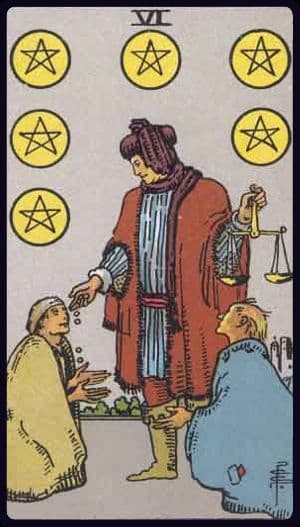
The Six of Pentacles points to giving, receiving, and the visible flow of support between people. It can reflect generosity, charity, or sharing wealth in a way that restores practical balance. At its best, this card describes help that preserves dignity rather than creating dependence. It also asks you to notice your position in the exchange: whether you are the one offering resources, the one needing them, or someone learning that both roles are human and temporary.
Reversed
Reversed, the Six of Pentacles can expose the strain in one-sided charity, unpaid debts, or support that comes with strings attached. Sometimes the lesson is self-care: learning that constant giving is not the same thing as fairness. In other cases, this card points to imbalance that has been normalized for too long, where one person carries the weight and the other accepts it as ordinary. It asks whether this exchange is generous, or merely uneven in a way no one has named yet.
Six of Pentacles as a Daily Card
The Six of Pentacles is balanced giving and receiving. Today, examine which side of that equation you tend toward. Both are necessary.
Lean toward
The exchange that feels clean.
Watch for
Mistaking leverage for generosity.
Do you find it easier to give or to receive, and what does that tell you?
In Different Situations
Relationships
Giving can be a way of showing love. It can also become the rule that one person always gives and the other always receives. In the Six of Pentacles, the scales matter as much as the offered coins: generosity and power occupy the same picture.
A relationship needn't involve equal contributions every day to feel mutual. But help that must be repaid with agreement, gratitude, or silence changes the terms of closeness. The card leaves room for genuine care while asking whether both people can receive without losing their dignity.
Career
A workplace reveals its values through who receives time, credit, training, and a chance to recover from mistakes. The Six of Pentacles brings those exchanges into view. Mentorship can be generous; praise can be deserved; resources can open a real door. Yet the scales also raise a harder possibility: support may depend on staying grateful, agreeable, or indefinitely available. If you're giving expertise without recognition, the imbalance matters. If you're receiving help, that needn't make you lesser. The card is about the terms of opportunity, not a verdict on anyone's character.
Decisions
When a decision involves accepting help, offering it, or dividing resources, an even split isn't always a fair one. The Six of Pentacles shows a giver, receivers, and scales. Each person has a different amount of choice.
An offer can be useful and still carry expectations. Refusing it might protect independence while closing off something you need. Before treating the exchange as generous or exploitative, its terms deserve a clear look: who can say no, and who bears the cost?
Burnout
Who keeps the work going when everyone else's capacity runs out? The Six of Pentacles can expose a rhythm in which your availability has quietly become someone else's safety net. Giving may still matter deeply to you, which is why the imbalance isn't always easy to name. The scales ask about the flow of time, care, and labor, not only money.
Receiving support might feel awkward if you're used to being the dependable one. Burnout here is tied to the terms of exchange: whether generosity has become an expectation with no room for limits.
Feeling Stuck
Stuckness sometimes has a hidden bargain underneath it. You keep helping because being needed gives you a place; you keep accepting help because changing the arrangement feels like risking that place. The Six of Pentacles makes the exchange visible. Its scales suggest that movement may be tangled with obligation, gratitude, or the fear of becoming indebted. This isn't proof anyone is manipulating you. It is a way to examine how a familiar role can become difficult to leave, even when the role is no longer comfortable. Fairness includes having room to change.
New Beginnings
Accepting help at the start of something can make possibility feel real. The Six of Pentacles places generosity beside a set of scales because early support also shapes a relationship. A kind offer may give you room to learn; one with unspoken terms may become difficult to carry later.
There's no need to treat every gift with suspicion or every dependence as failure. The question is whether gratitude can coexist with growing independence.
Grief and Loss
After a loss, people sometimes want to help and do not know what would be useful. The Six of Pentacles gives attention to the small exchanges that follow: meals, time, practical favors, the space to say no. Receiving can feel uncomfortable when nothing can put back what is missing. Giving can feel like a way to keep a connection to the person or life that changed.
The scales here are not measuring whether grief is fair. They ask whether care can be offered without turning gratitude into a debt or expecting the loss to become easier on schedule.
Recurring appearance
What does it mean when Six of Pentacles keeps appearing?
Exchange keeps becoming the real question. Help can carry imbalance even when it's useful.
Spreads that work well with Six of Pentacles
Past, Present, Future
3 cardsThe classic three-card arc. Where you've been, where you are, and where the energy is heading.
View spread →Career Path
4 cardsFor questions about work, purpose, and professional direction. Not job-search advice — a mirror for your working life.
View spread →Horseshoe
7 cardsA broad arc covering past, present, and future with attention to hidden influences, your attitude, and external forces at play.
View spread →Begin your practice
Draw Six of Pentacles in a reading
Context transforms a card's meaning. A full reading weaves your question, your spread, and your cards into a coherent reflection.