Minor Arcana — Swords
Ten of Swords
The Ten of Swords is the card of final rupture — an ending that leaves no room for denial.
Upright
Reversed
Ten of Swords Meaning
Upright
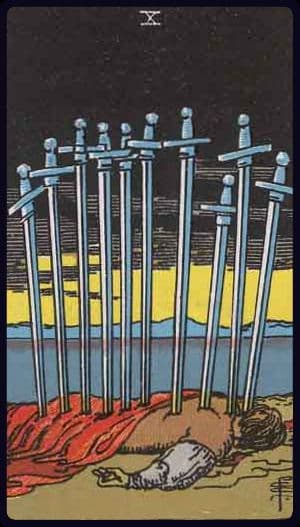
The Ten of Swords points to painful endings, deep wounds, betrayal, loss, or a crisis that makes continuation impossible in its old form. This is not a card of melodrama. It names the stark moment when something has clearly reached its limit and pretending otherwise becomes more painful than the truth. The damage may be emotional, relational, or mental, but the atmosphere is the same: overextension has met its consequence. What is difficult here is not only the ending itself. It is the recognition that the old arrangement cannot be restored by effort alone.
Reversed
Reversed, the Ten of Swords often points to recovery, regeneration, or the resistance that shows up when an inevitable end is already underway. Sometimes the worst has passed and the work now is learning how to live after it. Other times, the refusal to accept finality is prolonging what needs to conclude. This card suggests that renewal does not begin in triumph. It begins in honesty about what is over. Once that is admitted, even quietly, the body and mind can start doing what they know how to do: reorganize around survival, then around life.
Ten of Swords as a Daily Card
The Ten of Swords is dramatic — ten swords for one back. Today, consider if you're making something worse in your mind than it actually is.
Lean toward
The day after the collapse.
Watch for
Acting as if nothing remains.
Are you catastrophising, or is the situation genuinely as severe as it feels?
Recurring appearance
What does it mean when Ten of Swords keeps appearing?
A low point may still be defining the view. Something feels fully spent.
Spreads that work well with Ten of Swords
Decision
3 cardsNot a binary answer. Three cards to illuminate what each choice carries — energy, cost, and consequence.
View spread →Horseshoe
7 cardsA broad arc covering past, present, and future with attention to hidden influences, your attitude, and external forces at play.
View spread →The Fog
4 cardsFor moments when the path ahead is unclear and the old answers no longer hold. This spread doesn't offer direction — it offers orientation.
View spread →Begin your practice
Draw Ten of Swords in a reading
Context transforms a card's meaning. A full reading weaves your question, your spread, and your cards into a coherent reflection.