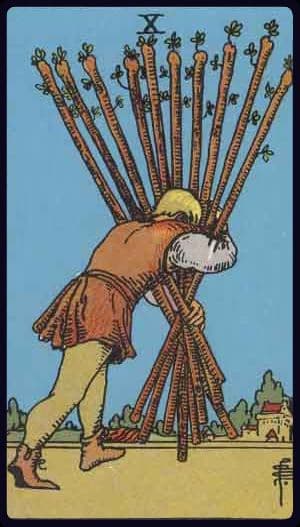
Minor Arcana — Wands
Ten of Wands
The Ten of Wands is the card of load-bearing — effort growing so heavy it begins to reshape you.
Upright
Reversed
Ten of Wands Meaning
Upright
The Ten of Wands points to burden that may have begun as commitment and turned into accumulation. Extra responsibility, hard work, and completion are all here, but so are stress and the quiet belief that everything depends on you. This card often appears when you are close to the end of something demanding, yet too overloaded to notice that the finish is near. It names the point where competence becomes costly if nothing is put down, shared, or reconsidered.
Reversed
Reversed, the Ten of Wands asks what happens when carrying it all becomes part of your identity. Doing it all can look impressive from the outside while leaving no room for balance, delegation, or honest limits. Sometimes this card points to releasing a burden that was never fully yours; sometimes it reflects the difficulty of letting go because usefulness has become tangled with self-worth. It suggests that relief may begin not with collapse, but with redistribution.
Ten of Wands as a Daily Card
Today, notice where ambition has tipped into exhaustion. The Ten of Wands succeeds but at great cost. Is the cost worth it?
Lean toward
Admitting the load has changed you.
Watch for
Resentment you keep calling responsibility.
What commitment could you reduce or delegate without losing what matters?
In Different Situations
Relationships
When you are the one who remembers, organizes, smooths things over, and keeps a connection going, care can begin to feel like a job with no end. The Ten of Wands gives weight to that invisible carrying. It does not measure who loves whom more, and it does not declare the relationship beyond repair.
It brings the distribution of effort into focus. Some responsibilities are freely chosen; others accumulate because someone has become used to doing them. The difficulty is that even a meaningful bond can feel crowded when one person has no room left simply to be in it.
Career
Being reliable often means receiving more responsibility than anyone thought to name. The Ten of Wands shows the point at which a growing workload becomes its own expectation: because you managed before, more is assumed to be manageable now. There may be pride in what you have built, and a genuine wish to see it through. Still, the amount one person can carry is not proof of how important the work is. This card draws attention to the structure around your effort: what belongs to the role, what has been added without discussion, and what could be shared without diminishing your contribution.
Decisions
Some decisions are hard because every option seems to come with another obligation. The Ten of Wands shifts attention from the ideal answer to what the choice would require you to carry day after day. A path may be meaningful and still be more than one person can sustain alone. Equally, releasing a responsibility can feel uncomfortable even when it was never entirely yours. This card does not make the decision for you; it exposes the quiet assumption that keeping everything going is non-negotiable. Capacity belongs in the calculation alongside loyalty, ambition, and the wish to finish what you began.
Burnout
The Ten of Wands is almost literal here: one person bent beneath what has been added, one responsibility at a time. Nothing has to be dramatic for the load to become too much. A commitment you chose willingly may sit beside duties that arrived because you were capable, available, or reluctant to disappoint. The card sees both the meaning of the work and the cost of carrying it without enough help. It does not turn fatigue into a personal failing or prescribe a cure. It makes visible how much of the weight is necessary, how much is habit, and how little space remains underneath it.
Feeling Stuck
It is hard to imagine a different life while every day is occupied with keeping the present one running. The Ten of Wands gives shape to a stuckness made of responsibility rather than indecision. You may know what interests you, or even what needs to change, but have no unclaimed attention left to explore it. The burden may contain commitments you value, which makes the idea of setting any of them down complicated. This card does not announce an escape route. It notices how little movement is possible when the hands that might reach for something new are already full.
New Beginnings
A fresh start rarely arrives with an empty calendar. The Ten of Wands reflects the strain of beginning something while still carrying obligations from the last chapter. Your enthusiasm may be real and the new work worth doing, but it does not create extra capacity on its own. There is no need to judge the beginning by how much you can shoulder at once. This card makes the existing load part of the picture, where it belongs.
Grief and Loss
Loss does not remove the tasks that need doing. It can add arrangements, decisions, and responsibilities to a life that is already carrying an absence. The Ten of Wands makes that practical weight visible, alongside the quieter burden of feeling that you must hold everything together.
The amount of work involved says nothing about how deeply someone loved or how well they are coping. This card leaves room for devotion and fatigue to exist together. There may be things worth continuing to carry, and others that have collected simply because no one has stopped to ask whose weight they are.
Recurring appearance
What does it mean when Ten of Wands keeps appearing?
Responsibility can turn into strain before it gets named. Something in daily life may be too much at once.
Spreads that work well with Ten of Wands
Past, Present, Future
3 cardsThe classic three-card arc. Where you've been, where you are, and where the energy is heading.
View spread →Career Path
4 cardsFor questions about work, purpose, and professional direction. Not job-search advice — a mirror for your working life.
View spread →Decision
3 cardsNot a binary answer. Three cards to illuminate what each choice carries — energy, cost, and consequence.
View spread →Begin your practice
Draw Ten of Wands in a reading
Context transforms a card's meaning. A full reading weaves your question, your spread, and your cards into a coherent reflection.