Major Arcana
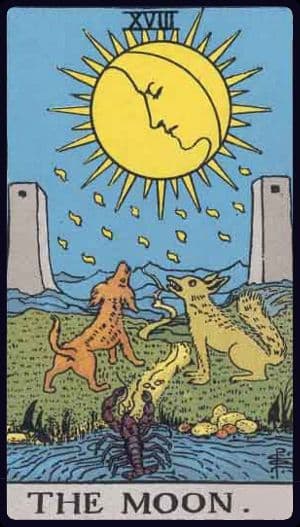
The Moon
The Moon is the card of uncertainty — what stirs beneath the surface before you can think it clearly.
Upright
Reversed
The Moon Meaning
Upright
The Moon speaks to illusion, fear, and the forms anxiety takes when clarity is incomplete. It often appears when the subconscious is active, sending up feelings, suspicions, or memories that do not yet arrive in a clean narrative. This card does not say your intuition is wrong; it says intuition and projection may be tangled together, and you need time to tell them apart. What is sensed here may be real, but it is moving through mist, mood, and older emotional material on its way to language.
Reversed
Reversed, The Moon can mark the release of fear after a period of psychic overexposure or uncertainty. Repressed emotion may be rising now, but in a form that is less atmospheric and more legible, even if the first result is inner confusion. Sometimes this card appears when what was vague becomes nameable, and that naming is both relieving and disorienting. The fog is thinning, though not all at once; what matters is that you are starting to see which feelings belong to the present and which were carried in from elsewhere.
The Moon as a Daily Card
The Moon illuminates through shadow. Today, trust that confusion has its own wisdom. Not everything needs to be clear to be meaningful.
Lean toward
What feels true before it's fully explained.
Watch for
Treating uncertainty as proof.
What situation in your life is unclear, and how might that ambiguity be teaching you something?
In Different Situations
Relationships
Not knowing where you stand can make every silence feel loaded. The Moon captures that uneasy space between noticing something and deciding what it means. A change in someone's tone may matter; so may an old fear that makes it harder to hear them clearly. Neither intuition nor suspicion is automatically the whole truth.
The card invites a distinction between what has actually happened and the story growing around it. You can take uncertainty seriously without treating it as evidence of betrayal, or dismissing a feeling just because you cannot explain it yet.
Career
A workplace can be full of signals and short on clear answers. Under The Moon, praise, silence, changing expectations, and your own ambitions may be difficult to read. This is fertile ground for imagined certainty: assuming you are failing, or assuming an opportunity is yours, before the facts have caught up. The card respects instinct without treating it as a private source of information about other people's motives. There may be something important beneath your unease. Its shape becomes more useful when you can separate what you know about the work from what you fear or hope it means.
Decisions
When every option seems to change shape each time you think about it, The Moon is close to the experience. Fear can make a risk seem larger; desire can make a warning seem smaller. Both may coexist with genuine missing information. The card does not offer a secret answer hidden beneath the surface. It distinguishes a decision that needs more facts from one that no amount of research can make entirely safe. If you are trying to choose only after all uncertainty disappears, the fog itself may have become part of what keeps the choice unresolved.
Burnout
Sometimes tiredness comes from the work itself. Sometimes it comes from never knowing when the next demand will arrive. The Moon catches that second kind of strain: watching for signals, filling gaps in information, rehearsing problems that may not happen. Your mind keeps working after the visible work is finished. Some concerns may be well founded; others grow in the space left by uncertainty. This card does not diagnose the source of exhaustion. It makes the hidden effort legible, especially when a day looks manageable from the outside but feels crowded with things you cannot settle.
Feeling Stuck
You can be stuck without facing a clear crossroads. The Moon describes a less tidy difficulty: you cannot tell what you want, what is frightening you, or even which question needs an answer. Pushing for an instant plan may only produce a convincing story that does not quite fit. Feelings that seem contradictory can be information, though they are not instructions. The card leaves space for what has not yet become clear. Sometimes the first change is being able to name the fog accurately instead of blaming yourself for not walking straight through it.
New Beginnings
At the start of something unfamiliar, excitement and apprehension may be almost impossible to separate. The Moon gives that mixture room without declaring either feeling a warning. You may be imagining futures from very little evidence, or sensing a concern you cannot yet explain. Both deserve more patience than a quick label of intuition or fear. Beginning does not require a complete map, but confusion need not be dressed up as confidence either.
Grief and Loss
Grief can make time feel unreliable. A memory arrives vividly, then the same place or sound seems unfamiliar; an emotion you thought you understood changes shape overnight. The Moon reflects that shifting inner landscape. It does not claim the feeling is a message from someone who is gone, or that every fear contains a hidden truth. It asks for gentleness toward uncertainty without turning it into a puzzle to solve. What you remember, imagine, and know may sit close together for a while. Their unevenness does not make the attachment any less real.
Recurring appearance
What does it mean when The Moon keeps appearing?
Something you can't quite see wants to be seen. The unclear hasn't resolved — and maybe that's the point.
Spreads that work well with The Moon
Past, Present, Future
3 cardsThe classic three-card arc. Where you've been, where you are, and where the energy is heading.
View spread →New Chapter
5 cardsDesigned for life transitions — starting something new, ending something familiar, or standing in the space between. This spread is Liminal Tarot's signature.
View spread →The Threshold
5 cardsFor moments when you know something needs to change but you can't yet see what comes next. This spread sits with you in the doorway — not rushing you through it, not pulling you back.
View spread →Pairs with The Moon
Begin your practice
Draw The Moon in a reading
Context transforms a card's meaning. A full reading weaves your question, your spread, and your cards into a coherent reflection.