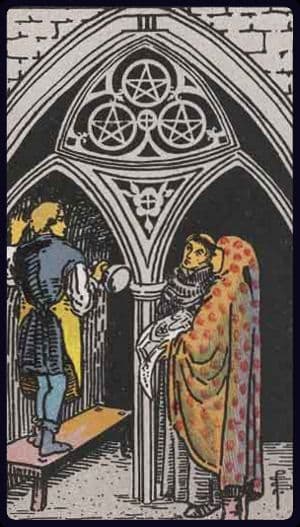
Minor Arcana — Pentacles
Three of Pentacles
The Three of Pentacles is the card of skill becoming visible through shared work.
Upright
Reversed
Three of Pentacles Meaning
Upright
The Three of Pentacles points to teamwork, collaboration, and the practical work of building something with others. It values learning, but not in isolation — understanding takes shape through feedback, implementation, and being part of a process larger than your own effort. This card often appears when craft improves because standards are shared and contributions are taken seriously. It suggests that progress comes not just from talent, but from working alongside people who sharpen the work.
Reversed
Reversed, the Three of Pentacles can describe disharmony in a group that is technically functioning but not truly in sync. Expectations may be unclear, contributions may be undervalued, or people may be working at cross-purposes without saying so. In some cases it points to working alone because collaboration has become more draining than useful. The card highlights the mismatch not as drama, but as the quiet inefficiency that appears when no one is really building toward the same thing.
Three of Pentacles as a Daily Card
The Three of Pentacles is skillful collaboration. Today, your work benefits from others' input. Mastery includes knowing when to ask for help.
Lean toward
The work improved by other hands.
Watch for
Protecting pride more than the result.
Who has expertise you could learn from in your current project?
In Different Situations
Relationships
Closeness has a shared-work side that is easy to miss when attention stays on chemistry. With the Three of Pentacles, trust takes shape through listening, making repairs, and learning how the other person actually does things. A difference in approach need not mean a lack of care; it may mean that neither person has yet understood what building together asks of them. But cooperation cannot rest on one person's invisible effort. The telling detail is whether each contribution is noticed, and whether both have some say in what they are making.
Career
Being good at something and having that work understood are not always the same experience. The Three of Pentacles is concerned with the point where skill becomes visible to other people: a standard shared, a piece of work examined, a contribution that fits into something larger.
Feedback can deepen craft without diminishing independence. It can also expose a team where expectations keep changing or credit rarely reaches the person doing the work. This is a card about the quality of collaboration, not a promise of promotion. Recognition means more when the people involved understand what has actually been made.
Decisions
You may know what you want to make or change and still be unsure whose judgment to trust. The Three of Pentacles gives expertise and shared standards a place in the decision without handing the choice to a committee. Good input can reveal a flaw, strengthen a plan, or show how another person's skill changes what is possible. Conflicting advice, meanwhile, may expose different expectations rather than one simple right answer. The useful distinction is between people who can help you understand the work and people whose approval you feel you must earn before acting.
Burnout
Working with other people is meant to distribute effort, yet collaboration can become another job when you must correct, explain, and coordinate everything yourself. The Three of Pentacles distinguishes the relief of shared craft from the fatigue of keeping a group functioning. It also recognizes how draining it is to contribute well and remain unseen. There may be genuine help nearby, or there may be a mismatch between the promise of teamwork and the work actually shared. This card brings that difference into view without treating tiredness as a failure of commitment.
Feeling Stuck
Sometimes you have worked on something for so long alone that you can no longer tell what is improving. The Three of Pentacles brings the outside eye into that stillness: not an audience to impress, but someone who understands the craft well enough to see what is unfinished or already good. Progress can stall when feedback is missing, just as it can stall when people are working toward different standards. This card does not make your movement dependent on permission. It notices how much clearer a next step can become when the work is actually seen.
New Beginnings
Starting again often means letting someone see the work before you feel fully ready. The Three of Pentacles treats that exposure as part of becoming skilled, not proof that you should already know everything. A new group, practice, or role takes shape through contributions, questions, and standards you learn together.
There is excitement in being useful while still learning. There can also be friction if nobody agrees on what good work looks like. This beginning is less about a dramatic leap than about finding where your effort fits, and whether the work can grow through honest exchange.
Grief and Loss
A loss can alter the way people do things together. There may be work that used to be shared, a skill someone taught you, or a familiar contribution whose absence is now felt each time the task returns. The Three of Pentacles gives attention to that practical inheritance of relationships. Others may help carry part of it, but cooperation after a loss can be awkward; people do not always know what is needed or how to offer it. The card honors the work and knowledge bound up with memory, without suggesting that another person can simply fill an empty place.
Recurring appearance
What does it mean when Three of Pentacles keeps appearing?
Craft and collaboration keep returning together. Being capable is not the same as being fully seen.
Spreads that work well with Three of Pentacles
Past, Present, Future
3 cardsThe classic three-card arc. Where you've been, where you are, and where the energy is heading.
View spread →Career Path
4 cardsFor questions about work, purpose, and professional direction. Not job-search advice — a mirror for your working life.
View spread →Horseshoe
7 cardsA broad arc covering past, present, and future with attention to hidden influences, your attitude, and external forces at play.
View spread →Begin your practice
Draw Three of Pentacles in a reading
Context transforms a card's meaning. A full reading weaves your question, your spread, and your cards into a coherent reflection.