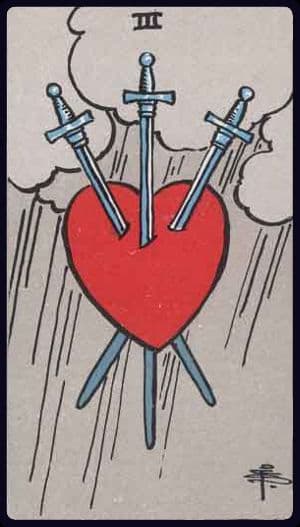
Minor Arcana — Swords
Three of Swords
The Three of Swords is the card of hurt made unmistakable — grief when the wound is clear.
Upright
Reversed
Three of Swords Meaning
Upright
The Three of Swords points to heartbreak, sorrow, and the clean pain of something that cannot be prettied up. It often appears when emotional pain has cut through denial and the hurt is no longer negotiable. This card does not exaggerate suffering, but it does refuse euphemism. Loss, betrayal, or grief may be sitting close enough now that language feels blunt around it. What gives this card its force is not spectacle but accuracy. Sometimes the hardest part is not the feeling itself, but having to admit exactly what happened and what it cost.
Reversed
Reversed, the Three of Swords often shows pain in the process of changing form. Negative self-talk may be prolonging an old wound, or releasing pain may be beginning in small, uneven ways that do not yet feel like relief. Forgiveness and optimism can belong here, but not as performance. They arrive only when the injury is no longer being rehearsed as identity. This card suggests the heart is trying to make a different kind of meaning from what happened. Recovery begins when the mind stops sharpening the blade every morning.
Three of Swords as a Daily Card
Today, truth may pierce. The Three of Swords says: the wound is real, but so is your capacity to heal from it.
Lean toward
Naming what disappointed you.
Watch for
Dressing betrayal up as misunderstanding.
What painful truth, once accepted, could actually set you free?
Recurring appearance
What does it mean when Three of Swords keeps appearing?
Pain can stay active even after the moment has passed. Something painful may still be shaping your thinking.
Spreads that work well with Three of Swords
Decision
3 cardsNot a binary answer. Three cards to illuminate what each choice carries — energy, cost, and consequence.
View spread →Horseshoe
7 cardsA broad arc covering past, present, and future with attention to hidden influences, your attitude, and external forces at play.
View spread →The Fog
4 cardsFor moments when the path ahead is unclear and the old answers no longer hold. This spread doesn't offer direction — it offers orientation.
View spread →Begin your practice
Draw Three of Swords in a reading
Context transforms a card's meaning. A full reading weaves your question, your spread, and your cards into a coherent reflection.