Minor Arcana — Swords
Two of Swords
The Two of Swords is the card of suspended choice — when not deciding starts becoming its own decision.
Upright
Reversed
Two of Swords Meaning
Upright
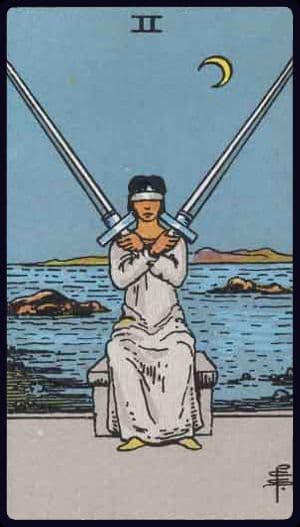
The Two of Swords points to difficult decisions where weighing up options has turned into an impasse. Sometimes this card appears when the available choices are both costly; other times when avoidance is disguising itself as careful thought. The tension here is not simple confusion. It is the strain of trying to remain untouched by a choice that will, in fact, involve you. This card names the standstill that develops when clarity is wanted but feeling is kept out of the room. Sooner or later, that balance stops holding.
Reversed
Reversed, the Two of Swords often reflects indecision that has become noisier rather than quieter. Information overload, confusion, or a long-running stalemate may be making it harder to hear what you actually think. This card suggests that more input is not necessarily helping. At a certain point, the problem is no longer lack of data but the inability to trust any of it enough to move. The mental back-and-forth can start to feel productive while leaving the situation exactly where it was. Something needs simplifying before it can be solved.
Two of Swords as a Daily Card
The Two of Swords is a crossroads. Today, you may feel stuck between two choices. Remember: not choosing is also a choice.
Lean toward
The choice you've kept in suspension.
Watch for
Calling delay discernment.
What decision are you avoiding, and what would happen if you just chose?
In Different Situations
Relationships
Sometimes keeping the peace means keeping a question closed. The Two of Swords captures that suspended moment: you can see reasons to speak and reasons to wait, so nothing changes. The crossed blades offer protection from a difficult answer, but they also limit what can be understood between people.
This card does not confirm that a relationship is ending or that another person is withholding something. It gives shape to your own stalemate. There may be genuine uncertainty, and there may also be a feeling you have been treating as inadmissible evidence because acknowledging it would complicate the calm.
Career
You may have two credible versions of a working life in view, each asking you to surrender something worthwhile. The Two of Swords belongs to this kind of career impasse, where more comparison does not necessarily create a painless option. Staying undecided can preserve possibility for a while, but it has its own consequences for attention and momentum. This is not an instruction to resign, accept an offer or make a dramatic move. The card draws attention to what your analysis may have kept outside the frame: the personal cost of each path, not only its measurable advantages.
Decisions
The Two of Swords is unusually direct about indecision: not choosing can be a way of trying to avoid the pain built into every available choice. The blindfold and crossed blades suggest a temporary balance maintained by holding competing claims apart. More information may help, but it may also add another layer to a stalemate that is already well understood.
This card does not tell you which way to go. It asks what you have not allowed into your weighing: loyalty, fear, a limit, or the knowledge that no option protects everything. That omission may matter more than one more argument.
Burnout
Exhaustion can make even small choices feel like traps. The Two of Swords describes the mental effort of holding opposing demands at bay, protecting a fragile equilibrium by deciding nothing. Sometimes the pause is necessary. Sometimes the background work of keeping every option open takes more capacity than it seems.
There may be no clean solution available at the moment. This card brings attention to the strain of the stalemate itself, rather than treating indecision as a personal flaw. When both sides seem non-negotiable, the pressure is part of the picture, not merely your ability to choose.
Feeling Stuck
There is a stillness that comes from having no clear direction, and another that comes from quietly resisting several directions at once. The Two of Swords is closer to the second. Its crossed blades hold a space shut: what looks like inertia may involve constant effort to keep opposing wants, fears or obligations from meeting. You need not manufacture a dramatic crossroads for this card to be relevant. Even a small, unnamed tension can keep movement suspended. Looking at what the standstill is protecting may tell you more than asking why you have failed to make progress.
New Beginnings
You can want a new beginning and still keep yourself at the threshold. The Two of Swords describes the effort to preserve the familiar while entertaining a different life, with neither desire granted full attention. Sometimes that hesitation protects against a real risk. Sometimes it asks the impossible: proof of how change will feel before you have begun.
The card does not demand a leap. It makes the suspended choice visible, including what staying put offers and what it quietly costs. A beginning can be uncertain without being reckless, and caution can be reasonable without becoming a permanent arrangement.
Grief and Loss
After a loss, you may find yourself caught between facing what has changed and keeping daily life moving as if it has not. The Two of Swords recognizes how protective that suspension can be. Holding two incompatible realities apart may be what makes an ordinary day possible for a while. It is also tiring to maintain. The card does not require a decision to “let go” or insist that acceptance follows a timetable. It shows the strain of protecting yourself from more than you can take in at once. What is unresolved can remain unresolved without becoming a failure.
Recurring appearance
What does it mean when Two of Swords keeps appearing?
A standstill keeps holding its place. Avoidance can feel like balance while nothing moves.
Spreads that work well with Two of Swords
Decision
3 cardsNot a binary answer. Three cards to illuminate what each choice carries — energy, cost, and consequence.
View spread →Horseshoe
7 cardsA broad arc covering past, present, and future with attention to hidden influences, your attitude, and external forces at play.
View spread →The Fog
4 cardsFor moments when the path ahead is unclear and the old answers no longer hold. This spread doesn't offer direction — it offers orientation.
View spread →Begin your practice
Draw Two of Swords in a reading
Context transforms a card's meaning. A full reading weaves your question, your spread, and your cards into a coherent reflection.