The Best Tarot Decks for Beginners
Looking for the best tarot decks for beginners? Choose a first deck that supports reflection, clarity, and steady practice. Explore our guide.
Aurora @ Liminal Tarot
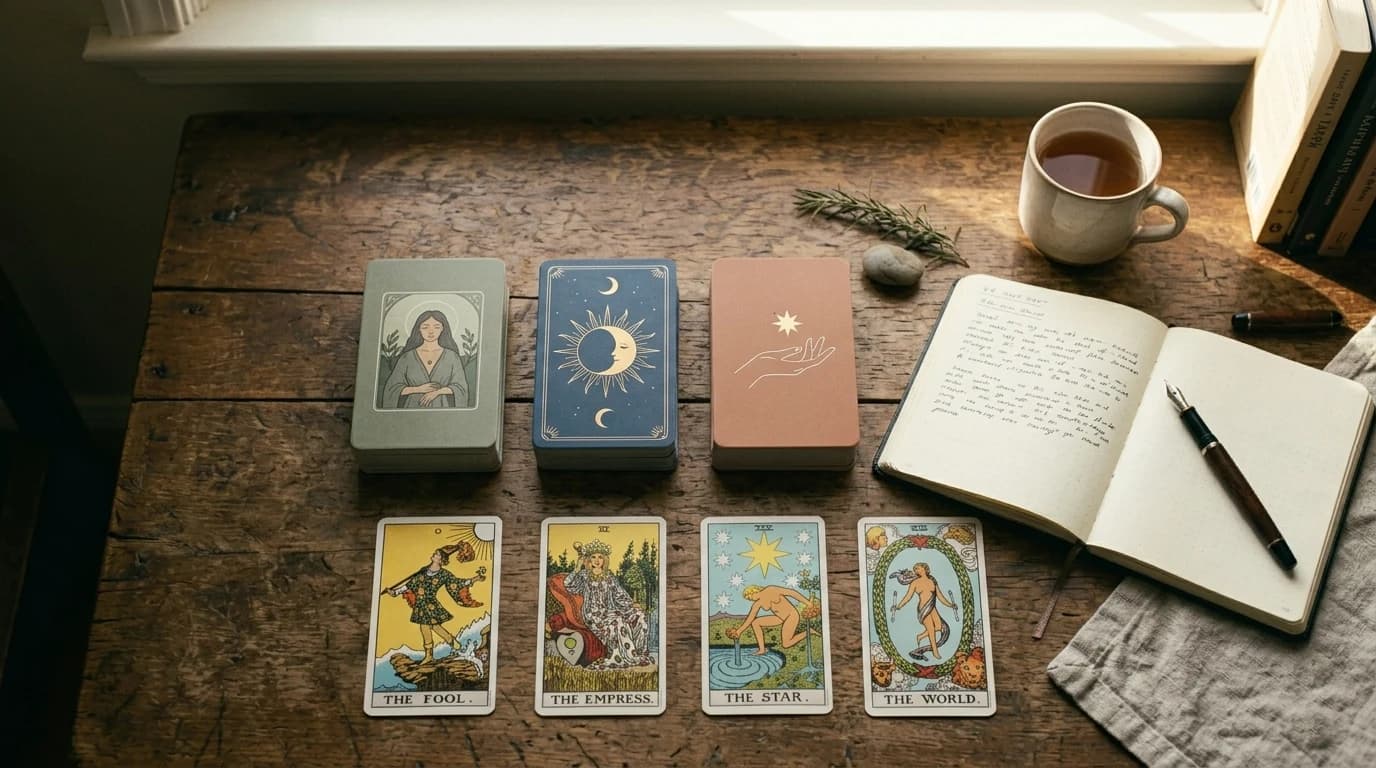
Choosing your first deck can feel weirdly high-stakes. You are not just buying paper cards. You are choosing the visual language you will return to when you are confused, in transition, or trying to hear yourself think.
That is why the best tarot decks for beginners are not necessarily the most famous, the most aesthetic, or the ones everyone on social media says you “should” start with. The right beginner deck is the one that helps you reflect clearly, stay engaged, and actually keep using it.
This guide is built for a specific kind of beginner: someone who wants tarot as a personal practice, not as performance. Maybe you want to journal, track patterns, or do the occasional spread when life gets messy. In that case, your first tarot deck should make self-inquiry easier, not impress other readers.
Below, we will walk through what makes a deck beginner-friendly, the tradeoffs between classic and modern decks, and how to choose one you will still want to use six months from now.
What makes a tarot deck good for beginners?
A beginner-friendly deck is not just “easy to read.” It is easy to build a relationship with. You want imagery that gives you something to notice, symbols that are legible without a PhD in esoterica, and a tone that invites reflection instead of intimidation.
For most people, the best beginner decks have four things in common:
- Clear imagery you can describe in plain language
- A structure that loosely follows Rider-Waite-Smith meanings
- Card titles and suits that are easy to recognize
- Artwork you genuinely want to sit with regularly
That last point matters more than people admit. A deck can be technically excellent and still be wrong for you. If the art feels cold, cluttered, or emotionally flat, you will avoid it. Consistency beats prestige every time.
Try this before you buy: look at five sample cards from the deck: The Fool, The Hermit, Three of Swords, Six of Cups, and Queen of Pentacles. Ask yourself, “Can I tell a story about what is happening here without opening a guidebook?” If the answer is yes, that is a strong sign.
The best beginner decks are often the clearest, not the prettiest
A lot of first-time buyers assume the most beautiful deck will be the easiest to use. Sometimes that is true. Often it is not.
Some decks are gorgeous but abstract. Others are stylish but symbol-light. That can be fine once you already know tarot structure, but it creates friction when you are still learning how to connect image, feeling, and interpretation.
For a first tarot deck, clarity usually wins.
A classic Rider-Waite-Smith style deck
If you want the lowest-friction entry point, start here. Rider-Waite-Smith based decks are still the default reference system for most books, apps, and tarot guides. The card names, visual scenes, and symbolic logic are widely supported.
This does not mean you need the most traditional version. It means your life will be easier if the deck keeps the bones of that system intact.
Why it works for beginners:
- Most learning resources map cleanly to it
- Minor Arcana cards usually show full illustrated scenes
- Symbolism repeats in useful ways across cards
Reflection prompt: pull a sample image from any Rider-Waite-Smith based deck and write three things you notice before reading any meaning. If interpretation starts forming on its own, that deck is doing its job.
A modern deck with strong emotional readability
Some beginners do better with contemporary art styles that feel more alive and personally resonant. A modern deck can absolutely be a good first tarot deck if the imagery is still readable and the system is not reinvented beyond recognition.
The question is not “Is this deck cool?” The question is “Will this deck help me notice something true?”
Look for modern decks that still preserve recognizable archetypes, relationship dynamics, and emotional movement from card to card.
Use this filter: if you showed a card to a friend with no tarot background, could they describe the mood and tension of the scene? If yes, that is a good sign.
How to choose based on the kind of practice you actually want
This is where most “best tarot decks for beginners” lists fall short. They assume every beginner wants to memorize meanings and eventually read for other people. Many do not.
If your goal is a reflective practice, journaling fit matters as much as tradition.
If you want a deck for journaling and self-reflection
Choose a deck with imagery that gives you emotional texture. You want cards that spark associations, memories, and honest questions.
Good signs:
- The facial expressions feel readable
- The scenes suggest relationships or internal states
- The artwork makes you want to write, not just decode
A reflective beginner does not need the “most accurate” deck in some abstract sense. You need a deck that helps you stay in conversation with yourself.
Mini exercise: imagine pulling one card on a hard morning. Which deck feels like it would help you pause and think, rather than perform a correct answer? That is the one to pay attention to.
If you want a deck to learn the system thoroughly
Choose something closer to classic Rider-Waite-Smith imagery. This makes it easier to use guidebooks, compare interpretations, and understand how the cards relate across spreads.
This path is especially useful if you are the type who likes structure, categories, and reference materials. There is nothing less “intuitive” about that. It is just a different learning style.
Practical checkpoint: see whether the deck uses standard suit names and recognizable court cards. Fewer translation steps means more practice, less friction.
If you want a deck you will use alongside an app
If you are planning to pull from your own deck and log readings digitally, choose a deck whose card system is easy to map. Standard names, familiar archetypes, and recognizable card numbering make the experience much smoother.
That matters because the value of tarot compounds when you can revisit your readings later. The individual reading is useful. The pattern across twenty readings is where things get interesting.
Once you have a deck, you can pair it with a reflective workflow instead of relying on memory alone. Our tarot deck guide can help you compare options, and if you are new to doing readings at all, our guide on how to do your first reading is the cleanest place to start.
Prompt for choosing: “Will this deck still make sense to me when I am tired, emotional, or short on time?” That is a better test than whether it photographs well.
Common beginner mistakes when buying a first tarot deck
Most first-deck regret comes from buying for fantasy instead of use.
A few traps to avoid:
- Picking a deck only because it is trendy
- Choosing artwork you admire but do not emotionally connect with
- Buying an ultra-abstract deck before you understand tarot structure
- Assuming more guidebook content automatically means a better fit
- Waiting for the “perfect” deck instead of choosing a workable one
A workable first deck is enough. You are not getting married to it. You are choosing a tool for this phase of practice.
That perspective helps a lot. Your first deck teaches you what you respond to. Later, you may want something moodier, stranger, softer, or more challenging. That is normal.
Helpful exercise: write down your actual goal in one sentence before buying. For example: “I want a deck that helps me do three quiet readings a week and journal honestly.” Use that sentence as your shopping filter.
So, what are the best tarot decks for beginners?
The honest answer is that the best beginner deck is the one that balances clarity, resonance, and repeat use.
For many people, that means starting with either:
- A Rider-Waite-Smith style deck with strong visual storytelling
- A modern but system-faithful deck with emotionally readable art
If you are torn between two, choose the one you can imagine actually reaching for on an ordinary Tuesday. Not during a candlelit identity transformation. Just a regular day when you need five minutes of perspective.
That is the real standard.
A first tarot deck does not need to be perfect. It needs to be legible, inviting, and steady enough to help you begin. Once you have that, the practice can grow from there.
And if you want help narrowing the field, browse our curated beginner-friendly tarot decks to compare options with reflective practice in mind.