Can Tarot Tell You If Someone Is Your Soulmate?
Tarot can help you examine why a relationship feels significant, but no card or spread can prove soulmate status, mutual feelings, destiny, or permanence.
Aurora @ Liminal Tarot
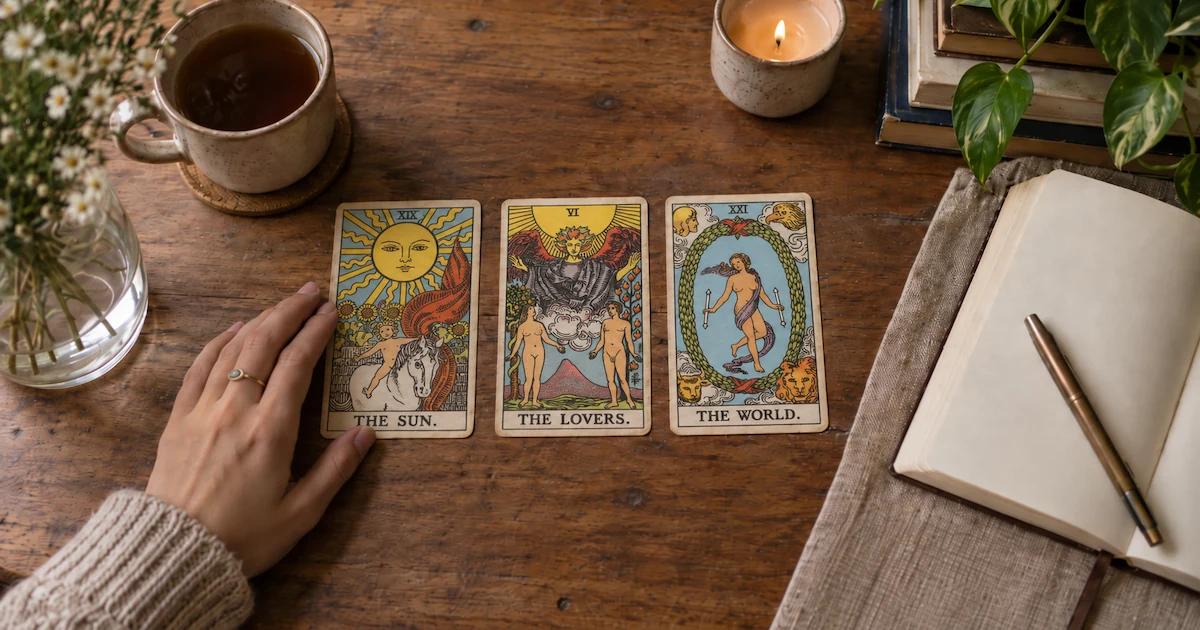
A connection can feel unusually important long before you have a clean explanation for it. When a tarot reading reflects that intensity with the Two of Cups, The Lovers, or several emotionally charged cards together, it can feel like confirmation.
A tarot card, pair, spread, or repeated pattern cannot establish that someone is your soulmate as an external fact. The reading can still be meaningful. It can help you examine reciprocity, attraction, values, hopes, fears, choices, and the future you are imagining with someone. The cards can carry weight without functioning as certification.
That distinction matters because the word soulmate often carries several questions at once. Separating those questions makes the reading more useful than asking one symbol to settle all of them.
Key points
- Cards such as the Two of Cups and The Lovers can raise reciprocity, attraction, values, and choice without proving soulmate status.
- Compare the connection's significance with observable mutual effort, communication, and compatible decisions instead of using symbolism as evidence.
- Repeated relationship cards can mark a recurring concern in your practice, but cannot certify another person's feelings, destiny, or permanence.
What are you asking the soulmate label to settle?
Sometimes soulmate means, “Why does this connection feel so important?” That is a question tarot can help you explore. A reading can bring the significance of the connection into focus and help you notice what part of your life it touches, what it awakens, or why it keeps occupying your attention. The answer does not require a claim that the connection was assigned by fate.
Sometimes the label is really about mutuality: “Does this person feel this too?” A card can invite reflection around reciprocity, attraction, distance, or uncertainty, but it cannot give access to another person’s private mental state. If that is the question underneath the question, a feelings reading is most useful when it stays short of mind-reading. Evidence of mutuality comes from what the other person communicates and does.
Compatibility is another question hiding inside the label. Tarot can help you examine values, expectations, conflict, desire, boundaries, or the kind of life you want. The relationship itself supplies the information that symbolism cannot: how you communicate, what each person chooses, whether your goals can coexist, and whether actions match stated intentions.
Then there is permanence. A relationship-coded reading can make hopes or fears about the future visible, but it cannot establish that a relationship will last. A reading happens in the present. Its emotional force does not turn duration into a known fact.
For some readers, soulmate is explicitly spiritual. You may understand a connection through that belief without asking the article or the cards to prove the belief as objective fact. Tarot can participate in a spiritual practice while leaving metaphysical certainty with the reader.
Strong relationship cards do not change the evidence category
Certain cards can make a relationship theme feel impossible to ignore. The Two of Cups may draw attention to mutual exchange or the wish for it. The Lovers can bring attraction, values, alignment, and choice into the reading. The Ten of Cups can make an image of shared fulfillment or belonging vivid. Major Arcana such as Judgement or the Wheel of Fortune can make a moment feel unusually consequential.
Those are useful interpretive directions. They still describe what the symbolism is bringing into view.
A dramatic combination can become more salient within the reading without creating a new source of information about another person’s private feelings, the future, or a metaphysical relationship category. Two relationship-coded cards do not become proof because they appeared together. A spread full of Cups does not become a guarantee because the pattern feels emotionally coherent. A Major Arcana card does not certify fate because its imagery feels large.
The same distinction applies when a reading feels intense rather than reassuring. Intensity tells you something about the experience of the connection. It does not establish reciprocity, compatibility, permanence, or what you should conclude about the relationship.
Keep three layers separate
A soulmate reading becomes easier to handle when you separate three kinds of information that often get merged.
The reading itself is the interpretive layer. This is where you can explore connection, attraction, reciprocity, choice, commitment, fear of loss, hopes for a shared future, or the meaning you are assigning to the relationship. This layer can be personal and important while remaining interpretation.
The relationship itself gives you observable information outside the cards. What has the other person actually said? Do their actions match their words? Is effort reciprocal? Are plans and expectations explicit? Are both people making choices that can coexist? These observations do not make the reading irrelevant. They simply belong to a different evidence category.
Some things remain private, future, or metaphysical. Another person’s unspoken internal state, whether a relationship is cosmically assigned, whether it will last forever, and what someone else will decide later are not resolved by a spread. Leaving those questions open is a valid outcome.
This separation lets the cards keep their reflective value without asking them to carry information they do not contain.
A worked example: Two of Cups with The Lovers
Suppose you ask, “Are we soulmates?” and draw the Two of Cups with The Lovers.
It is easy to turn that pairing into a verdict: mutual love, destined partnership, confirmation that the relationship is meant to last. The cards support a substantial reading without that leap.
The Two of Cups can focus attention on reciprocity and exchange. The Lovers can bring attraction, values, alignment, and choice into the same frame. Together, they give you a strong relationship theme to examine. The next step is to compare that theme with the relationship you are actually living.
Useful questions include:
- Where do I have evidence of reciprocity rather than hope for reciprocity?
- What values become more important when I think about this relationship?
- What am I asking the word soulmate to guarantee for me?
- What choice is mine even if I never receive certainty about the label?
The reading still has a clear job. It can show you what feels important and what deserves closer attention without turning a symbolic pairing into proof.
What repetition can show
Repeated cards can feel even more convincing than one dramatic spread. If the same relationship card appears several times, or the same theme keeps returning, the repetition may be worth noticing within your practice.
What it can show most clearly is that the question is still active for you.
A recurring partnership theme may point you back to the same hope, fear, expectation, or unresolved choice. It can help you notice that your attention keeps returning to reciprocity, commitment, loss, or the future. It may also show that you are asking the cards for a level of certainty the relationship itself has not supplied.
The useful comparison is not “How many times has this card confirmed the answer?” It is “What, if anything, has changed outside the reading since I last asked?”
A repeated symbol can become a stronger motif in your practice. Repetition alone does not give tarot more authority over an external claim.
Better questions for a soulmate reading
You do not need to strip the relationship of meaning to ask a more grounded question. Keep the importance of the connection and move the reading toward something you can actually examine.
Try questions such as:
- What is this connection bringing into focus for me?
- What do I want the word soulmate to guarantee?
- Where is reciprocity visible, and where am I assuming it?
- Which values matter most in the choices I am making here?
- What do I know from the relationship itself?
- What remains unknown even after the reading?
- If I set the soulmate label aside, what choice or conversation still matters?
- What kind of relationship am I hoping to build, and what evidence supports that possibility?
These questions leave room for emotional and spiritual significance. They also keep the reading anchored to reflection, observable context, uncertainty, and your own choices.
Spiritual meaning does not need a certificate
Some readers use soulmate as part of a spiritual worldview. A grounded tarot practice does not need to argue that belief away.
You can hold a spiritual understanding of what a connection means. The cards still do not become independent proof of that belief, another person’s private feelings, or the relationship’s future. The distinction is about authority, not about telling you which worldview to adopt.
That leaves space for symbolism to matter without borrowing certainty from it.
A meaningful connection can remain meaningful without proof
Tarot can help you see why a connection carries so much weight, what you are hoping it means, what the relationship is actually showing you, and where certainty is still unavailable.
A reading can leave the soulmate label unresolved and still clarify something important: the values, evidence, expectations, and choices that belong to you.