How to Choose Your First Tarot Deck (Without Getting Overwhelmed)
Learn how to choose a tarot deck without spiraling. This first tarot deck guide helps you buy one you will actually use. Explore our guide.
Aurora @ Liminal Tarot
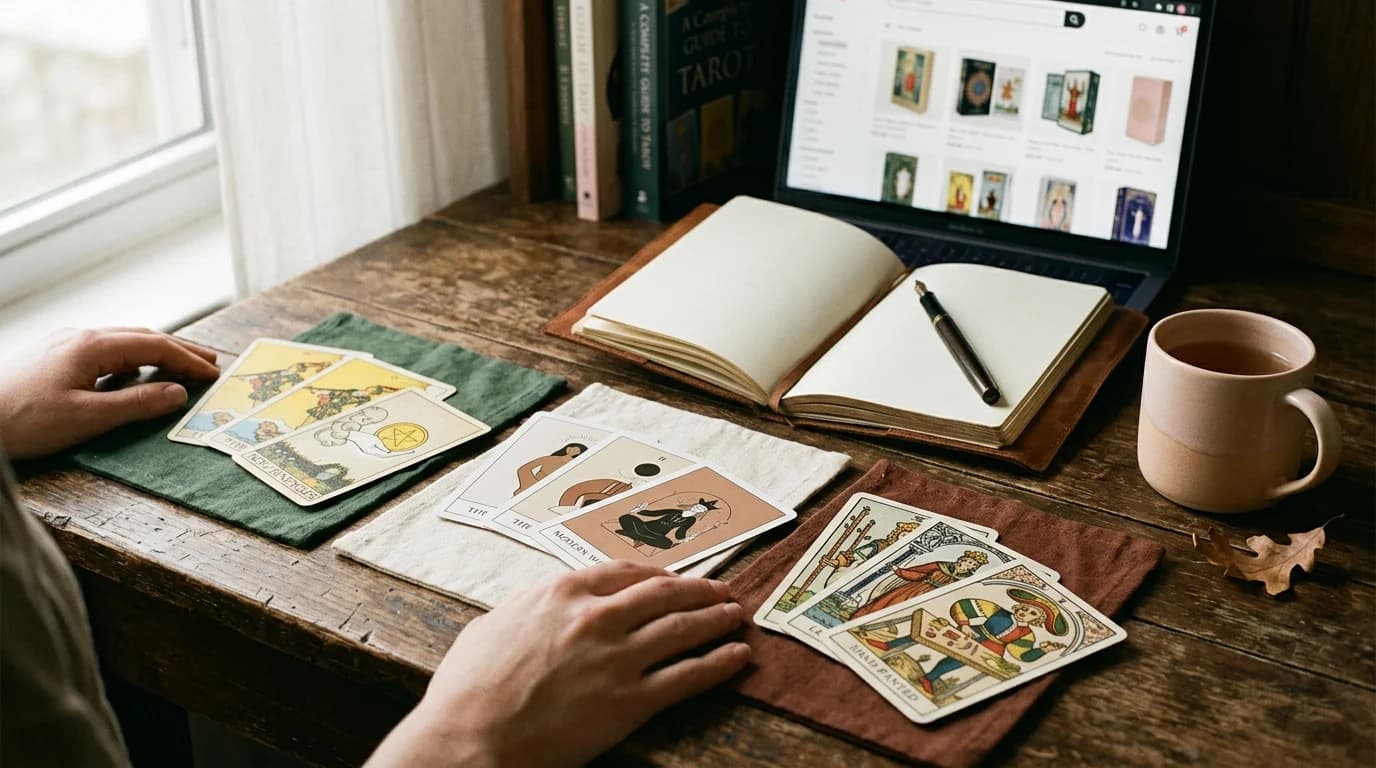
You open one deck guide and suddenly you are staring at hundreds of options: classic decks, indie decks, pastel decks, shadow-work decks, minimalist decks, decks with gorgeous art and reviews that all sound life-changing. Ten tabs later, you still have no idea what to buy.
That is exactly why this guide exists. How to choose a tarot deck is not really a question about finding the one perfect deck. It is a question about finding a first deck you will actually understand, enjoy, and keep using after the initial excitement wears off.
The good news is that you do not need rare taste, special intuition, or deep tarot knowledge to choose well. You just need a simple framework. In this first tarot deck guide, we will look at what matters, what does not, and how to stop treating your first deck like a once-in-a-lifetime identity decision.
Start with the practice you actually want, not the deck fantasy
A lot of beginner overwhelm comes from shopping for a fantasy version of tarot instead of the way you are realistically going to practice. Maybe you imagine elaborate spreads, linen cloths, and a beautifully curated altar. In real life, your first deck might mostly live on your desk and come out when you are stressed, journaling, or trying to think clearly on a Tuesday night.
That is not a lesser practice. It is the one that matters.
Before you compare artwork or editions, answer this: what do you want this deck to help you do?
Common answers include:
- learn tarot structure clearly
- journal and reflect on daily pulls
- work through a transition or ongoing question
- build a quiet personal ritual
- pair a physical deck with a digital reading log
The answer changes what tarot deck to buy. A deck for learning is not always the same as a deck for emotional resonance. A deck for collecting is not always the same as a deck for repeat use.
A simple exercise before you shop
Write one sentence and keep it visible while browsing:
“I want my first tarot deck to help me ______.”
Fill in the blank as specifically as you can. For example: “notice patterns in my week,” “learn the cards without getting intimidated,” or “journal through a career transition.”
That sentence will cut through a lot of noise.
The four things that matter most in a first deck
When people ask how to choose your first tarot deck, they usually assume the answer is a ranked list of titles. A list can help, but the more useful move is to understand the criteria first.
1. Familiar structure
For a first deck, it usually helps if the deck follows Rider-Waite-Smith structure, or stays close enough that most books and guides still make sense. That means standard suits, recognizable archetypes, and illustrated Minor Arcana scenes rather than purely decorative pips.
Why this matters: learning is much easier when the wider tarot ecosystem speaks the same language as your deck.
Prompt: look at the deck’s sample cards and ask, “Would a beginner guide still make sense with this deck, or would I be translating everything?”
2. Readable imagery
Beautiful is not enough. You want images that tell you something at a glance. A good beginner deck gives you emotional cues, movement, tension, and enough visual information that you can start reflecting before checking a guidebook.
If the art is abstract, hyper-stylized, or so ornate that you cannot tell what is happening, the deck may be lovely but not beginner-friendly.
Prompt: choose three sample cards and describe what is happening in plain language. If you cannot do that, the deck may be harder to grow with.
3. Physical usability
Deck size, card stock, finish, readability, and shuffle feel matter more than people think. If the cards are too large for your hands, too slippery, or too visually dense to read quickly, you may use them less.
That sounds minor until it becomes the reason your practice never takes root.
Prompt: check the card dimensions and ask, “Could I comfortably shuffle or handle this deck when I am tired or distracted?”
4. Genuine resonance
You do not need to choose the most famous deck. You do need to choose one you want to spend time with. Tarot is a repeat-use tool. If the tone of the artwork annoys you, bores you, or feels emotionally flat, you will probably drift away from it.
Resonance is not about dramatic spiritual fireworks. It is often quieter than that. It is the feeling that the deck invites you in.
Prompt: when you look at the sample images, do you feel curious enough to keep looking?
What matters less than beginners think
The internet can make first-deck shopping feel loaded with rules. In practice, some of the things beginners obsess over matter far less than people say.
You do not need the “most advanced” deck
A deck being deep, layered, or beloved by experienced readers does not automatically make it a good first deck. Sometimes the best first deck is the clearest, simplest one because it gets you practicing sooner.
A deck does not need to impress anyone. It needs to be usable.
You do not need a deck chosen by fate
Some tarot communities are romantic about the idea that your deck should find you, or that you should wait for a sign. If that framing delights you, fine. But you do not need it.
You can choose a deck the same way you choose a journal, a notebook, or a meditation app: by asking whether it supports the practice you want.
Reflection exercise: if no one on the internet had opinions about your deck, which one would you quietly pick for yourself?
You do not need to fear the “wrong” choice
This one is huge. People get frozen because they think buying the wrong first deck will derail their whole relationship with tarot. It will not.
At worst, you learn something useful: maybe you prefer classic imagery, smaller cards, softer color palettes, or less abstract symbolism. That is not failure. That is data.
A first deck is allowed to be a first draft.
Choose based on your learning style, not just your aesthetic taste
This is where a lot of better decisions happen. Two people can want tarot for completely different reasons, and their ideal first deck may not overlap much.
If you want to learn the system clearly
Choose a deck that stays close to Rider-Waite-Smith imagery or at least preserves the structure cleanly. This lowers friction when you use books, apps, and beginner resources.
A clear system-faithful deck is often the smartest first step for analytical learners who like knowing what the cards are doing and why.
Try this: compare The Fool, The Tower, Three of Swords, and Queen of Cups in a sample gallery. If the emotional and symbolic logic feels easy to follow, that is a strong sign.
If you want a reflective journaling practice
Choose a deck with imagery that sparks personal associations. You want pictures that help you notice mood, memory, tension, and internal states. The deck should make you want to write, not just memorize.
This matters especially if your practice is less about prediction and more about self-inquiry.
Try this: imagine pulling one card before opening your journal. Which deck feels like it would actually help you begin writing?
If you want to use a physical deck alongside an app
Choose a deck with standard card names and clear structure. That makes it easier to log readings, revisit patterns, and keep your practice coherent across tools.
This is especially useful if you want the ritual of using your own deck but also want reading history, pattern tracking, or a clean interpretation flow. Our guide to the best tarot decks for beginners can help narrow the field, and our deck recommendations page is a practical place to compare options when you are ready.
Try this: ask whether the deck would still be easy to enter, remember, and revisit after twenty readings, not just on day one.
A sane buying process when you feel stuck between five decks
Once you have narrowed things down, do not keep adding more options. That is how simple buying decisions become personality tests.
Use this short process instead:
- Pick three candidate decks, not ten.
- Compare sample images from the same five cards across all three.
- Check size, card stock notes, and guidebook quality.
- Ask which deck best fits your real practice sentence.
- Choose one and stop researching.
That last step matters. At a certain point, more browsing does not create better judgment. It just creates noise.
The five-card comparison method
Use the same five cards in every deck preview:
- The Fool n- The High Priestess
- Three of Swords
- Six of Pentacles
- The Hermit
These cards give you a good mix of emotional tone, archetypal clarity, and scene readability. If one deck keeps making more intuitive sense across these five, pay attention.
Prompt: “Which of these decks feels easiest to have an honest conversation with?”
So, what tarot deck should you buy?
The honest answer is: buy the deck that is clear enough to learn from, resonant enough to keep using, and practical enough to fit your real life.
That is a much better standard than “most recommended” or “most aesthetic.”
If you are still torn, lean toward readability and familiarity for your first deck. You can always get stranger, more niche, or more art-forward later. Your first deck is not supposed to express your final form. It is supposed to help you start.
And starting matters more than optimizing.
If you want help narrowing the options, browse our curated tarot deck recommendations or pair this with our guide to the best tarot decks for beginners for a more specific shortlist.