How to Actually Read the Celtic Cross (Step by Step, in Context)
Learn how to read celtic cross tarot as a full system, not just ten labels, so your readings become clearer and more useful. See our guide now.
Aurora @ Liminal Tarot
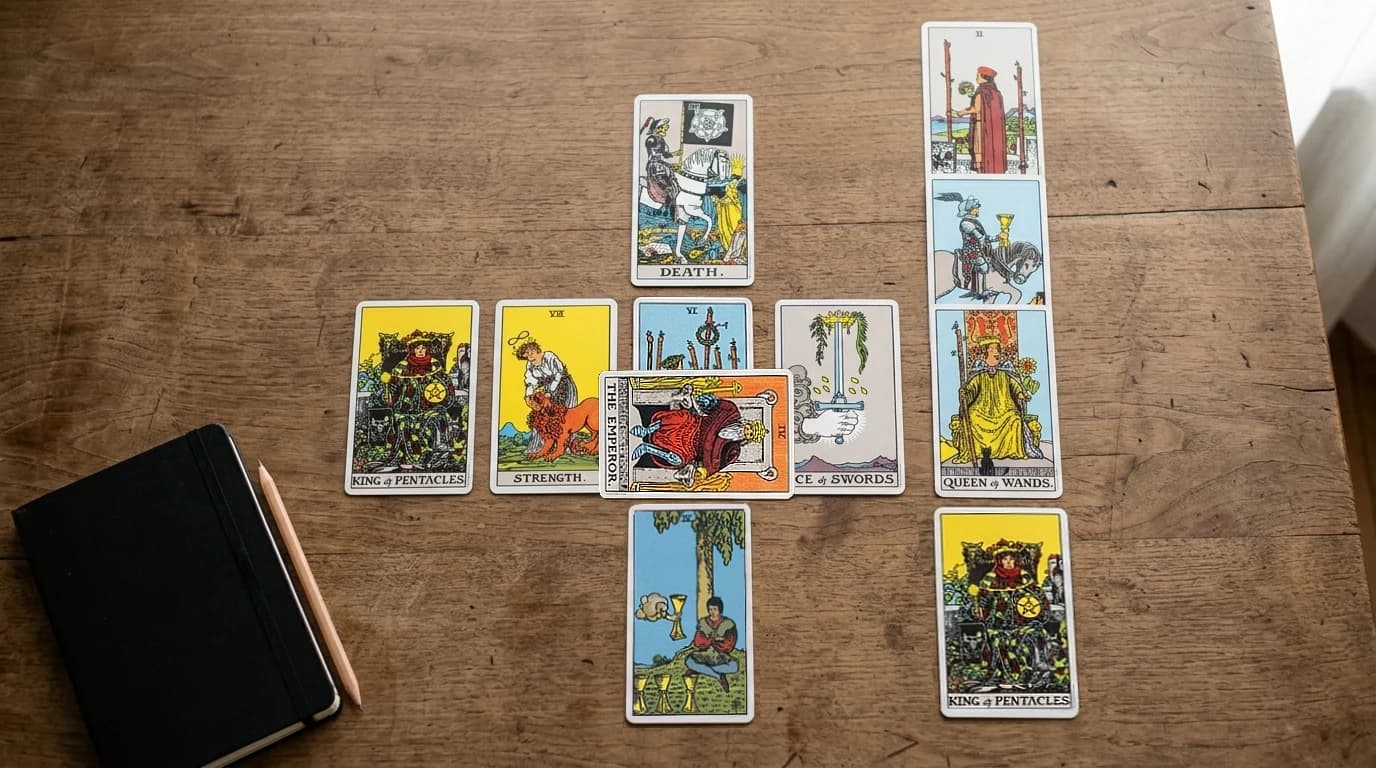
If you have ever laid out a Celtic Cross, stared at ten cards, and felt like the spread somehow got less clear as it got bigger, you are not doing it wrong.
The problem is that most guides on how to read celtic cross tarot teach the layout like a vocabulary quiz. Position one means this. Position two means that. Position three means something else. Useful, but not enough to help you interpret the spread as a system.
The Celtic Cross becomes readable when you stop treating it like ten isolated mini-readings and start reading relationships: tension, movement, pressure, deeper influence, and probable direction. That is what makes the spread useful for a real layered question.
In this guide, we will walk through what the positions are actually doing, how to read across the spread without getting lost, and how to adapt the interpretation for an open reflection question versus a concrete choice.
When the Celtic Cross is the right spread to use
The Celtic Cross is not the best spread for every question.
It is best when the situation is layered, emotionally loaded, or hard to reduce to a simple yes-or-no. If you are trying to understand a work conflict, a relationship pattern, a big transition, or a decision with competing pressures, this spread gives you more context than a one-card pull.
That is also why it can overwhelm newer readers. A large spread does not automatically create clarity. It creates more material.
A good rule: use the Celtic Cross when you need structure around complexity, not when you just want a quick nudge.
For the layout itself and visual reference, start with our Celtic Cross spread guide. Then come back here for the interpretive layer most position-only guides leave out.
A quick decision check before you pull
Before you lay any cards, ask yourself:
- Is this question complex enough to need ten positions?
- Am I looking for context, not prediction?
- Can I phrase the question in a way that invites reflection rather than fate?
If the answer to all three is yes, the spread is probably a fit.
Try this: write your question in one sentence, then rewrite it without asking what will happen. Change “Will I get the job?” to “What do I need to understand about this career move?” That one shift usually makes the reading sharper.
The Celtic Cross positions explained as functions, not labels
A lot of celtic cross positions explained content stops at naming the slots. That is where confusion starts.
What matters is not just what each position is called, but what kind of information it tends to carry inside the system.
Positions 1 and 2: the core tension
The first card is the heart of the matter as it is currently being lived.
The second card, crossing it, shows the friction point: what complicates the issue, presses on it, interrupts it, or forces movement. Sometimes the crossing card is clearly an obstacle. Sometimes it is a necessary challenge. Either way, these two cards form the engine of the reading.
Do not rush past them. If the whole spread feels confusing, come back here first.
Try this: ask, “What changes if I read the crossing card as pressure instead of pure blockage?” That one reframing often opens the spread back up.
Positions 3 through 6: the storyline around the question
These four cards usually show the architecture of the situation.
Position 3 often reflects what sits below the surface: roots, habits, older patterns, or something you know but have not fully named. Position 4 frequently points to what is receding but still active. Position 5 can show conscious aim, ideal, fear, or what is mentally prominent. Position 6 often points toward the near-forming direction if the current dynamic continues.
This is why celtic cross tarot meaning cannot be reduced to one fixed script. The positions help you map depth, history, attention, and momentum.
Try this: after you place cards 3 to 6, summarize the storyline in four short phrases: “what is underneath,” “what is fading,” “what is on my mind,” and “what is taking shape.” Then see whether the sequence tells a coherent story.
Positions 7 through 10: the human context and likely direction
The staff on the right side is where many readers lose confidence, because these cards can feel abstract.
In practice, they answer four grounded questions: how am I showing up, what environment matters, what am I hoping or fearing, and where is this headed if nothing meaningful changes?
That last card is not destiny. It is trajectory.
That distinction matters. Tarot is more useful when you treat it as a way of clarifying pattern and momentum, not as a machine that locks the future in place. That is also why we frame the cards as reflective structure rather than prediction in Tarot and the Limits of Logic.
Try this: when you reach card 10, say “given everything above, the current pattern tends toward...” instead of “this will happen.” You will usually read the card with more precision and less drama.
How to read the Celtic Cross as a system
This is the part most every celtic cross spread guide under-teaches.
Once all ten cards are down, do not interpret them in order from one to ten and call it done. Read in passes.
First pass: find the dominant energy
Scan for repetition before interpretation.
Are several cards from the same suit showing up? Is there a heavy concentration of Majors? Are multiple cards echoing the same emotional temperature — guardedness, urgency, grief, ambition, suspension? Repetition tells you what the reading cares about most.
A spread with five Pentacles cards is talking differently than one dominated by Swords. Three Major Arcana may point to a bigger turning point than a temporary mood.
Try this: before reading individual meanings, write one sentence beginning with “The strongest energy in this spread is...” Use only patterns you can point to in the cards.
Second pass: read the relationships
Now compare cards that speak to each other.
Look at 1 and 2 as a pair. Then compare 3 and 5: what is underneath versus what is consciously emphasized. Compare 4 and 6: what is falling away versus what is arriving. Then compare 7 and 8: inner stance versus outer environment.
This is where nuance appears. Maybe you are consciously focused on being practical, but the underlying card shows grief or anger. Maybe the future-facing card looks promising, but the self-position shows reluctance to engage. The meaning lives in the mismatch as much as in the cards themselves.
Try this: identify one pair in the spread that feels aligned and one that feels contradictory. The contradiction is often where the real reading begins.
Third pass: say the spread back in plain language
After you have looked at patterns and relationships, translate the whole spread into normal speech.
For example: “The situation is being driven by indecision under pressure. An older disappointment is still shaping how I see the choice. Consciously I want certainty, but the near future asks for movement before I feel ready.”
If you cannot say the reading back in plain language, you do not understand it yet.
That is not failure. It is a signal to simplify.
Try this: explain the reading as if you were describing it to a thoughtful friend who knows nothing about tarot. No card names at first — just the pattern.
How to read the Celtic Cross for a decision versus an open question
The same layout behaves differently depending on what you are asking.
That is why many people feel like the spread “does not work” when really they are using the wrong reading stance.
If the question is about a decision
When the spread is decision-based, focus on conflict, tradeoffs, and direction.
You are not asking the cards to choose for you. You are looking for the structure of the choice: what pressure is present, what history is distorting it, what motive is conscious, what fear is hiding inside that motive, and what trajectory becomes more likely if you continue as you are.
In decision readings, cards 1, 2, 5, 6, and 10 often carry extra weight. They show what is happening now, what complicates it, what the conscious mind wants, what direction is forming, and where the pattern tends if left unexamined.
Try this: after the reading, finish these two prompts: “The decision is really about...” and “The part I least want to admit is...” That usually reveals more than asking which option wins.
If the question is open-ended
When the question is reflective rather than decisional, read the spread for self-understanding.
In these readings, cards 3, 7, and 8 often become especially revealing. They tell you what pattern is underneath your awareness, how you are currently meeting the situation, and what the wider context is asking of you.
The goal is not to force action. The goal is to understand the weather system you are inside.
Try this: instead of asking “What should I do?” ask “What am I being invited to understand more clearly?” The spread often becomes more honest immediately.
Common mistakes that make the Celtic Cross feel harder than it is
Most trouble with the spread comes from interpretation habits.
The first mistake is asking a murky question. Ten cards cannot rescue a question that is too broad to anchor. The second is reading every position as equally important. Some cards carry more weight in a given spread than others. The third is turning card 10 into a fixed prophecy and panicking over it.
Another common mistake is clinging to position keywords even when the pattern is clearly pointing elsewhere. If three cards are all speaking about exhaustion or tension, trust that pattern. The spread is a conversation, not a form you fill in mechanically.
And finally: do not force closure. Some Celtic Cross readings end with clarity about the problem, not certainty about the answer. That still counts.
Try this: when you finish the spread, do not ask “Did I get the right answer?” Ask “What became clearer?” That question builds confidence faster and keeps the reading grounded.
The Celtic Cross earns its reputation when you learn to read it in layers. Not ten separate meanings, but one structured field of information.
That is the real answer to how to read celtic cross tarot: start with the layout, but interpret the relationships. Read for pressure, pattern, and trajectory. Then translate the spread back into ordinary language.
If you want the visual layout and position reference in front of you while you practice, use our Celtic Cross spread page as your companion. Then give yourself a real question and read the spread like a system, not a checklist.