How to Read a Three-Card Spread as One Reading, Not Three Separate Meanings
A practical five-pass method for turning three card meanings into one coherent tarot reading through position, relationship, shape, and synthesis.
Aurora @ Liminal Tarot
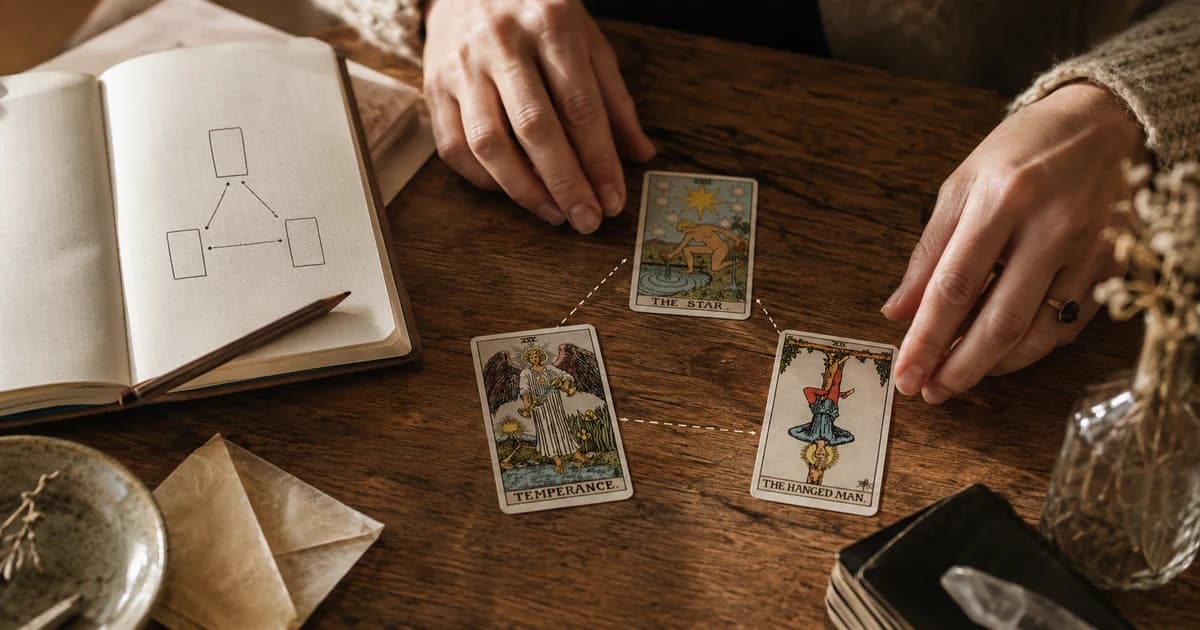
Knowing what three tarot cards mean can still leave you with three separate answers. You read the first card, then the second, then the third. Each interpretation makes sense on its own, but the spread never quite becomes a reading.
The missing skill is composition: seeing what the cards are doing together after each one has been read in its position. The position gives a card a job, the card is interpreted inside that job, and then the three positioned meanings are compared for the relationship carrying the most weight. Only after that do you compress the spread into one observation.
This is one practical method rather than a universal system for tarot combinations. Three-card spreads can use many different position schemes, so the method starts with the structure you actually chose.
Position comes before combination
A three-card spread is more than three cards arranged in a row. The positions create the grammar. A chronological spread might use Past / Present / Future; a diagnostic spread might use Situation / Obstacle / Advice; a comparative spread might use Situation / If I move forward / If I stay. The same card would do different work in each of those positions because the question being asked of it has changed.
In Liminal Tarot's Past, Present, Future spread, the positions ask what past influence is shaping the situation, what is current, and what is emerging. The three-card Decision spread uses a different structure: the situation, what follows from moving forward, and what follows from staying. The layout is still three cards, but the reading logic is different.
That plurality is not unusual. Biddy Tarot's three-card spread examples include several different position sets, while Labyrinthos' reading guide treats the spread as structure for individual cards and combining meanings as a further reading skill. Before asking how the cards combine, ask what each position is responsible for.
A quick check can help: can you describe each position in one sentence, does each answer a different part of the question, and would swapping two positions materially change the reading? For a named spread, use its actual position questions rather than quietly replacing them with generic meanings.
The five-pass method, worked through once
The method is small enough to use without building another memorization system. To see how the five passes connect, imagine a Past / Present / Future reading about a work project that stalled and has recently begun moving again. The cards are The Hanged Man, The Chariot, and Strength.
1. Position — give each card a job. The Past position asks what earlier influence is still shaping the situation. Present asks what is active now. Future asks what is emerging. Combination should not erase those jobs; it should connect them.
2. Sentence — write one bounded interpretation per card. The Hanged Man can be read through pause, suspended motion, and a perspective changed by not forcing movement. In the Past position, that becomes: a period of suspension changed how the situation is being seen. The Chariot brings directed will, momentum, and effort organized around a chosen course; in the Present position: the current moment asks for a chosen direction and sustained effort behind it. Strength brings quiet power, courage, and influence without force; in the Future position: the emerging direction calls for steadiness that does not depend on forcing the situation.
You still have three interpretations at this point. That is useful. Keeping them bounded gives you something concrete to compare. If each card becomes a page of possibilities, almost any connection can be made to fit after the fact.
3. Relationship — find the strongest connection. Three cards can support many comparisons, but the reading rarely needs all of them. Sometimes the cards reinforce the same issue from different positions. Sometimes two positions create a genuine tension or tradeoff. A chronological spread may show movement; another card may complicate or reframe what the first two seemed to establish. And sometimes one card acts as a hinge, carrying more compositional weight because it changes how the other positions are understood.
In this example, the clearest relationship is progression, with an important correction inside it. The Hanged Man moves into The Chariot, then Strength: suspension gives way to directed movement, but the movement does not need to harden into pressure. The Chariot and Strength both involve power or capacity, yet the quality shifts from drive toward steadier control of effort.
4. Shape — describe the spread in ordinary language. Put the card names aside for a moment and state the structure you can actually see. A spread might be shaped as from X toward Y, X is being interrupted by Y, X and Y reinforce the same issue; Z changes the response, or both branches carry different costs.
For this reading, the shape is simple:
suspension → directed movement → steadier control of effort
That phrasing is easier to hold than three separate card definitions because it names what changes across the positions. A chronological spread can genuinely form an arc like this. A comparative spread may need a branch instead. The spread determines the grammar.
5. Synthesis — write one sentence for the whole reading. The synthesis does not need every symbol, keyword, or possible interpretation. It needs the central relationship. A useful test is whether the sentence would still describe the reading if the card names disappeared.
For the stalled project, the five passes lead to this:
The project has moved from a pause that changed the reader's perspective into a period of deliberate momentum, and the emerging task is to make that momentum sustainable rather than simply stronger.
The sentence does more than repeat three meanings. It explains the arc that the positions and cards create together. The Future position also stays conditional: it describes an emerging direction inside the reading, not a promise that the project will succeed or that a particular event will happen.
Once the synthesis is clear, you can expand back into card detail. The difference is that each paragraph now serves the same reading.
A Decision spread changes the grammar
Three cards in a row can look chronological even when the spread is comparative. Liminal Tarot's Decision spread uses The Situation, If You Go Forward, and If You Stay. Imagine the cards are The Lovers, The Magician, and The Hermit.
Read them inside their jobs first. Situation — The Lovers: the decision exposes what the reader values and what they are willing to choose clearly. If You Go Forward — The Magician: moving forward asks for active participation with the skills and resources already available. If You Stay — The Hermit: staying preserves distance, reflection, and a quieter reconsideration of the decision.
The Situation card becomes the hinge. The structure is not a sequence in which The Lovers happens, then The Magician, then The Hermit. It is closer to a branch:
what the decision is really about
↙                         ↘
what moving asks           what staying asks
The two branch cards describe different conditions to examine through the spread rather than fixed predictions. The synthesis becomes:
The choice is exposing a values question: moving forward asks the reader to act with the tools already available, while staying preserves a period of deliberate distance and reflection.
The sentence does not decide for the reader. It clarifies what each branch asks of them. The same three cards placed into Past / Present / Future would create a different composition because their jobs would be different.
When the cards do not resolve cleanly
A coherent reading does not need a neat beginning, middle, and end. Sometimes the strongest synthesis is a tension: two positions pull in different directions and the third does not resolve the conflict. That can still be the reading. Coherence means the cards belong to the same interpretive problem; it does not require them to agree.
When a spread feels resistant, a few checks are worth keeping because they change how you look at the whole rather than adding more card meanings:
- Start with the strongest pair. Which two cards have the clearest relationship, even if the third is harder to place?
- Look for a hinge. Does the Situation, Obstacle, or another position explain why the other two feel contradictory?
- Recheck the spread grammar. Are you forcing chronology onto a structure that was designed as comparison, diagnosis, or advice?
- Notice uneven weight. Are two cards repeating a pattern while the third changes the response? A balanced layout does not require equal emphasis.
- Leave tension unresolved when that is more accurate. Synthesis does not require manufactured closure.
One card may carry more compositional weight than the others because of its position, the question, or the relationship it creates across the spread. A useful test is to imagine changing that one card while leaving the other two in place. If the whole reading would change substantially, that card is probably doing more than one-third of the work. A reading can have a center of gravity.
Reversals change one input, not the method
If you use reversals, keep the same composition method. First decide what the reversal changes inside that card's position according to the reversal framework you already use. Depending on the practice, a reversed card might be considered blocked, turned inward, delayed, resisted, distorted, or simply expressed differently. Those are possible lenses rather than universal reversal rules.
Then return to the same sequence:
position
→ card-in-position
→ strongest relationship
→ shape
→ synthesis
A reversal changes one input. It does not require a separate combination system for every upright-and-reversed permutation.
The five-pass version to keep beside your deck
For a compact reference, keep the five passes in this order:
- Position: What distinct job is each position doing?
- Sentence: Write one bounded interpretation sentence for each card in its position.
- Relationship: Find the strongest relationship: reinforcement, contrast, movement, complication, reframe, or hinge.
- Shape: Describe the spread in ordinary language. Is it a progression, a tension, a branch, a repeated pattern, or a reframing?
- Synthesis: Write one sentence that states what the three positions reveal together.
Then expand again only where the detail helps.
Three cards are a useful place to learn this because the relationships remain visible. The same craft scales to larger layouts: positions still give cards jobs, repeated themes still form clusters, one position can still reframe several others, and synthesis still has to explain the pattern rather than restate every card.
The useful movement is from parts, to structure, to whole.