Tarot for Big Decisions: A Framework for Using the Cards Before a Major Move
Tarot for big decisions offers a grounded framework for weighing fear, options, and next steps with the cards before a major move. Try it free.
Aurora @ Liminal Tarot
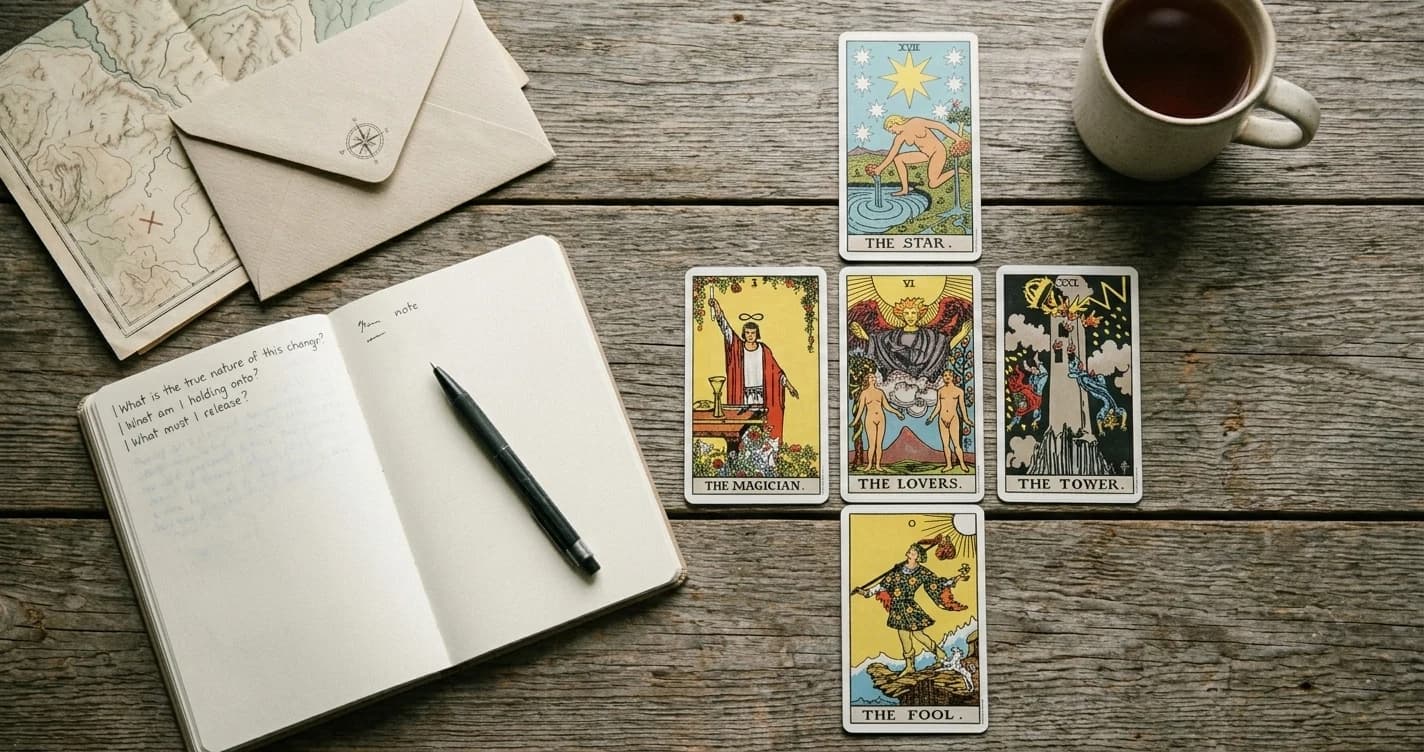
Some decisions do not get clearer just because you think about them longer. You make more lists. You open more tabs. You talk to three thoughtful friends and somehow end up with six new angles instead of one answer. Tarot for big decisions can be useful in exactly this kind of moment — not because the cards decide for you, but because they interrupt the mental loop and give your thinking a structure.
That structure matters when the choice in front of you is large enough to rearrange your life. A move to another city. Leaving a stable job. Staying in a relationship that no longer fits. Taking the offer. Turning it down. Saying yes to the path that feels alive, even if it also feels risky.
The problem is rarely a total lack of information. More often, you already know a lot and cannot tell what is signal, what is fear, and what is just noise. In this guide, we'll walk through a practical tarot decision making framework you can use before a major move, with questions that create clarity without pretending the cards can predict the future.
Why tarot helps when a decision feels bigger than logic alone
Logic matters. So do spreadsheets, practical conversations, financial planning, timelines, and plain common sense. Tarot is not here to replace any of that.
But large decisions often get stuck in the space where logic has already done its job and still has not resolved the feeling underneath. You can know the pros and cons of both paths and remain completely frozen. You can understand the external stakes while still avoiding the internal truth.
That is where tarot becomes useful. It gives you a structured way to ask questions that ordinary decision-making tools often leave out:
- What am I already clear on but not trusting?
- What fear is distorting the way I see these options?
- What part of this decision is really about identity, not logistics?
- What cost am I pretending doesn't count?
Imagine someone deciding whether to relocate for work. On paper, the move makes sense. Better pay. More room to grow. But every time they think about accepting, their body tightens. A tarot reading might reveal that the real tension is not the job at all. It is grief about leaving a familiar life, or fear that success will require becoming someone they no longer want to be.
Or picture someone deciding whether to stay in a long-term role that has become draining. Their question sounds practical: "Should I leave now or wait six more months?" But the cards keep pushing toward a different layer entirely: self-trust, exhaustion, permission. The useful shift is not prediction. It is accuracy.
If that sounds familiar, you may also relate to why logic isn't always enough when a decision has emotional, relational, or identity-level weight.
Try this before you pull any cards: write down the decision in one plain sentence. Then underneath it, finish this line: "What feels hardest about this is..." That second sentence is often the real reading.
How to use tarot for big decisions without treating it like a verdict machine
The biggest mistake people make with tarot for major life decisions is asking the cards to hand down a ruling. "Should I go or stay?" sounds clear, but it usually collapses too many layers into one dramatic question.
A better reading breaks the decision apart.
Instead of asking for a verdict, ask for perspective. You are not trying to outsource your agency. You are trying to understand the terrain well enough to choose with more honesty.
Here are the five questions worth asking before a major move:
1. What do I already know?
This question cuts through the fog. It identifies the truth you keep circling but haven't quite named.
Sometimes the answer is simple: you already know the current situation is no longer sustainable. Sometimes it is subtler: you already know both options come with loss, and your real task is choosing which loss you can live with.
2. What am I afraid of?
Fear deserves a dedicated place in the reading. Otherwise it sneaks into every position and disguises itself as wisdom.
3. What am I not seeing clearly?
This position is for blind spots, avoided costs, idealization, and missing context. It keeps the reading honest.
4. What does the yes path ask of me?
Not "What happens if I say yes?" but "What does saying yes require?" This question shifts the focus from fate to participation. Every path asks something of you.
5. What does the no path ask of me?
Declining a path is not neutral. It has a cost, a relief, a shape. This position helps you see the meaning of staying, postponing, or refusing — not just the meaning of action.
That is the core of a tarot decision making framework. It turns one emotionally overloaded question into five smaller, more usable ones.
Try this reframe: if your question begins with "Should I," rewrite it into these five prompts before you start. Your reading will almost always get clearer.
A simple spread for tarot before a major move
If you want a practical layout for tarot for big decisions, use a five-card spread with one card for each question above. This works especially well for choices involving relocation, work, relationships, or any other threshold moment.
- What I already know
- What I am afraid of
- What I am not seeing clearly
- What the yes path asks of me
- What the no path asks of me
This is close in spirit to the decision spread, which gives the question enough structure to keep you from drifting into abstraction.
Here is how it can play out in practice.
A person deciding whether to move abroad for a new role pulls the Six of Swords in position one. They already know they are in transition, even if they have been minimizing it. In the fear position they get the Five of Pentacles, which points less to literal disaster than to anxiety about instability and belonging. In the blind-spot position, the Two of Wands suggests that part of them is already oriented toward expansion. The yes path lands as Strength: courage, patience, emotional steadiness. The no path lands as Four of Pentacles: protection, control, maybe stagnation.
Notice what this does. It does not say, "Move abroad." It clarifies the emotional shape of both paths.
A second reader is deciding whether to end a relationship that has become quietly painful. Their cards might not answer the relationship question directly at all. Instead, they may highlight self-abandonment, uncertainty tolerance, and the difference between grief and wrongness. Again, the value is not fortune-telling. It is precision.
Try this spread note-taking method: after each card, write two lines only — "What this card reflects" and "What this card asks." Keeping your notes short prevents over-interpretation.
How to tell whether the reading is clarifying you or just feeding anxiety
Not every reading helps. Sometimes you are too activated, too outcome-hungry, or too deep in rumination to hear anything useful.
A clarifying reading usually leaves you with more grounded language, even if the decision is still hard. An anxiety-feeding reading tends to leave you frantic, more dependent on another pull, or obsessed with getting the cards to confirm the answer you want.
Here are a few signs the reading is helping:
- you can name the real conflict more clearly than before
- you feel less split between performance and honesty
- you can identify one concrete next step
- the cards widen perspective instead of narrowing into doom
And here are signs to pause:
- you keep re-pulling because you dislike the answer
- every card becomes a secret prediction about the future
- you are trying to remove all uncertainty before acting
- the reading makes you feel more helpless rather than more honest
This matters especially for readers who already tend to spiral. If that is you, tarot for overthinkers may be the more useful companion article, because the goal is movement, not infinite interpretation.
One grounded practice is to separate the reading from the decision itself. Do the reading first. Walk away. Let the notes sit for a few hours or overnight. Then return and ask, "What in this reading still feels true when I am calmer?"
Try this pause rule: if you feel compelled to do three readings in a row on the same decision, stop after the first and revisit your notes the next day instead.
What to do after the reading so the decision actually becomes clearer
A good reading should lead somewhere. Not necessarily to an immediate answer, but to a more honest next step.
That next step may be practical. Review your budget. Ask the question you've been avoiding. Visit the neighborhood before deciding. Write the resignation draft without sending it. Tarot is not separate from real-world action. It is supposed to support it.
It also helps to name what kind of decision this actually is. Some are about timing. Some are about grief. Some are about risk tolerance. Some are about identity catching up to a truth you've been postponing.
When you know which kind of decision you are inside, the reading becomes easier to use. You stop looking for permission from the cards and start using the cards to become more articulate with yourself.
For bigger life transitions, it can be useful to keep multiple readings in one ongoing thread rather than treating each one as a separate event. A single decision often unfolds over weeks. Your first reading may show fear. The second may show clarity. The third may show what you are ready to accept. Keeping those readings connected helps you notice the shift.
Try this closing exercise: finish the reading by writing one sentence that starts with, "Based on what feels true here, my next honest step is..." Not your final answer. Just your next honest step.
Conclusion
Tarot for big decisions works best when you stop asking the cards to decide your life and start using them to reveal the shape of the choice in front of you. The most useful reading will not erase uncertainty. It will help you separate what you know, what you fear, what you are missing, and what each path actually asks of you.
That is enough to move from spinning to discernment. If you're facing a major move, try a free reading on Liminal Tarot and use a structured spread to give the decision somewhere honest to land.