Tarot for Overthinkers: A Tool That Moves You Forward, Not Deeper Into Your Head
Tarot for overthinkers can interrupt rumination, structure reflection, and turn looping thoughts into grounded daily next steps. Try it free.
Aurora @ Liminal Tarot
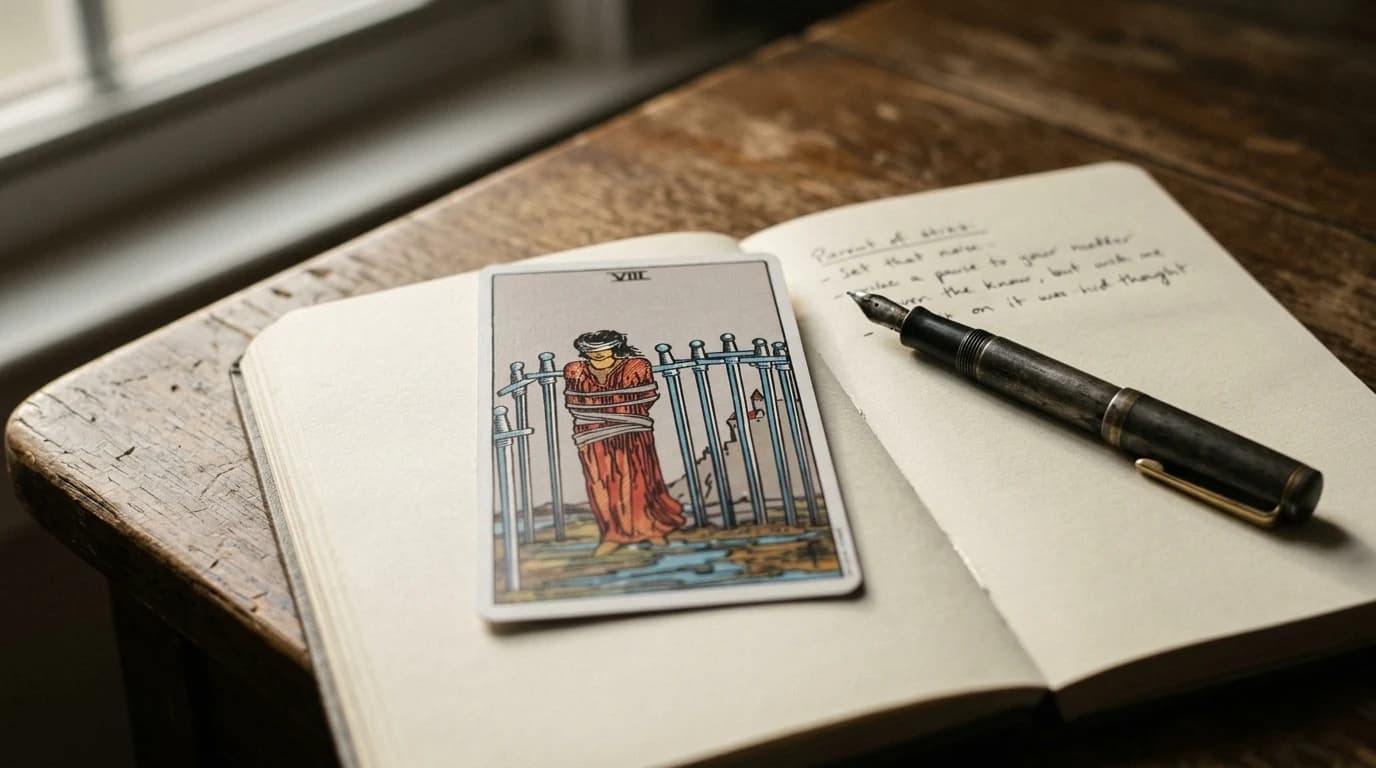
If you overthink, you probably already know the pattern. You review the conversation again. You make a cleaner spreadsheet. You read one more article. You ask smarter questions and somehow feel less clear.
That is exactly why tarot for overthinkers can be surprisingly useful.
Not because the cards solve uncertainty. Not because they predict what happens next. But because a tarot reading gives your mind a boundary: one question, one draw, one response. It interrupts the endless loop of “maybe, but also” and replaces it with a structure you can actually answer.
For a lot of thoughtful, skeptical people, that is the real value. Tarot becomes less of a mystical act and more of a circuit-breaker for rumination.
If you have ever felt stuck in your own head, this is how the practice can help without becoming one more thing to obsess over.
Why overthinking gets worse when reflection has no structure
Overthinking often disguises itself as responsibility.
It feels like you are being careful. Rational. Thorough. But in practice, what is usually happening is that your mind keeps reopening the same question without changing the conditions. You are not moving deeper into insight. You are moving in circles.
That is one reason blank-page journaling can be strangely hard for people who think a lot. Too much freedom means too many doors. You start writing, then immediately begin editing the thought, qualifying it, and trying to land on the perfect conclusion before you have even named what hurts.
Tarot changes that by giving reflection a frame. Instead of asking your mind to generate everything from scratch, you respond to a prompt outside yourself: a card image, a spread position, a specific question. That outside structure narrows the field just enough for something honest to surface.
For example, say you are spiralling after a vague message from your manager. A blank journal page may invite ten pages of scenario-building. A single card drawn with the question “What am I reacting to most strongly here?” gives you one focal point. If you pull the Nine of Swords, you are not obligated to treat it as prophecy. You can simply notice that your anxiety is outrunning the available facts.
That is useful. Grounded and immediate.
If you are coming at all of this with skepticism, Tarot for Skeptics is worth reading too, because the point here is not belief. It is structure.
Try this: when you catch yourself mentally reopening the same problem for the third time in a day, write one question only: “What am I assuming that I do not actually know?” Pull one card and respond in five sentences max.
Tarot for overthinkers works best when the question is narrow
One of the fastest ways to turn tarot into another overthinking device is to ask enormous, slippery questions.
Questions like “What is going to happen with my life?” or “Should I completely change everything?” are catnip for an anxious mind. They invite abstraction, projection, and the kind of interpretation that can go on forever.
The better approach is narrower and more honest.
Ask questions that help you identify the real pressure point:
- What part of this decision am I avoiding?
- What fear is making this situation feel bigger than it is?
- What am I trying to control right now?
- What would bring a little more steadiness this week?
These are strong questions for tarot self-reflection tool use because they pull you toward awareness rather than false certainty.
Imagine two readers facing the same situation: whether to leave a draining job.
The first asks, “Will quitting work out?” That can generate endless second-guessing because the question tries to force prediction.
The second asks, “What am I not admitting about my current situation?” That question is much more readable. If the card points toward exhaustion, fear, or self-betrayal, you have something to work with. Not an outcome. A truth.
This is also where overthinkers tend to misread tarot. They treat ambiguity as a sign that they need another card, then another, then another. Usually the issue is not that the reading is unclear. It is that the question was too wide.
If your brain tends to keep hunting for certainty, Tarot When Logic Isn't Enough speaks directly to that threshold moment where analysis stops helping.
Try this: before any reading, rewrite your question until it can be answered with reflection instead of prediction. If the question starts with “Will,” “When,” or “Am I supposed to,” narrow it until it starts with “What,” “Where,” or “How.”
The draw-respond-record sequence is what interrupts rumination
The most helpful tarot rhythm for overthinkers is simple: draw, respond, record.
Draw a card. Respond to it before explaining it away. Record what came up so you do not have to keep reprocessing the same moment from scratch.
That middle step matters.
A lot of people who struggle with rumination never really let themselves have a first response. They move straight to analysis. But your first reaction to a card often tells you something important: resistance, relief, defensiveness, recognition, irritation. Those reactions are information.
Suppose you draw the Four of Pentacles around a relationship question and instantly think, “I already know what this means.” Slow down. What did you feel before the interpretation arrived? Tightness? Embarrassment? A sense that you are protecting yourself too hard? That first reaction may be more revealing than a polished card meaning.
Then record it.
This is where tarot becomes helpful for tarot for rumination instead of becoming part of the problem. When you log the reading, you stop your mind from insisting that it must keep everything active. You have captured the thought. You can return to it later. The loop does not need to stay open.
Over time, that record also shows you which questions repeat, which cards appear when you are especially activated, and whether your interpretations shift once the emotional charge settles. That is often where the real insight lives.
Tarot can complement professional mental health support, but it is not a replacement for it.
Try this: use a three-line log after your next pull: 1) the question, 2) your first reaction, 3) one grounded next step. Keep it shorter than your impulse wants.
How to keep tarot from becoming another overthinking habit
Tarot for overthinkers helps most when it contains your thinking, not when it gives it a new playground.
That means you need boundaries.
A healthy practice for overthinkers is often smaller than expected: one card, one question, one reflection, then stop. Maybe you revisit the reading tomorrow. Maybe you do not. What matters is that the reading closes rather than multiplies.
There are a few signs you have slipped from reflection into compulsion:
- you keep re-pulling because you dislike the first answer
- you ask the same question in slightly different wording
- you start treating every ambiguous card as a warning
- you cannot end the session without “resolving” the feeling
That last one is especially important. Tarot is not always meant to resolve the feeling immediately. Sometimes it names the tension accurately enough that you can carry it more honestly.
In practice, this is what many readers eventually learn: clarity is not always the same thing as certainty. Often it is just knowing what the real question is.
That is why the best tarot habit for an overactive mind is a contained one. A daily pull. A short spread with a clear intention. A note that lets the rest of the day continue.
Liminal Tarot’s daily card pull works well for this because it gives you a low-friction ritual without forcing a huge interpretive session. And if one situation keeps returning, you can group readings around that thread instead of mentally starting over every time.
Try this: set one rule for the next week: no clarifier cards unless you cannot paraphrase the first card’s relevance in one sentence. Most of the time, the sentence will tell you enough.
What overthinkers are usually looking for is permission to trust what they already know
This is the quiet part people do not always say out loud.
A lot of overthinking is not a lack of intelligence. It is a lack of permission. You already sense that the job is draining you, that the relationship is uneven, that the decision you keep postponing will not become easier through more analysis alone. But acting on what you know feels risky, so your mind keeps trying to produce a more airtight case.
Tarot can help because it moves the question sideways. Instead of demanding proof, it invites recognition.
You look at a card and think, annoyingly, yes. That is the texture of this. That is what I have been circling.
Not because the card knows your future better than you do. Because the structure helped you say something true without litigating it for another six hours.
That is the best use of tarot and anxiety together: not to eliminate uncertainty, but to interrupt the habits that make uncertainty impossible to bear.
If you tend to live in your head, tarot does not need to become another system to master. It can be smaller than that. One honest question. One bounded reflection. One record of what came up.
And sometimes that is enough to move you forward.
Pull today's daily card on Liminal Tarot — it's free, no account needed.