Tarot for People Who Don't Believe in It
Tarot for skeptics can still be useful as structured reflection, not belief. Learn a grounded way to try it with a single card. Try it free.
Aurora @ Liminal Tarot
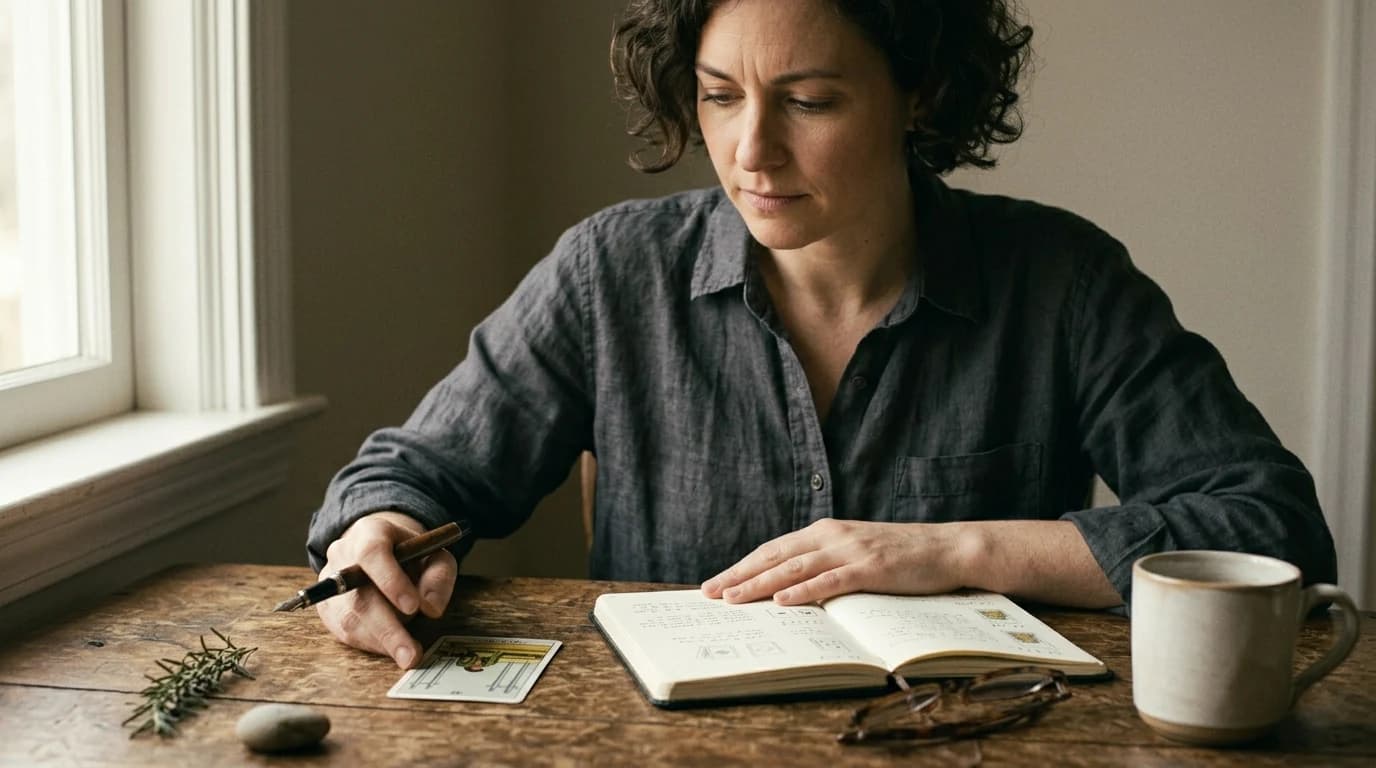
Maybe you've rolled your eyes at tarot before. Maybe you still do. But then life gets messy in a way logic alone doesn't quite solve, and suddenly you're curious about tools you once dismissed. That's usually where tarot for skeptics starts: not with belief, but with the uncomfortable sense that spreadsheets, pros-and-cons lists, and long walks with your own thoughts are somehow still not getting to the heart of it.
This article is for that exact moment. Not for people looking to be convinced that cards are magical. Not for people who want certainty dressed up as destiny. Just for people who are willing to ask a better question: can tarot be useful even if I don't believe in it?
I think the answer is yes — but not because the cards predict anything. The value is that tarot gives you a structure for reflection. It interrupts your usual thinking, hands you a symbolic prompt, and helps you notice what your mind is already circling. Used that way, tarot becomes less like a supernatural system and more like a strange, surprisingly effective mirror.
You do not need belief to get value from tarot
Most tarot content quietly assumes you already buy into the worldview behind it. That's one reason skeptical people bounce off it so fast. The language can feel inflated. The claims can feel impossible to verify. And if you're already wary of magical thinking, being told to "trust the universe" is not exactly persuasive.
But belief is not the only way to approach a tool.
You do not need to believe a poem was sent by fate to be moved by it. You do not need to believe a dream predicts the future to find meaning in how it reflects your fears. And you do not need to believe a tarot card is objectively "true" to notice that it prompts a useful reaction in you.
That reaction is often the point.
If you pull a card about rest and immediately think, "No, that's not relevant at all," that response still tells you something. Sometimes resistance is information. Sometimes relief is information. Sometimes the speed with which you interpret an image reveals what you were already carrying before the card hit the table.
A practical way to frame the experience
Try this the next time you feel skeptical but curious:
- Pull one card.
- Describe it literally before interpreting it.
- Ask, "What part of my situation does this make me think about first?"
- Write three sentences without trying to sound spiritual.
That last part matters. You do not need special language. You can write, "This card makes me think I'm more tired than I've admitted," and be done. That's already a valid use of tarot.
A simple one-card spread is especially good for this because it keeps the exercise small. You are not building a cosmology. You are creating a moment of structured attention.
Tarot works best when you treat it as structured self-inquiry
The strongest secular case for tarot is not that the cards know something you don't. It's that they help you access parts of your own thinking that ordinary analysis often misses.
When you're stuck, your mind tends to loop inside familiar grooves. You rehearse the same arguments. You ask the same people the same questions. You keep trying to force clarity through repetition, which usually just deepens the rut.
Tarot interrupts that loop.
A card introduces imagery, tension, mood, and metaphor. That matters because human beings do not think in logic alone. We think in stories, symbols, memories, associations, and felt sense. Even highly rational people do this; they just may not like admitting it. Tarot gives that non-linear layer somewhere to land.
That is why it can function as a journaling tool rather than a belief system. The card becomes a prompt. Your interpretation becomes the meaningful part.
Use this reflection exercise when you're overthinking
When you catch yourself spiraling, try this five-minute practice:
Card prompt: Pull a single card and ask, "What am I not seeing clearly right now?"
Then journal in four lines:
- What is the most obvious interpretation?
- What emotion comes up when I look at this card?
- What part of my situation does this image resemble?
- What would I do next if I treated this as advice from my wiser self, not from fate?
That final question is useful because it removes the pressure to "believe." You are not obeying a mystical command. You are testing whether the prompt helps you see your own situation more honestly.
If you want a more grounded primer on what tarot is actually doing in practice, start with what tarot is. The answer is far more practical than most people expect.
Why skeptics often get more from tarot than they expect
There is a funny paradox here: people who don't fully believe in tarot are often less likely to misuse it.
They are less likely to ask the cards to replace judgment. Less likely to treat every pull like a cosmic decree. Less likely to confuse symbolism with certainty. That skepticism, when it stays flexible rather than dismissive, can actually create a healthier relationship with the practice.
Instead of asking, "What will happen?" skeptical readers tend to ask better questions:
- What am I avoiding?
- What pattern am I repeating?
- What does this situation feel like beneath the story I'm telling about it?
- What would change if I stopped pretending I don't already know part of the answer?
Those are excellent tarot questions.
And they tend to produce better reflections because they keep agency where it belongs: with you.
A useful rule for secular tarot practice
Use tarot to generate perspective, not to outsource decisions.
That distinction keeps the practice grounded. A card can help you articulate what feels off in a relationship, but it should not become the sole authority on whether to end it. A reading can help you notice burnout at work, but it should not replace practical planning, evidence, or conversation.
A good tarot session makes you more reflective, not more passive.
What to do if the whole thing still feels silly
Good. Seriously.
A little embarrassment is often part of trying anything outside your usual identity. If you're used to being the analytical one, the competent one, the one who trusts systems and evidence, tarot may feel uncomfortably soft-edged at first.
That does not mean it has no value. It may just mean it doesn't flatter the part of you that prefers to stay in control.
You do not need to become "a tarot person" to experiment with tarot. You can stay skeptical. You can stay uncertain. You can even stay mildly unconvinced and still notice that the practice helps you pause, name things, and reflect with more honesty than your normal inner monologue allows.
That is enough.
Try this low-stakes experiment for one week
For seven days, pull one card each morning and answer only two questions:
- What might this card be asking me to pay attention to today?
- By the end of the day, did that question turn out to be useful?
Do not ask whether the card was "accurate." Ask whether it sharpened your attention.
That subtle shift is everything.
You are not testing the universe. You are testing a reflective practice.
A simple daily rhythm works especially well here because it lowers the stakes. You are not waiting for a dramatic life crisis to justify the cards. You are using them as a regular check-in — one symbolic prompt, one honest response, one small moment of perspective.
The real question is not whether tarot is real
For most skeptical adults, that debate becomes a dead end pretty quickly.
The more interesting question is whether tarot helps you think, feel, and reflect in a way that your usual methods do not. Does it help you notice your patterns? Does it make it easier to put language around a conflict? Does it reveal where you are split between what you say and what you know?
If yes, then the practice has done something useful.
Not magical. Useful.
And usefulness is a perfectly respectable standard.
That is the frame we come back to again and again at Liminal Tarot: the cards are not there to dominate your judgment. They are there to provoke reflection. Sometimes a single image is enough to shift the angle of your thinking just enough that you can finally hear yourself.
If you're curious but unconvinced, that's actually a fine place to begin. Start small. Pull one card. Treat it as a prompt, not a prophecy. See what your own mind does with it.
If you want a low-pressure way to try that, use Liminal Tarot's daily pull and begin with one card at a time — no spiritual buy-in required.