What Tarot Looks Like After Six Months of Practice
Tarot long term practice changes how you reflect, notice patterns, and handle uncertainty. See what six months of steady reading can reveal.
Aurora @ Liminal Tarot
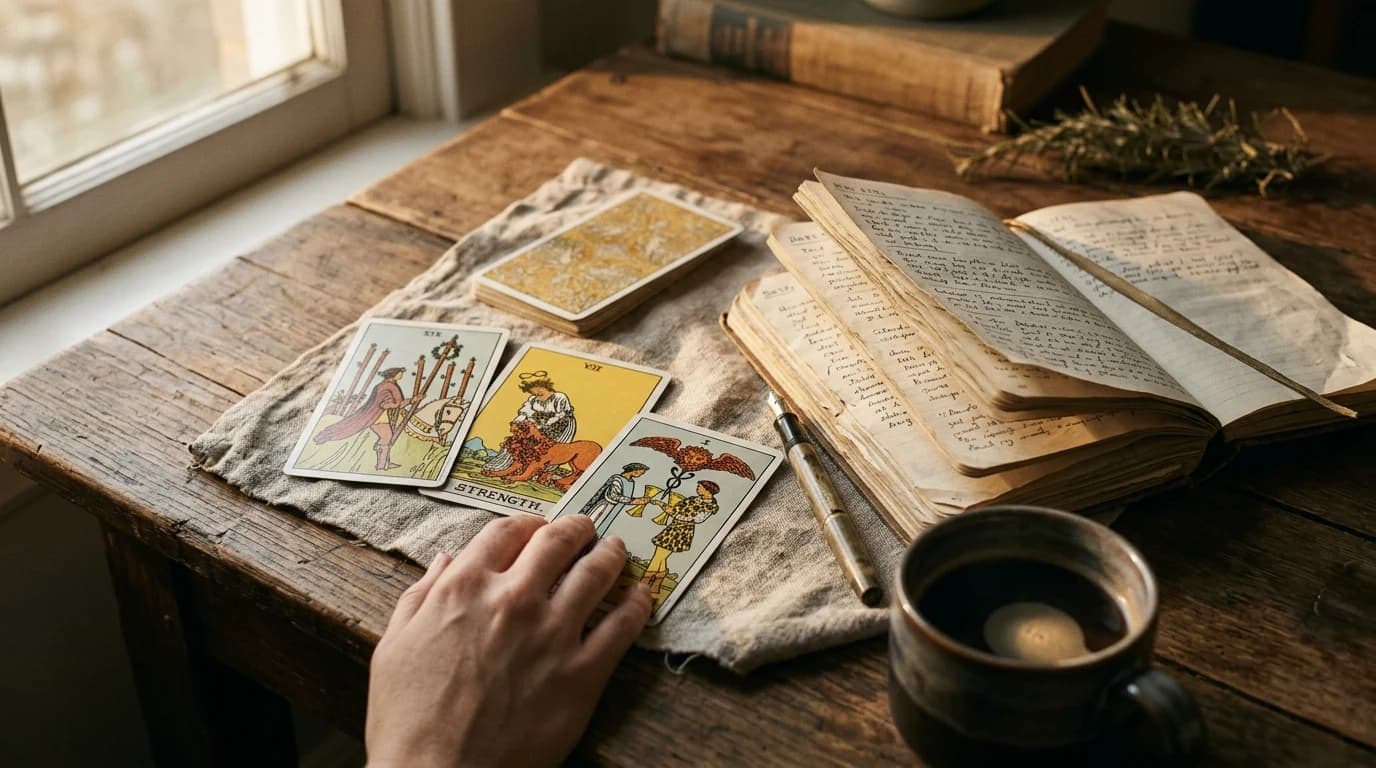
Most people imagine tarot practice in dramatic terms at first. They think the change will look like faster intuition, more accurate readings, or a sudden ability to “understand” every card on sight.
Sometimes skill does sharpen that way. But the deeper change in a tarot long term practice is usually quieter. You become less interested in getting the perfect interpretation and more interested in noticing what keeps returning. You stop asking the cards to hand you certainty and start using them to track the shape of your own thinking.
That is what six months of practice can give you. Not mystical mastery. Not a fixed system that answers everything. Something more useful than that: context. You begin to see which cards recur during stress, which questions you ask when you are avoiding something, and how your relationship to uncertainty shifts when you have a reflective structure to return to.
If you have only ever experienced tarot as isolated readings, this can be hard to imagine. So here is a grounded look at what often changes after six months of consistent use, and why the value of practice compounds over time.
You stop treating each reading like a final verdict
Early on, it is common to load a lot of pressure onto one spread. You pull cards about a relationship, a job, or a difficult decision and instinctively want the reading to settle the matter. When you are new, every draw can feel high stakes.
After a while, something softens. In a real tarot long term practice, one reading becomes a snapshot rather than a verdict. You start to understand that today's spread shows how the situation looks from today's emotional weather, not from some all-knowing vantage point.
That shift matters. It creates breathing room. Instead of asking, “What is the answer?” you begin asking, “What is becoming visible here?” That is a more reflective question, and it usually produces better thinking.
Imagine someone who keeps drawing on a strained friendship every few weeks. In month one, each reading feels loaded: Is this friendship ending? Am I being too sensitive? By month six, the same person may notice that the cards are not really giving a single outcome. They are showing a recurring pattern: over-functioning, unspoken resentment, and a reluctance to name disappointment directly. The change is not that the cards suddenly became clearer. The change is that the reader stopped demanding a verdict and started observing a pattern.
This is one of the biggest signs of tarot practice progress. You stop trying to force closure out of a reflective tool.
Try this prompt: Look back at your last three readings on the same topic and ask, “What stayed the same across all three?” Start there before interpreting any one reading in isolation.
You start recognizing your recurring cards and themes
One reading can feel meaningful. Repetition is what makes a practice illuminating.
When you have been reading for several months, certain cards often begin to feel familiar in a new way. Not because you have memorized textbook definitions, but because you have seen how they tend to appear in your own life. Maybe the Hermit shows up whenever you are withdrawing before a decision. Maybe the Seven of Cups arrives when you are flooded with possibilities and secretly hoping someone else will choose for you. Maybe Strength keeps surfacing not during obvious victories, but during periods when you are holding a difficult line quietly.
This is where tarot after months starts to feel different from beginner tarot. The cards are no longer abstract symbols alone. They become part of a lived archive.
That does not mean every recurring card has one permanent personal meaning. It means repetition gives you texture. You have examples. You remember what was happening the last two times this card appeared. You can ask better questions because you have history with the symbol.
This is also why record-keeping matters so much. Without notes, you are relying on memory, and memory is selective. With a log, you can actually confirm whether a card has been recurring or whether it just feels that way because one reading hit hard.
Liminal Tarot's piece on tarot as a pattern-recognition tool goes deeper into why this matters. The short version is simple: patterns do not become visible because you are more mystical. They become visible because you have enough material to compare.
Try this prompt: Pick one card that has shown up at least three times. Write down the date, context, and emotional tone of each appearance. Then ask, “What does this card tend to illuminate for me specifically?”
Your relationship to uncertainty becomes less frantic
This is probably the most meaningful change, and it is easy to miss because it does not look flashy from the outside.
A mature tarot long term practice often changes not what you know, but how you stay with what you do not know yet. You become less frantic in the gap between question and answer. Less likely to spiral after one difficult draw. Less dependent on pulling again and again until you get something soothing.
That does not happen because tarot gives certainty. It happens because practice builds tolerance. Over time, you learn that not every unclear reading means something is wrong. Sometimes it means the situation is still unfolding. Sometimes it means the useful question has not been asked yet. Sometimes it means you are too activated to interpret fairly today.
A practical example: in month one, someone doing readings about work may ask the same question five different ways across a single weekend because they are desperate to resolve the anxiety. In month six, that same person may still feel the anxiety, but they are more likely to pull once, journal honestly, and let the reading sit for a day or two. That is not passivity. It is a different relationship to uncertainty.
If that sounds small, it is not. For many people, this is the real value of building tarot practice over time. The cards become less of an emergency hotline and more of a steady reflective container.
Try this prompt: After your next reading, do not interpret immediately. Write only: “What feels uncertain right now, and what can remain unanswered for 48 hours?” Notice what happens when you let the reading breathe.
You begin to see that the real subject of the reading is often you
One of the humbling things about six months of practice is realizing how often your readings circle back to the same inner material, even when the outer situations change.
At first, it may seem like you are reading about a job, then a family tension, then a romantic disappointment, then a creative block. But after enough time, deeper through-lines emerge. Maybe the real recurring subject is trust. Or self-abandonment. Or overextension. Or the habit of confusing clarity with permission.
This is where a single reading and a real practice part ways. A standalone reading can describe a moment well. A longer arc can show you the question beneath the question.
That is why single readings and ongoing practice are not the same thing. One gives you a reflection. The other gives you perspective on your own patterning.
Consider someone who keeps using tarot for very different surface-level issues: whether to rest, whether to leave a situation, whether to have a hard conversation. Six months in, they may notice the same tension underneath nearly all of them: fear of disappointing others. Once that pattern becomes visible, the readings stop feeling random. They become coherent.
This can feel confronting, but in a good way. It is easier to work with a recurring pattern once you can finally name it.
Try this prompt: Review five recent readings and complete this sentence: “Even though these readings were about different things, they may all be touching the same underlying issue, which is...”
Your journal becomes evidence of change, not just a storage place
A lot of people imagine tarot notes as a habit of record-keeping. Helpful, maybe, but secondary. After six months, many discover the journal is not just where the readings go. It is where the practice starts proving its value.
This is one of the clearest signs your tarot practice progress is becoming tangible. You can see how a hard period felt from the inside while you were still in it. You can see what you thought was the central problem then, and what later turned out to matter more. You can see where you were perceptive, where you were reactive, and where the cards kept inviting you toward something you were not ready to hear yet.
That kind of record is hard to create from memory alone. It requires time-stamped reflection. It requires enough consistency for the archive to mean something.
And perhaps most importantly, it lets you witness resolution. Not every reading resolves cleanly, of course. But over six months, some situations do move. A painful chapter shifts. A stuck question untangles. A fear that dominated several readings either softens or clarifies. Looking back, you are not just reading cards. You are reading the evolution of your own thinking.
This is especially powerful when readings are grouped by life context rather than left as isolated entries. A chapter on burnout, heartbreak, relocation, or creative uncertainty becomes easier to follow when the material is held together over time. You are no longer hunting through scattered notes trying to remember what came first.
Try this prompt: Revisit a reading from three months ago that felt intense at the time. Then answer: “What did I understand correctly? What did I misunderstand? What has changed since then?”
Six months in, the practice usually feels simpler, not more elaborate
This surprises people. You might expect a longer tarot practice to become more complex over time, full of denser spreads and more advanced techniques. Sometimes that happens. But more often, the opposite is true.
People with a steady tarot long term practice often become simpler readers. They ask cleaner questions. They stop over-pulling. They know when one card is enough. They trust a pause. They understand that not every reading needs to be profound to be useful.
That simplicity is not lack of depth. It is a sign that the practice is becoming integrated.
You no longer need tarot to perform importance for you. You know what it is for. It is there to help you notice, reflect, record, and revisit. It is there to help you think in a more honest way when life is noisy. It is there to give shape to an ongoing conversation with yourself.
And after six months, that conversation usually feels less theatrical and more real.
That may be the most encouraging vision for anyone at the beginning. The point is not to become impressive. The point is to become more aware of how you move through uncertainty, repetition, desire, fear, and change.
If you have been reading consistently, even in a small way, that shift may already be underway.
If you want to make the most of what a practice reveals over time, keep your readings somewhere you can actually revisit by theme, question, or life chapter. Liminal Tarot is built for that long-arc kind of reflection, so you can track recurring cards, revisit old questions, and see how a season of your life looked while you were living it.