Tarot as a Pattern-Recognition Tool: The Case for Keeping Records
Learn how tarot patterns over time reveal habits, fears, and turning points you cannot see in one reading alone. Start noticing the pattern.
Aurora @ Liminal Tarot
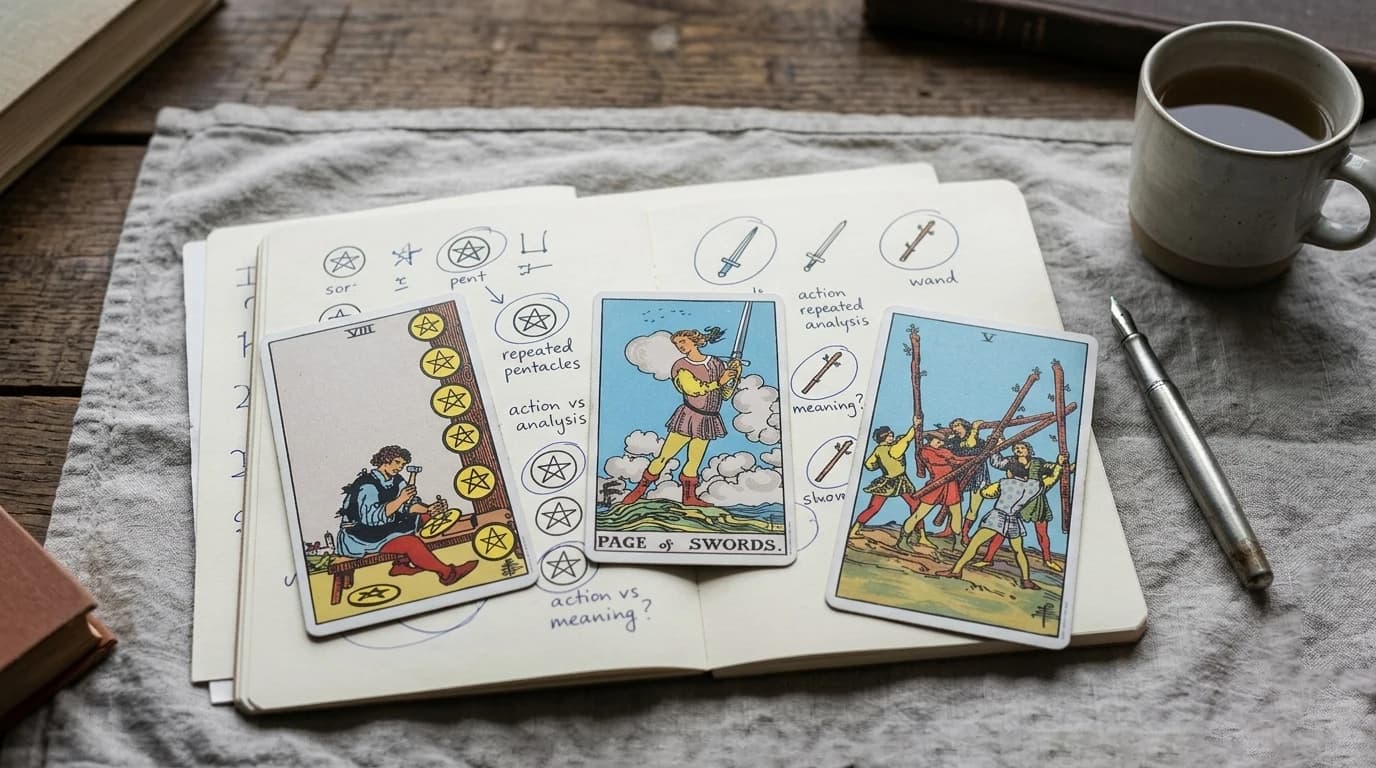
A lot of people have one memorable tarot reading and assume the insight lives in that single spread. Sometimes it does. But the deeper value usually appears later, when you start noticing tarot patterns over time instead of treating each draw like a separate event.
A lone reading can name what feels true today. A record of readings can show what keeps returning, what changes when your mood changes, which questions you avoid, and where your thinking has quietly evolved.
This is the real case for keeping records. Because if tarot works for you as a mirror, then a mirror you glance at once will only ever show the surface. In this guide, we will look at what patterns to track, why a reading history is often more useful than one “accurate” reading, and how to keep simple records without turning your practice into admin.
Why one tarot reading rarely tells the whole story
A single reading is a snapshot.
That can still be useful. If you are in the middle of a conflict, a breakup, burnout, or a career decision, one spread can surface the pressure point you have been circling without naming. But snapshots are limited. They capture a moment, not a pattern.
That is why people sometimes over-attach to one dramatic pull. They draw The Tower once and assume everything is collapsing. They draw the Two of Swords and conclude they are hopelessly stuck. Patterns are what help you separate momentary intensity from something more durable.
For example, imagine two scenarios:
A reader pulls the Eight of Swords once during a stressful week and then never sees it again. That may simply reflect a temporary sense of pressure.
Another reader keeps pulling the Eight of Swords across three different spreads over two months, each time around questions involving work, visibility, or asking for help. That is not just a card appearing. That is a structure showing itself.
The second situation is where tarot becomes far more intellectually honest and practically useful. You are no longer asking, “What does this card mean?” You are asking, “What pattern keeps reasserting itself in my life, and what does that say about how I am meeting this situation?”
Try this: after your next reading, write one sentence answering this question: “What feels specific to today, and what feels like part of a longer pattern?” That distinction is where record-keeping starts to matter.
What to track if you want to see tarot patterns over time
You do not need a complicated spreadsheet to notice meaningful repetition.
What you do need is consistency. If you want to see tarot patterns over time, track the same few things often enough that comparisons become possible.
Start with the parts that actually recur
The most useful pieces to record are usually:
- the question or intention
- the spread used
- the cards drawn
- your immediate interpretation
- what was happening in your life at the time
- what changed afterward
That last point is the one people skip most often.
Without follow-up, you only have interpretation. With follow-up, you start building tarot reading history. You can look back and see whether a reading caught a real turning point, reflected your emotional state, or highlighted a pattern you only recognized in hindsight.
You also begin to notice something subtler: not just repeating cards, but repeating conditions. Maybe you draw a lot of Swords when you are over-researching. Maybe Major Arcana cluster around periods when your identity is shifting. Maybe the same spread becomes muddy whenever you ask it to make the decision for you.
If you are still getting grounded in the basics, it helps to pair this article with What Is Tarot, Really?, because pattern-recognition only becomes meaningful when you are clear about what kind of tool tarot is in the first place.
Try this: for the next five readings, record the same five fields every time: question, cards, first impression, emotional state, and one follow-up note a week later. Keep it small enough that you will actually do it.
Repeating tarot cards are not the only pattern worth noticing
When people decide to track tarot readings, they often focus almost entirely on repeating cards.
That is understandable. Repetition is easy to spot. If the Hermit keeps turning up, you notice. If the Five of Pentacles appears in every work reading, it gets your attention. Repeating tarot cards can absolutely matter.
But they are only one layer.
Sometimes the more revealing pattern is in the suit balance, the kinds of questions you ask, the spread you reach for under stress, or the interpretations you default to. You may notice that whenever you are anxious, you read every ambiguous card as a warning. You may realize you keep asking slightly different versions of the same question because you do not like the answer you are already living with.
That is why the phrase repeating tarot cards can be useful but incomplete. You are not just tracking symbols. You are tracking your own interpretive habits.
Here is another concrete example. Someone doing readings about dating keeps drawing Cups and immediately treating that as encouragement. But when they review six months of notes, they notice the same pattern: the cards often suggested emotional openness, while their own follow-up notes repeatedly mention boundary confusion and avoidance of direct conversations. The real pattern was not “lots of Cups.” It was a mismatch between emotional hope and practical behaviour.
Our guide to Tarot Journaling Explained pairs well with this, because the point of a journal is not to produce beautiful entries. It is to make future pattern recognition possible.
Try this: review your last three readings and ignore the card meanings at first. Instead ask: “What kind of questions was I asking? What tone was I in? What was I hoping the cards would let me avoid?” You may find the pattern before you find the message.
Why keeping records makes tarot more grounded, not less intuitive
Some people resist record-keeping because they think it will make tarot feel clinical.
In practice, it usually does the opposite.
When you keep records, you stop demanding that each reading deliver a perfect answer on the spot. That lowers the pressure. It lets the reading be exploratory rather than performative. It also gives your intuition something real to work with.
Intuition is not only about first impressions. It is also about pattern memory. You notice that a card feels different in one context than another because you have seen it in multiple contexts. You trust your sense of a spread because you can compare it against your own reading history rather than relying on vague recall.
This is where tarot starts functioning less like a one-off oracle and more like a reflective practice. One reading says, “Here is what seems alive right now.” A body of records says, “Here is how this chapter has been unfolding, and here is how you have been relating to it.”
Try this: the next time a reading feels inconclusive, resist the urge to redo it immediately. Save it, date it, and return in two weeks. Ask, “What became clearer after time passed?” That is often where the reading becomes readable.
A simple way to build a tarot record you will actually keep
The best tracking system is not the most elaborate one. It is the one that survives your real life.
If you want to track tarot readings without creating friction, think in layers.
Start with a quick log: date, question, spread, cards, one-sentence takeaway.
Then add optional reflection only when it feels useful: emotional state, recurring themes, what action you took, what changed later.
If you read often around one ongoing situation, group those readings under the same life thread rather than scattering them as unrelated notes. That is where pattern-recognition gets much stronger. You stop seeing isolated entries and start seeing the shape of a chapter.
A good record should help you answer questions like:
- What cards or suits recur around this topic?
- What assumptions keep showing up in my interpretations?
- What has actually changed since the first reading?
- Am I asking new questions, or recycling the old one?
Notice that none of those are fortune-telling questions. They are reflective questions. That is the point.
Try this: create a running note titled after one active area of life, such as “career transition” or “relationship uncertainty.” Put every reading about that situation in one place for a month. At the end, reread the entries in order and summarize the pattern in five lines.
A single reading can be striking. A sequence of readings can be instructive.
That is why keeping records matters. Not because more notes automatically make you wiser, but because a reading history gives you something a one-off spread cannot: context. And in tarot, context is often where the real insight lives.
If you want your practice to become more than isolated pulls, start recording enough to notice your own tarot patterns over time. That is when the cards stop being random moments and start becoming part of an honest conversation with your life.