What to Do When Your Tarot Question Changes Mid-Reading
If your tarot question changes halfway through a reading, keep the original cards tied to their first frame. A practical way to decide whether to continue, pause, or start a separate follow-up.
Aurora @ Liminal Tarot
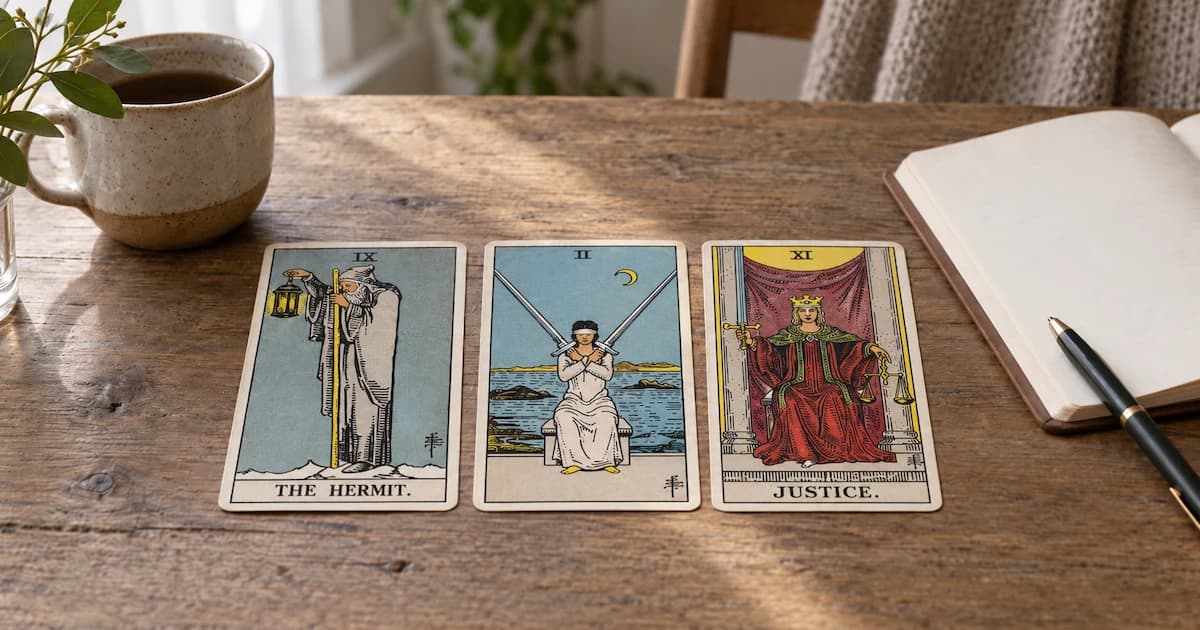
You can be two cards into a spread when the question changes.
You started by asking what you were not seeing about a job offer. Then you notice the job itself is not what has you stuck. It is the move that comes with it.
That realization belongs in the reading. What does not belong is quietly turning the cards already drawn for the job question into cards about relocation.
A tarot question gives the spread a frame. It tells you what the cards and their positions are being asked to help you examine. When that frame changes after the draw has started, the cleanest practice is to let the new realization change what happens next without pretending it changed what happened before.
The method below is a reading discipline, not a universal tarot rule. Its purpose is simple: keep the reading interpretable while making room for the fact that your real concern can become clearer halfway through.
Start by keeping the original question visible
Before you decide whether to keep going, write down the question as it stood when the reading began.
Keep the wording even if it now feels imperfect. That sentence records the frame under which the cards were selected and the spread positions were understood.
For example:
Original question: What am I not seeing about whether to accept this role?
What changed: I realized the relocation is the part I am actually resisting.
The second sentence may be the more important realization. It still does not make the first sentence disappear.
Without both in view, hindsight can make the reading feel neater than it was. It becomes easy to remember the cards as though they had been drawn for relocation all along. Preserving the original wording keeps the chronology honest.
The question can change. The earlier cards do not need to change jobs with it.
Work out what actually changed
Not every change in wording creates a new reading. The useful distinction is whether the spread is still being asked to do essentially the same work.
A wording refinement keeps the same subject and interpretive job. “What should I know about this new role?” might become “What deserves my attention before I decide whether to take this role?” The second is more precise, but the decision and the basic frame are still the same. You can usually continue, while noting that the clearer wording is what you realized you meant.
A shift of emphasis goes a little further without necessarily replacing the question. You may begin with “What is making this career decision difficult?” and realize that most of the difficulty is about what you would be giving up. Loss and tradeoff can become more visible in the interpretation because they still sit inside the original question. The cards were drawn for the difficulty around the decision, not for a new reading called “What will I lose?”
A materially different question changes the subject, decision, person, time horizon, or reflective task enough that the current draw no longer has a stable relationship to it. “What am I not seeing about accepting this job?” becoming “Do I want to move cities at all?” is connected, but it gives the reading a different job. So does “What do I need to understand before this conversation?” becoming “What boundary do I want to set if it goes badly?”
That is the point to separate the questions rather than make the existing spread carry both.
A useful test is:
Can I still explain what every card is doing against the question I actually asked before drawing?
If yes, the new realization may be context or emphasis. If no, the frame has probably moved far enough that you need to pause or close the first reading.
Continue, pause, or close the reading
Once the original and new questions are both visible, there are three clean ways forward.
Continue when the original frame still works. The subject is still the same, the spread positions still make sense, and the new realization clarifies or narrows the concern rather than replacing it. You might note, “Halfway through, I realized I am mostly worried about what I would lose by taking the role,” then keep reading the cards against the original career-decision question.
Pause when you can no longer tell which question you are interpreting. Earlier cards keep changing meaning as you move between the two questions. A spread position that was clear under the original frame no longer has a defined job. You find yourself keeping the interpretations that fit the new realization and dropping the ones that do not. At that point, more interpretation can make the reading less clear rather than more.
Close the reading when the new question has replaced the first one. If the original spread still forms a coherent reflection on the first question, you can finish it briefly. If continuing would require pretending the old cards belong to the new question, leave it incomplete.
An incomplete reading is not necessarily a failed one. Sometimes the useful result is that the question itself changed. You began by asking how to make a collaboration work and realized you were no longer sure you wanted to continue it. Forcing the remaining cards to solve the old premise would hide the most important thing that happened.
Why the old cards stay with the old question
There is nothing physically stopping you from looking at the same cards through a second question. The problem is that you have already seen them.
Once the symbols, tensions, and associations are on the table, it becomes very easy to find a new use for them. Two cards that looked like risk and hesitation under a job question can suddenly look like an obvious comment on relocation. That second interpretation is not automatically false. The method simply has no clean way to distinguish between the cards illuminating the new question and you reshaping material you already know is available.
A stable frame gives the reading a boundary.
Spread positions make that boundary even more important. A card drawn for “What complicates this job decision?” cannot quietly become a card for “What sits underneath my fear of moving?” Those are different interpretive jobs, even if both questions belong to the same life situation.
This is also why a clarifier card should not be used to smuggle in a different question. A clarifier can have a defined job inside the original reading. If the new concern needs a new job, name it as a follow-up instead.
A second reading is a follow-up, not a correction
When the new question is materially different, a separate reading can be useful. It is not the “real” reading that fixes the first one.
The first reading may have helped you notice what you actually wanted to examine. That gives it value even if you stop early. A follow-up becomes useful when the new question is distinct, clear enough to give a new spread a stable job, and worth separating from the frame you started with.
You also do not have to draw again immediately. Writing down the new question may be enough for now. Waiting can make the distinction clearer, especially when the first reading changed how you understand the situation.
This is different from repeatedly returning to an unchanged question because the last reading felt unsatisfying. If the issue is that the same question keeps coming back across separate readings, use a different discipline: compare what changed around the question before drawing again.
The point is not to impose a waiting period or a fixed number of readings. It is to give each draw a defined job.
A few edge cases
Some versions of question drift happen quickly or blur the boundary between clarification and replacement.
- Only one card has been drawn. The amount of material is smaller, but the principle is the same. Interpret that card under the original question, leave it unresolved, or mark the first draw as closed before beginning a separate question.
- The first question was vague. “What do I need to know right now?” naturally has room to become more specific. Ask whether the new concern still fits inside the job the original question gave the reading. If it does, you may be seeing question discovery rather than question replacement.
- The premise falls away. “How can I make this project succeed?” can become “I am not sure I want to keep doing this project.” Once the assumed goal is no longer settled, do not force the spread to solve it. Record what changed and decide later whether the new question deserves its own reading.
- The time horizon changes. “What should I consider this week?” and “What am I working through over the next six months?” may concern the same topic, but they ask the reading to work at different scales. A meaningful horizon change usually deserves a new frame.
- The question shifts toward another person's private motives. A reading can move from “What do I want to do here?” toward “What are they secretly thinking?” Keep the follow-up grounded in what you can observe, choose, or reflect on rather than treating tarot as access to another person's internal state.
The common thread is not how many cards are on the table. It is whether you are reassigning cards after the question that selected them has changed.
Keep the change in the record
Question drift becomes much easier to work with when you preserve it instead of cleaning it up after the fact.
A simple note can be enough:
Original question: What am I not seeing about accepting this role?
What changed: I realized the relocation is what I am actually resisting.
Possible follow-up: What matters to me about staying versus moving?
That record shows where the reading began and where your attention moved. If you want a broader structure for keeping questions, cards, and later reflections together, a simple tarot journal gives you enough context to compare without turning every reading into an essay.
This is also where reading history and notes become more useful than a cleaned-up final interpretation. Keep the original intention attached to the draw. Use a note to record what changed. If the new question later gets its own reading, let that reading keep its own frame.
Over time, the way a question changes can be as informative as the cards themselves. You can see what you thought you were asking, what became more specific, which assumptions fell away, and which concerns eventually needed their own space.
The rule to keep
When your tarot question changes mid-reading, you do not need to ignore the realization. You also do not need to make the existing cards answer it retroactively.
Keep the original question attached to the draw. Name what changed. Continue while the first frame still holds. Pause or close when it does not. If the new question is genuinely different, let it become a separate follow-up when it is clear enough to deserve one.
Let the realization change what happens next without rewriting what the earlier cards were asked to do.