What Gets Lost When You Skip the Shuffle
Explore tarot shuffle meaning and why the ritual before a reading matters more than it seems. Build a more intentional practice with your deck.
Aurora @ Liminal Tarot
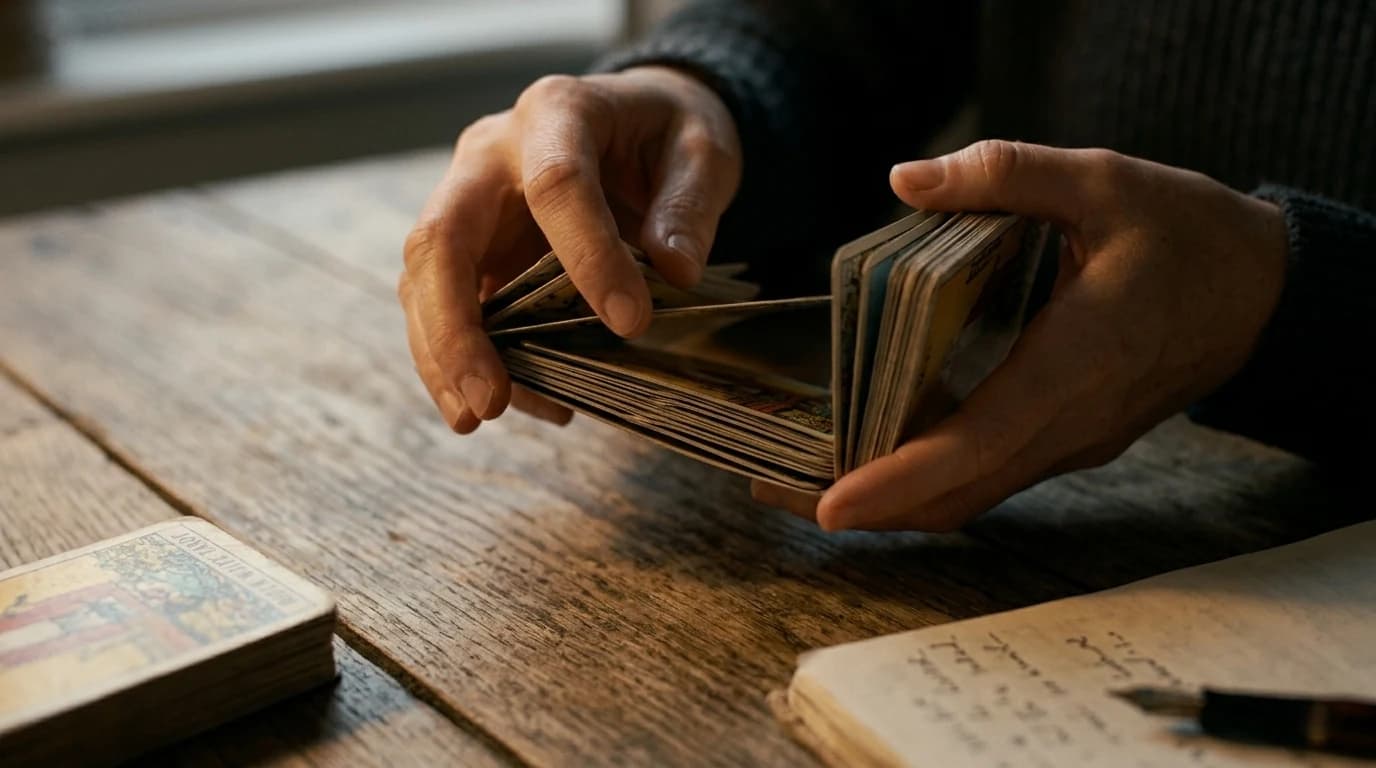
A lot happens before the first card is even on the table. You reach for the deck, settle the question in your mind, start moving the cards through your hands, and feel yourself cross from ordinary thought into deliberate reflection. That transition is a big part of tarot shuffle meaning, even if you do not describe it in spiritual language.
This is why some readers feel strangely disconnected when a digital app skips straight to the draw. Nothing “mystical” has gone missing, exactly. But a mental step has. The shuffle, cut, and pause before selection often act as the bridge between noise and attention.
If you have ever felt that a reading landed flatter when it began too quickly, this is probably why. In this article, we will look at why the shuffle matters, what kind of cognitive shift it creates, and how to protect that shift whether you read with a physical deck every day or only when life slows down enough to let you.
Tarot shuffle meaning starts before the first card
The shuffle is not valuable because it proves anything supernatural. It matters because it gives your mind something to do while your question becomes clearer.
In practice, people often sit down with a question that is still too vague. “What is going on with my relationship?” can become “What am I avoiding in this relationship?” while the hands keep moving. The body occupies itself, and the mind gets specific.
That is the first layer of tarot shuffle meaning: it is a preparation ritual. It creates a small container for attention before interpretation begins.
A reader working through burnout might notice this immediately. If they open an app and receive cards in two seconds, the reading can feel abrupt. If they shuffle for a minute first, they often arrive at a cleaner question: not “Why am I so exhausted?” but “What pattern am I maintaining that keeps me exhausted?” The cards did not change. Their entry into the reading did.
Try this before your next reading:
- Hold one question in mind while you shuffle.
- When the wording shifts, stop and write the better question down.
- Only then cut or draw.
That exercise shows why tarot ritual importance is not really about aesthetics. It is about giving your inner monologue time to turn into an actual prompt.
Why tarot ritual matters for focus, not just atmosphere
People sometimes dismiss ritual because they associate it with performance. Candle, cloth, deck, shuffle, cut — all style, no substance. But that misses how ritual works psychologically.
A simple repeated action can tell your brain, “We are doing something different now.” It is the same reason some people light a specific lamp before journaling or make tea before deep work. The act is ordinary. The consistency is what gives it meaning.
That is a useful answer to the question of why tarot ritual matters. Ritual is not only decorative. It marks a shift in mode.
When many practitioners talk about a reading “opening up,” what they often mean is that they stopped multitasking long enough to hear themselves think. The shuffle helps with that because it slows the beginning down just enough to interrupt automatic thinking.
Imagine someone asking about a job decision while half-checking messages. A digital pull may still produce insight, but the reading will have to fight for their attention. A physical shuffle changes the pacing. The hands are busy. The phone is down. The question gets a moment to take up space.
Use this focus reset:
- Put your phone out of reach.
- Shuffle until your breathing slows a little.
- Say your question once, in one sentence.
- Draw only when you can repeat the question without changing it.
That is a practical tarot practice ritual because it turns a vague mood into a clear act of inquiry.
What skipping the shuffle changes in the reading
Skipping the shuffle does not make a reading invalid. But it can change the quality of your participation.
The most common loss is not “energy.” It is ownership. When the cards appear instantly, some readers feel like the reading happened to them instead of with them. The shuffle is one of the few parts of tarot that is unmistakably yours.
That matters more than it sounds. A reflective practice becomes stronger when you feel involved in the setup, not just the interpretation. The shuffle is where you commit. It is the moment you stop browsing your thoughts and start engaging them.
This is also where tarot ritual importance overlaps with trust. Not trust in fate, but trust in your own willingness to stay with the question. If a reading begins too fast, you may be more likely to project onto the cards and move on. If it begins with a pause, you are more likely to notice what actually resonates and what does not.
Quick reflection prompt: After your next reading, ask: “Did I feel like I entered this reading on purpose, or did I just receive it?”
If the second answer keeps coming up, the issue may not be interpretation skill. It may be that your entry ritual is too thin.
This is one reason many readers still care deeply about physical decks, as we wrote in why a physical tarot deck still matters. The tactile sequence changes how the mind arrives.
You do not need an elaborate ritual to keep the meaning
The good news is that protecting tarot shuffle meaning does not require turning every reading into an event. A useful ritual can be brief, plain, and realistic.
If you read daily, your ritual might only be thirty seconds: one breath, one question, one shuffle, one cut. The point is not length. The point is consistency.
This is especially important if you are building a practice in a crowded life. Most people do not fail at tarot because they lack sincerity. They fail because they design a practice that only works on ideal days. A modest pre-draw ritual is easier to repeat than a perfect one.
Build a minimal ritual you can keep:
- Name the question.
- Shuffle until the question feels specific.
- Cut the deck once.
- Draw.
- Record one sentence about why this reading matters now.
That last step matters because ritual becomes stronger when it links to reflection. If you are trying to make tarot part of real life instead of a once-in-a-while performance, building a consistent tarot practice starts here: a repeatable entry point.
How to keep the shuffle when you also use an app
This is where the conversation gets more practical. Not every reading has to be fully physical. Sometimes the app is what makes the reading possible at all.
But if you care about tarot shuffle meaning, the answer is not to reject digital tools. It is to avoid letting them erase your intentional setup.
One option is to use your own deck, do the shuffle and draw by hand, then enter the cards into an app for interpretation and logging. That keeps the part many readers experience as personally significant while still giving you the benefits of continuity and reflection support.
Another option is to create a pre-draw pause even when you use digital mode. Put the phone down for ten seconds. Name the question. Breathe once. Decide what you are actually asking before you tap anything.
Try this hybrid ritual:
- If you have your deck, shuffle and pull physically first.
- If you do not, pause before the digital draw and state the question out loud.
- In both cases, write one note after the reading: “What did I bring into this reading before the cards even appeared?”
That question gets to the heart of why tarot ritual matters. The reading never starts at interpretation. It starts at attention.
Liminal Tarot supports both that attention and the reflection that follows. You can keep the shuffle with your own deck, then use physical deck mode to log the cards and continue the reading flow without losing your ritual. The goal is not to force one “correct” method. It is to preserve the part of the practice that helps you arrive honestly.