Why Your Physical Deck Still Matters in the Age of AI Tarot
A physical tarot deck still offers ritual, attention, and ownership that digital pulls miss. See how to keep both in a modern tarot practice.
Aurora @ Liminal Tarot
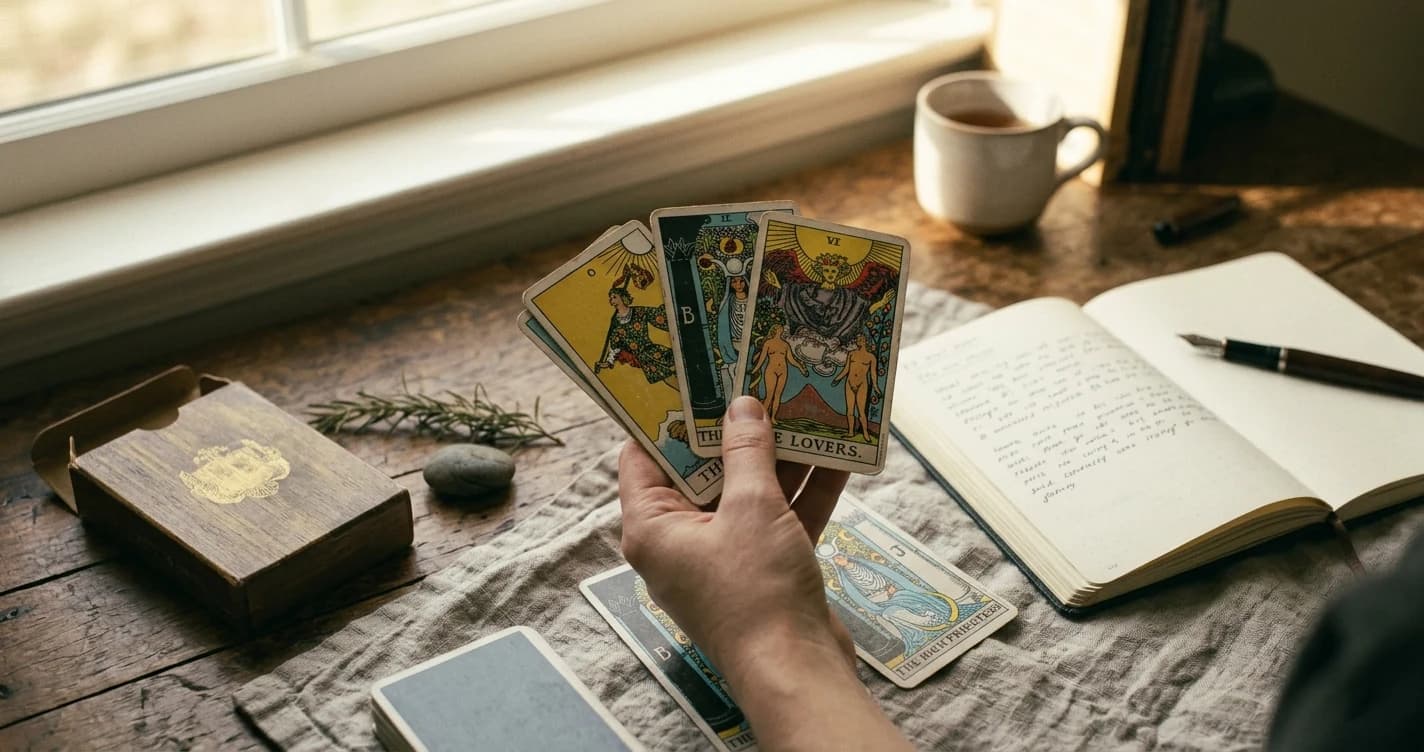
You open an AI tarot app, tap once, and get a card instantly. Convenient? Absolutely. But if you have ever done that and thought, “Why does this feel weirdly empty?” you are not imagining it. A physical tarot deck asks more from you, and that is exactly why it often gives more back.
This is not about pretending paper cards are magical while digital tools are fake. It is about how attention works. When you shuffle, cut, draw, and place cards with your own hands, you enter the reading differently. You invest effort. You slow down. You become part of the process instead of outsourcing all of it.
That is the core tension in digital vs physical tarot. One gives speed. The other gives friction in the useful sense: enough ritual to help a reading matter. Below, we will look at why physical decks still feel different, where AI tarot genuinely helps, and how to build a practice that keeps the ritual without giving up the convenience of modern tools.
Why a physical tarot deck changes your state before you even interpret
A reading does not start when you Google a card meaning. It starts earlier, in the small actions that tell your brain, “Pay attention now.” A physical tarot deck creates that threshold naturally.
You choose the deck. You notice its size, texture, and artwork. You shuffle longer when you are agitated. You cut quickly when you already know what you are avoiding. In practice, those details are not decorative. They are part of the reading because they shape the quality of your attention.
That is why many people try an app-generated draw and feel nothing. The cards may be random either way, but the experience is not the same. With a physical deck, your body has already joined the question.
Take a simple example. One person does a late-night pull after a rough conversation. They tap an app, see the Five of Pentacles, skim the interpretation, and close the tab. Another shuffles their own deck, notices they keep fumbling the cards, pulls the same Five of Pentacles, and writes down, “I already feel shut out before I even begin.” Same card. Very different reading.
Try this: do one one-card pull with an app and one with your own deck on the same question, ideally on different days. Before interpreting either card, write three sentences about how you felt entering the reading. Compare the notes. Focus on your mental state, not which method felt more “accurate.”
What physical decks give you that AI-generated pulls usually do not
The strongest case for a physical deck is not mysticism. It is ownership.
When you read with your own deck, you are not only receiving output. You are participating in a sequence: intention setting, shuffling, selection, layout, pause, interpretation, reflection. That sequence is a container. It holds your question long enough for something honest to surface.
AI-generated pulls often skip straight to the answer-shaped part. That can feel efficient, but it also tempts you to consume tarot instead of practice it.
Ritual creates useful friction
Useful friction is anything that slows you just enough to notice yourself. A reading cloth. A journal. The moment you decide whether a card is upright or reversed. None of that is fluff. It is part of the reflective structure.
Many practitioners notice that when they use a physical deck, they are less likely to ask the same question five times in ten minutes. The ritual itself discourages compulsive re-pulling because each reading costs a little attention.
Prompt: before your next reading, set a timer for 60 seconds and do nothing except shuffle and repeat your question silently. After the card appears, write what changed in your question during that minute.
Deck ownership changes interpretation
A deck you have used for months becomes personal. Not because it gains supernatural powers, but because you build associative memory with it. The Star in your deck is not just “hope.” It is also the card that kept appearing during your burnout leave, or the one you pulled before sending that hard email.
This is where tarot with my own deck starts to matter. The card meanings are still grounded in tarot tradition, but your own history gives them texture. A generic digital pull cannot replicate that relationship on its own.
One reader might keep a worn Rider-Waite-Smith deck whose Eight of Cups always brings up leaving work that no longer fits. Another might use an indie deck where the same card feels softer and more grief-oriented. The meaning is not infinitely flexible, but the relationship is real.
Try this exercise: pick one card you have pulled more than once. Look at the physical card for two minutes before reading any interpretation. List three memories, seasons, or situations you now associate with it. That is part of your reading vocabulary.
Where AI tarot is genuinely useful
None of this means digital tools are shallow by definition. AI can be excellent at helping you articulate, compare, and reflect. The mistake is assuming it should replace the whole reading process.
The better use of AI is after or alongside the draw, not necessarily instead of it.
A good system can help you name patterns, explain spread positions, and offer grounded interpretation when your mind goes blank. It can also make it easier to revisit older readings without flipping through half-filled notebooks. That is especially useful if you already know you prefer paper cards but want stronger continuity over time.
This is why the real question is not whether AI tarot is bad. It is whether you want convenience to replace ritual or support it.
If you are still early in practice, it helps to understand what tarot is actually doing as a reflective tool before you decide what role technology should play. And if you want to build a steadier routine with your cards, our guide on how to do your first tarot reading gives you a clean foundation.
Small experiment: after a physical reading, ask an AI tool to interpret the spread in plain language. Then add one paragraph of your own. Highlight what the AI clarified and what only you could know from the moment, mood, and card handling. That split is the point.
The false choice in digital vs physical tarot
A lot of people frame this as a binary. Either you are “traditional” and use a real deck, or you are modern and let an app do everything. That is a bad frame.
The more interesting question is how to keep the parts of tarot that deepen reflection while using technology for the parts it genuinely improves.
For example, someone might do a three-card spread every Sunday morning with their own deck, photograph the layout, and then forget half the insight by Wednesday. Another person might rely on an app for quick card pulls all week but never develop a felt relationship with any deck or spread. Both are missing something.
The strongest practice often combines physical ritual with digital memory.
That is the appeal of a tarot app for physical deck use case. You still shuffle your own cards. You still choose the spread. But instead of relying on memory alone, you capture the reading, enter the cards, and reflect with support. In other words, you keep the embodied part and outsource the admin.
This is also the most useful answer to people searching for can I use tarot with my own deck and an app. Yes. And for many readers, that hybrid approach is better than either extreme.
Practice prompt: look at your last five readings. Which part keeps breaking down: drawing consistently, interpreting clearly, or remembering what happened later? Do not optimize the whole system at once. Fix the weakest point first.
What if you did not have to choose?
Your physical deck still matters because ritual matters. Tactile handling matters. The feeling of “these are my cards” matters. A reading becomes more grounded when you are not just receiving content but participating in it.
At the same time, AI can be useful when it helps you interpret, journal, and spot patterns without taking over the reading itself. That is the sweet spot. Not paper versus technology. Practice first, tools second.
If you want that middle path, use your own deck and let the app support the reflection rather than replace the ritual. Liminal Tarot is built for exactly that kind of practice. You can draw your own cards, enter them into a spread, and keep the continuity of your readings over time without losing the part that made tarot meaningful in the first place.