Tarot Spreads for Big Life Transitions
Find the right tarot spread for life transition moments, from career pivots to breakups, and read big change with more clarity. Try it free.
Aurora @ Liminal Tarot
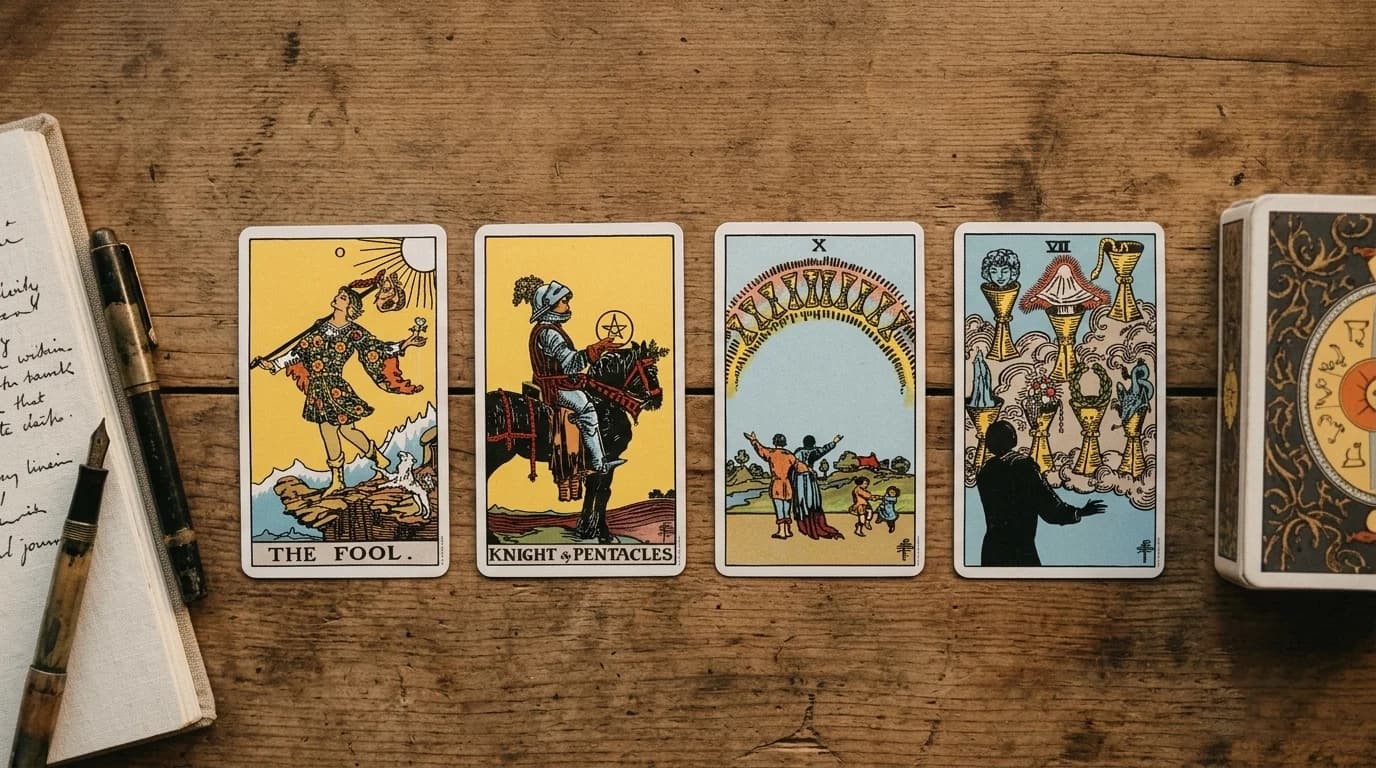
Some readings go nowhere because the cards were wrong for the moment. More often, the question was too big, the spread was too vague, or the reading asked for certainty when what you actually needed was structure. When you're in a major change, choosing a tarot spread for life transition moments matters more than pulling more cards.
A career pivot, a breakup, a move, or an identity shift all create different kinds of pressure. The best spread is the one that matches the kind of change you're in, not the one with the most positions. Below, we'll look at four transition types, the spread shape that fits each one, and how to read for insight instead of prediction.
One note before we begin: tarot can be a steady reflective tool during upheaval, but it is not a replacement for professional mental health support when you need it.
How to Choose a Tarot Spread for a Life Transition
Before you pick a layout, name the real task of the reading. Are you trying to decide? Process? Stabilize? Notice a pattern? In practice, that's what should determine the spread.
A useful tarot spread for life transition periods usually does one of four jobs:
- clarifies what is changing
- separates fear from fact
- shows what support is available
- helps you track the transition over time
If your question is still blurry, start smaller. "What should I do with my life?" is too wide. "What am I avoiding in this job decision?" gives the cards something workable.
Try this before you shuffle: finish one of these prompts in writing.
- "The part of this change I understand is..."
- "The part I keep circling is..."
- "The decision underneath the drama is..."
If you want a broader menu of layouts, the full tarot spreads library is the best place to browse by situation instead of guessing from memory.
For a Career Pivot: Use a Decision-and-Alignment Spread
Career transitions often get framed as "Which path wins?" But most of the time, the real reading is about fit, fear, timing, and what kind of life each option creates. A simple three-to-five-card decision spread works better than an oversized general reading here because it forces contrast.
A solid structure looks like this:
1. What this path offers
This position shows the genuine opportunity, not the fantasy version. When The Sun appears here, for example, it may point to visibility or confidence. When Eight of Pentacles appears, it may point to craft, repetition, and earning your way into a new phase.
2. What this path asks of me
This is where the hidden cost shows up. Many practitioners miss this and read only for attraction. A promising career change can still require grief, humility, financial caution, or a willingness to be a beginner again.
3. What I already know but haven't admitted
This is often the hinge card. In practice, this position surfaces the truth you've been stepping around: the job is wrong, the title is flattering but empty, or the safer option is only "safe" because it postpones discomfort.
4. What supports the transition
Support can be practical, relational, or internal. Don't assume this means "everything will work out." It often points to habits, boundaries, mentors, or evidence you can rely on.
5. Next grounded step
End with action, not prophecy.
Imagine someone deciding between staying in a stable operations role and moving into freelance design. A career reading that keeps returning to Two of Swords, Page of Pentacles, and Six of Swords is not shouting "quit tomorrow." It's showing indecision, a beginner phase, and a real passage from one mode of life to another.
Try this spread when: you are comparing two work paths, considering a resignation, or trying to tell excitement apart from escapism.
Reflective exercise: after the reading, write one sentence for each option beginning with "This path becomes sustainable if..." That question usually reveals more than "Which one should I choose?"
For a deeper look at this exact situation, see Tarot for Career Transitions: Reading Your Way Through a Pivot.
For a Relationship Ending: Use a Processing Spread, Not a Prediction Spread
After a breakup, the temptation is to ask whether you'll reunite, whether they regret it, or what happens next. That usually produces anxious, repetitive readings. A better tarot spread for life transition moments like a breakup is one that helps you process attachment, meaning, and the shape of the ending.
Use a four-card spread like this:
1. What is ending, exactly?
Not every breakup ends the same thing. Sometimes it's the relationship. Sometimes it's the imagined future, the role you played, or the version of yourself that held it together.
2. What still has a grip on me?
This card is often about rumination, unfinished stories, or the need to be understood. When Devil or Eight of Swords appears here, the reading is usually asking you to notice the loop, not stay inside it.
3. What needs honoring before I move on?
This position matters because transitions become harder when you rush past what deserves witness. Grief has texture. So does relief.
4. What supports the next chapter?
This might be solitude, friendship, routine, anger with a clean edge, or a return to your own values.
One composite example: someone asks if their ex will come back, but the cards in a processing spread keep pointing to Five of Cups, Justice, and Queen of Pentacles. That's not evasive tarot. It's a better question. The reading is steering them away from surveillance and toward grief, truth, and self-possession.
Reflective exercise: after the reading, make two columns in your journal: "What ended" and "What remains." Fill both without trying to make them symmetrical.
If this is your transition, Tarot for Breakup Recovery goes deeper into how to read without feeding the spiral.
For Relocation or a Major Move: Use a Stability-and-Adjustment Spread
Moving is rarely just logistics. Even when the move is wanted, it can unsettle identity, routine, community, and the body's sense of safety. The best tarot major life change spread for relocation is one that reads both the external move and the internal adjustment.
Try a five-card layout:
1. What I am leaving behind
This is not only about place. It may show a role, a rhythm, or a version of yourself tied to the old environment.
2. What this move is really asking of me
This card often reveals the developmental task of the transition: flexibility, courage, patience, visibility, or surrender.
3. What will help me settle
Look for ordinary support here. Tarot tends to be more useful when it points you toward routines, neighbors, resources, and small rituals rather than dramatic signs.
4. What may feel disorienting at first
Naming friction ahead of time prevents you from reading every wobble as a bad omen.
5. How to build belonging where I land
This is the card that turns a move into a life.
In practice, relocation readings often improve when you revisit the same layout twice: once before the move, once a few weeks after. That turns the spread into a tracking tool rather than a one-off performance.
Reflective exercise: when you finish the reading, choose one card and answer, "What would this look like as a practical ritual in my first seven days?" If the card suggests grounding, maybe that means a morning walk. If it suggests community, maybe it means texting one local friend instead of waiting to feel settled first.
For this transition specifically, Tarot for Relocation and Moving can help you read the emotional layer of the move, not just the decision.
For Identity Shifts: Use a Chapter Spread You Can Repeat
Some transitions don't have a clean event marker. You are changing, but not in a way that fits a neat before-and-after story. This is common after burnout, grief, parenthood, spiritual change, illness, queerness, career reinvention, or any period where your old self-concept no longer fits.
This is where a repeatable chapter spread is more useful than a dramatic one-time reading. A tarot transition spread for identity shifts should help you notice emergence over time.
Use three cards and repeat weekly or monthly:
1. What identity is loosening?
This card often shows the role, defense, or story that no longer holds. It can feel uncomfortable because the reading is naming something familiar that is no longer alive.
2. What is becoming possible?
This is not the fully formed answer. It is the shape of the next chapter.
3. What helps me stay in honest relationship with this change?
This final card keeps the reading grounded. It points toward the practice that lets the new self become legible.
What many practitioners notice is that these readings become more useful in sequence. The first reading may feel abstract. By the third or fourth, patterns emerge: the same suit, the same court energy, the same tension between safety and expansion.
Reflective exercise: give the transition a chapter name before you log the spread. Something like "Learning to be seen at work" or "Life after the old plan." A named thread makes later readings easier to revisit and compare.
This is where Liminal Tarot's Chapters feature is especially useful: you can group readings around one life transition and see what themes keep returning instead of treating each draw like it exists alone.
The Best Spread Is the One That Matches the Work
During upheaval, it is easy to assume more cards will create more certainty. Usually the opposite is true. The right tarot spread for life transition periods narrows the question, matches the emotional task, and gives you a structure you can actually read.
Use a decision spread for career pivots, a processing spread for breakups, a stability spread for moves, and a repeatable chapter spread for identity shifts. The point is not to force the future into view. It's to make the transition more thinkable, honest, and inhabitable.
If you're in the middle of a change, start a spread that fits the work you're actually doing. And if you want to keep returning to the same transition over time, Liminal Tarot lets you log those readings in one place so the pattern becomes easier to see. What kind of change are you really trying to read right now?