What Is Tarot, Really? A Grounded Introduction for the Curious
Tarot isn't fortune-telling — it's a structured tool for self-reflection. A grounded guide to what tarot actually is and why it's worth your time.
Aurora @ Liminal Tarot
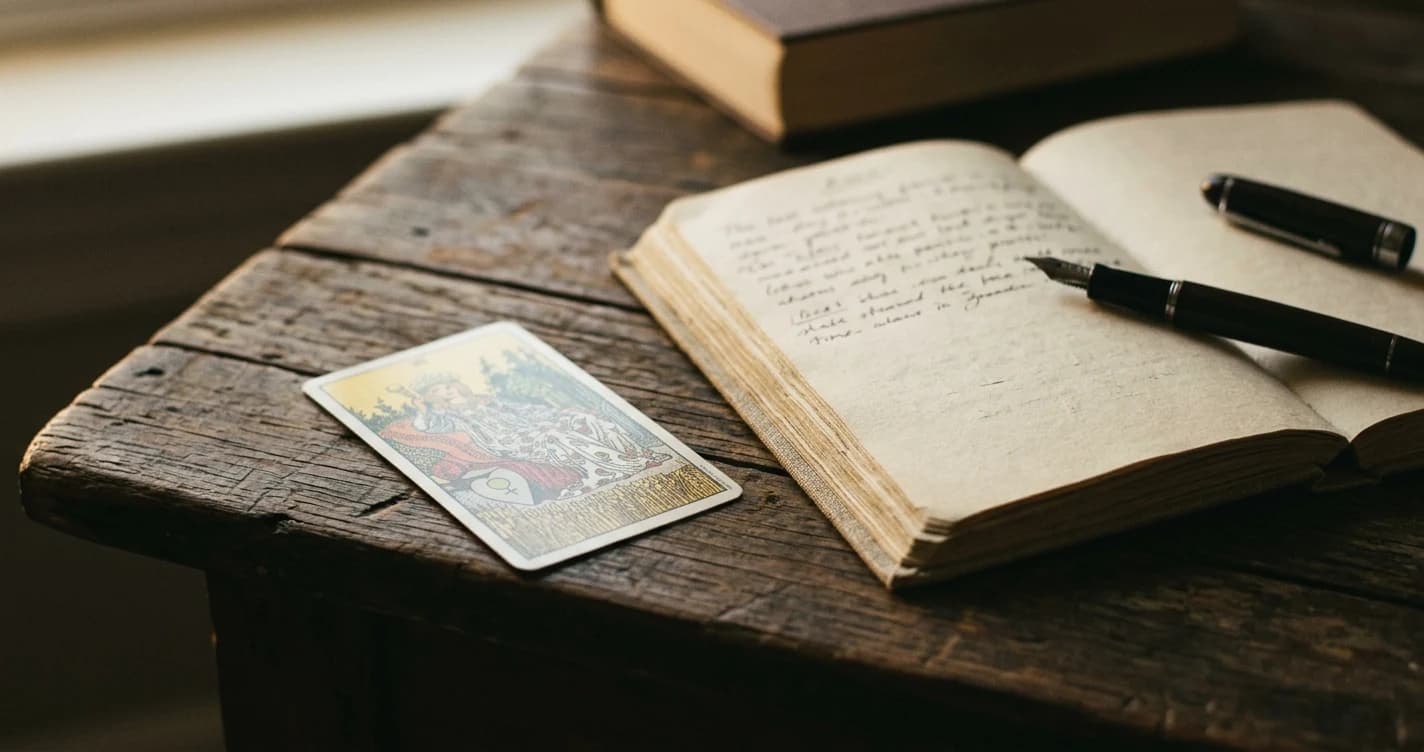
You've probably encountered tarot at some point and felt two things at once: a flicker of genuine curiosity and an immediate instinct to dismiss it. That tension is worth examining. Because the version of tarot most people picture — velvet curtains, hushed prophecy, dramatic revelations about your future — has very little to do with how thoughtful practitioners actually use the cards.
This is a guide for people who want to understand what tarot is before deciding whether it's worth their time. No spiritual buy-in required. No glossing over the parts that seem strange. Just a clear-eyed look at what a tarot practice actually involves and why a growing number of people who are explicitly not mystically inclined find it genuinely useful.
The Deck, Explained Without the Drama
A standard tarot deck contains 78 cards divided into two groups: the Major Arcana and the Minor Arcana.
The 22 Major Arcana cards represent the broad, archetypal experiences of a human life — beginnings, disruption, transformation, stagnation, renewal. The Fool, The Tower, The World. If you've seen tarot imagery at all, you've likely seen these: the striking, symbolic images that feel like something between mythology and a Rorschach test.
The 56 Minor Arcana cards cover the texture of ordinary experience. They're organised into four suits — Wands (drive and ambition), Cups (emotion and relationship), Swords (thought and conflict), and Pentacles (material reality and practical concerns). Where the Major Arcana deals in themes, the Minor Arcana deals in moments.
A practical observation: The suits map onto domains you're already familiar with from everyday reflection. When you talk a problem through with a friend, you're usually moving between these same territories — what do I feel, what do I think, what do I actually want, what's materially at stake? The deck just gives those territories names and symbols.
What Tarot Is Actually For
Here's the thing most tarot introductions avoid saying directly: the cards don't do anything on their own. There is no mechanism by which a shuffled deck can access information about your future. If you need that stated plainly before you can engage with the rest of this, there it is.
What the cards can do is give your thinking structure.
Consider how much of what we call "not knowing what to do" is really "not having organised what we already know." You carry a lot of unexamined material — half-formed fears, conflicting priorities, assumptions you haven't questioned, things you want but haven't let yourself say out loud. A tarot reading is, at its core, a structured prompt to surface some of that material.
You choose a question. You lay cards in a pattern (a spread). Each position in the spread represents something — where you are, what's working against you, what you're not seeing, what's emerging. The imagery on each card is rich enough that your mind reaches for its own associations. What resonates? What makes you uncomfortable? What feels like a surprising fit?
What many practitioners notice is that the reading doesn't tell them something new so much as it organises something they already sensed but couldn't articulate.
Try this: Before you ever pick up a card, write down the question you'd ask if you were going to do a reading. Just the question, one sentence. Notice how hard it is to make the question specific. That difficulty is the work.
The Mirror Frame: Why "It's Just Projection" Isn't a Dismissal
The most common skeptical response to tarot is: "You're just projecting your own meanings onto the cards." And the honest answer is: yes, partly. That's the point.
Projection in this context isn't a failure. It's the mechanism. When you look at an image of a figure standing at a crossroads and feel a particular pull toward it, that pull is information about where you are. The card didn't create the feeling. It surfaced it.
This is why tarot works regardless of what you believe about the cards metaphysically. The symbolic imagery is dense enough, and archetypal enough, to serve as a reliable set of prompts for self-inquiry. You don't need the cards to be mystical for them to be useful. You just need them to be interesting enough to think alongside.
Scenario: Priya had been avoiding a conversation with her manager for three weeks. She couldn't figure out why — it wasn't a difficult topic, and she generally didn't shy away from hard conversations. She did a single-card draw and pulled the Eight of Swords: a figure blindfolded and surrounded by swords, but with a clear path out if they'd just remove the blindfold. Her response to that image — a sudden clarity about her own avoidance — told her something that three weeks of overthinking had not.
The card didn't predict anything. It gave her something to react to.
What Tarot Is Not (And Why That Matters)
Tarot does not predict the future. It cannot tell you whether you'll get the job, whether the relationship will work, or whether the decision you're considering is the right one. Any reading framed as prediction is doing something different from what we're describing here — and doing you a disservice.
This matters beyond semantics. When tarot is treated as prediction, you're outsourcing your reasoning to the cards rather than using the cards to sharpen your reasoning. The result is passivity, not clarity. People who leave a reading saying "the cards say I should stay" are in a worse position than people who leave a reading having examined why they want to stay and what they're afraid of if they don't.
The most useful tarot question is never "what will happen?" It's "what am I not seeing?" or "what do I actually want here?" or "what would I do if I weren't afraid?" Those questions have answers you can act on.
Tarot also isn't therapy, and isn't a substitute for it. If you're navigating something serious — grief, a mental health crisis, a relationship with real safety concerns — a tarot practice can be a useful complement to professional support, but it's not a replacement for it.
A Practice, Not a Session
One thing becomes clear once you use tarot regularly: the value isn't in any single reading. It's in the accumulation.
A reading today has meaning in the context of the reading you did three weeks ago, and the one you'll do in a month. Themes repeat. The same card appears in different spreads across different questions. You start to notice what you're consistently avoiding, what you're consistently drawn to, what's been present in the background of your thinking through a whole season of your life.
This is why keeping a record matters — not for nostalgia, but for pattern recognition. A single reading is a snapshot. A history of readings is a map.
If you're new to tarot and wondering where to start, the simplest entry point is a single-card pull with a genuine question. Not "what does this card mean?" but "what does this card invite me to consider?" The shift is small. The difference in what surfaces is significant.
Pull today's daily card on Liminal Tarot — it's free, no account needed. You don't have to know anything about tarot to start.