What to Ask Tarot After You Have Already Made the Decision
After the choice is made, use tarot to examine tradeoffs, implementation, uncertainty, and what has genuinely changed—without turning every reading into another vote on the decision.
Aurora @ Liminal Tarot
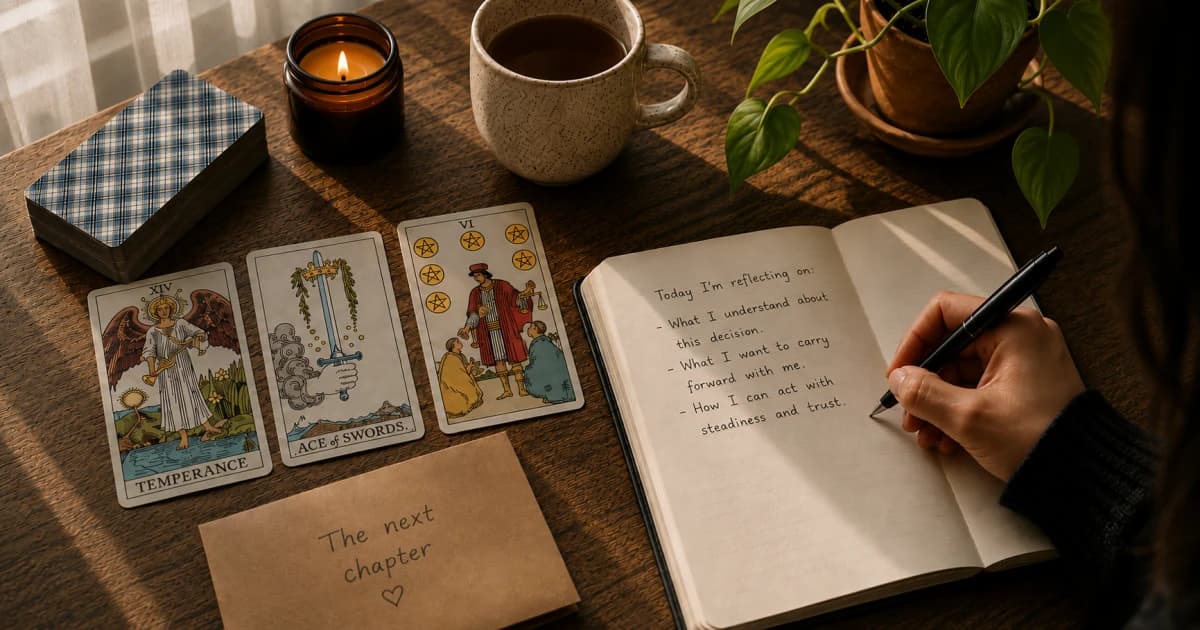
The decision is made. You accepted the offer, turned it down, moved, stayed, left, said yes, said no, or ended something you had spent weeks trying to understand.
Then a few days later, the question comes back in a different form: Was that actually the right choice?
This is where tarot can quietly take on the wrong job. Before a decision, a reading may help you examine options, priorities, fears, or tradeoffs. After the decision, repeating the same yes-or-no frame can turn every new spread into another vote on a choice that has already happened. A different card starts to look like different evidence. A more reassuring reading starts to feel like a correction.
But the object of reflection has changed. Before the choice, you were comparing possibilities. After it, you are living with consequences.
The more useful move is to change the job of the reading.
After the decision, review what you are living
A decision can be complete while uncertainty remains. Those two facts can coexist.
Once you have acted, a useful reading is less concerned with certifying the past and more concerned with the situation that now exists. What did the choice make possible? What did it cost? Which part is harder in practice than it was in theory? What are you learning only because you actually chose? Has anything important changed since then?
That is decision review. It treats the choice as a current fact and examines its aftermath.
Decision reopening is different. It asks whether the choice itself should become live again: Should I reverse it? Was the premise wrong? Does this still fit what I need? Reopening is not inherently a mistake. A past decision is not sacred. Facts change. Constraints change. Goals change. A consequence can become more serious than you expected. Something that was acceptable at the time can stop being acceptable later.
The distinction is simply that reopening needs a reason beyond the existence of discomfort or a different card.
If you are still before the choice itself, tarot for a big decision is a different task. After the choice, start here instead:
What is happening inside the decision I already made, and has anything materially changed that makes the decision itself worth reopening?
That question gives the reading a present-tense job.
Sort the difficulty before you pull a card
Post-decision uncertainty becomes easier to work with when you stop treating every uncomfortable feeling as the same problem. Four things often get mixed together.
An accepted tradeoff is a cost that came with the choice. You chose the better role, but the commute is worse. You moved, but you miss the people you left. You ended a commitment and gained space while also losing familiarity. A cost can be real without proving the choice was mistaken. The useful question is not “Why does this feel bad?” but “Which part of the tradeoff am I having the hardest time accepting?”
Implementation friction means the choice may be settled while the way you are carrying it out needs work. You accepted the role, but expectations are unclear. You chose the project, but the sequence is wrong. You decided to leave, but practical loose ends keep pulling you back into the old arrangement. In that case, “Was the decision wrong?” is larger than the problem. Ask: “What part of carrying out this decision needs attention now?”
Residual uncertainty is what remains because acting does not make the future fully knowable. You can make a reasonable choice with incomplete information and still not know how it will turn out. Another card can add another interpretation, but it cannot turn an unavailable fact into an available one. A useful question here is: “What uncertainty am I asking this reading to remove that no decision could have removed?”
Materially changed information is the category that can genuinely reopen the choice. A central assumption proves false. A new constraint appears. The consequences are meaningfully different from what you agreed to. Your priorities change. An option that did not exist before becomes available. New behavior from another person changes the situation you are responding to. The question then becomes: “What has changed since I made the choice, and which part of my original reasoning does that change affect?”
Before you draw, try one sorting question:
Am I dealing with a tradeoff, an implementation problem, unresolved uncertainty, or genuinely new information?
You do not need a perfect classification. You only need enough clarity to stop “Was I wrong?” from swallowing four different problems.
Give the reading one job
A post-decision reading gets muddy when it tries to do everything at once: confirm the original choice, explain the discomfort, predict the outcome, compare the unlived alternative, and decide whether to reverse course.
Choose one job instead.
If the problem is a tradeoff, you might ask:
- Which cost of this choice am I treating as proof that I chose badly?
- What did I knowingly give up when I chose this path?
- Which tradeoff needs to be acknowledged rather than solved?
If the problem is implementation:
- What part of this decision is not being carried out well yet?
- What practical adjustment deserves my attention?
- Where am I blaming the decision for a problem in execution?
If the problem is uncertainty:
- What do I still want to know that cannot yet be known?
- Which uncertainty actually requires new information, and which simply requires time?
- What am I asking the cards to guarantee for me?
If something has genuinely changed:
- Which original assumption does this new information affect?
- Does this change the tradeoff itself, or only make an existing cost more visible?
- What would I need to know before reversing course?
The point is not to find the “best” tarot question. It is to make the question match the problem you actually have.
Decide what would justify reconsideration before you interpret
This is one of the most useful boundaries you can set after a choice.
Before looking at the cards, complete this sentence:
I would seriously reconsider this decision if ________ changed or became true.
Fill the blank with a real-world condition, not a tarot result.
Maybe a core assumption turns out to be false. Maybe a cost rises beyond the limit you had accepted. Maybe a promised condition never materializes. Maybe the situation becomes unsafe or materially harmful. Maybe a non-negotiable priority changes. Maybe a new option appears that genuinely changes the original tradeoff.
This does two things. First, it keeps you open to revision when revision is warranted. Second, it makes it harder for a difficult card to move the goalposts by itself.
A reconsideration threshold is not a vow to stay with the original choice. It is a way of naming what would count as new information before the symbolism starts exerting pressure on the decision.
The threshold can change as your circumstances change. What matters is that it remains connected to the life you are actually living.
When a later reading seems to disagree
Suppose your first reading after a decision felt steady. Two weeks later, you draw again and the new cards feel harsher. It is tempting to treat the second reading as a correction: perhaps the first spread was wrong, or perhaps you missed a warning.
Start outside the cards.
What has changed in the situation? What new fact exists now? Which assumption has been confirmed or disproved? Has the cost of the decision changed, or are you simply encountering the cost more directly than before?
If nothing material has changed, the later reading is another interpretive frame. It may still be useful. It may help you notice a tradeoff you had minimized or an implementation problem you had ignored. But the fact that the cards differ does not become new external evidence about whether the decision was objectively right or wrong.
This is especially important when you find yourself asking tarot the same question again. The useful comparison begins with the question, context, choices, and facts around each reading. Only then does it make sense to compare the cards.
There is another asymmetry worth noticing after a decision: the chosen path has to encounter reality. The unchosen path does not. The real job has meetings, delays, awkward conversations, and Monday mornings. The job you turned down can remain clean in your imagination because you never had to live its costs. The move you made includes boxes, loneliness, and wrong turns; the city you did not choose never had to disappoint you.
That does not mean the unchosen path was worse. It means you do not have equal evidence about both paths anymore. Tarot cannot restore that symmetry.
A stronger question is:
What am I learning from the path I am actually living that I could not have learned while it was still hypothetical?
A simple spread for after the choice
If you want a compact structure, use four cards. Keep the positions focused on the aftermath rather than turning the spread into a hidden yes-or-no reading.
-
What is settled?
What can I stop treating as an open decision for now? -
What needs attention?
What part of living this choice deserves practical or reflective attention next? -
What tradeoff needs naming?
What cost, loss, limitation, or tension is part of the choice rather than automatic evidence against it? -
What would justify reconsideration?
What real-world condition should I watch for if the decision may need to become live again?
You can add a fifth position if the situation is especially unresolved:
- What can remain uncertain?
What do I not need to force into an answer yet?
Position four is the important boundary. It is not asking the cards to predict whether the condition will happen. It is asking you to name the kind of evidence that would matter if it did.
Keep a record that is fair to the decision you actually made
Hindsight has more information than the person who made the choice. That makes it easy to judge the earlier decision using facts that were not available at the time.
You do not need a detailed decision diary. A few lines are enough:
- What did I know when I chose?
- What mattered most then?
- Which tradeoff did I knowingly accept?
- What remained uncertain?
- What was the main assumption behind the choice?
- What has actually changed since then?
When you return later, compare those notes with what is true now. The most useful continuity question is often:
What changed in the situation, and what only changed in my interpretation?
This is where keeping readings together can become more useful than collecting isolated answers. A notebook works. A document works. In Liminal Tarot, a Chapter can hold several readings and notes around one period of life so the earlier context does not disappear when the next reading arrives.
The value is not in making every reading agree. It is in being able to see what stayed stable, what moved, and why the question changed shape.
Know when the reading is finished
A post-decision practice needs a stopping rule because the desire for certainty can always invent one more question.
Stop when three things are true:
- you can name the current job of the reading;
- you know what to pay attention to next, even if you do not know the final outcome;
- the remaining uncertainty depends on time, an external fact, another person, or a future condition rather than something another interpretation can settle.
At that point, more cards may add more symbolism without changing the decision situation.
If you later want to reopen the choice, return to the threshold you named. Ask what is different now. If the answer is “nothing outside the reading,” that matters.
Keep high-stakes evidence outside the cards
For safety, medical care, legal questions, significant financial decisions, crisis situations, or other high-stakes choices, tarot should not be treated as evidence for what to do. Use the direct facts, qualified professional guidance, and real-world safeguards appropriate to the situation.
Tarot can still give reflective structure to what the situation brings up. It does not replace the sources that determine what is safe, lawful, medically appropriate, or financially sound.
A decision can become a chapter without becoming a verdict
A choice does not have to be permanently correct to be worth living long enough to learn from it. It also does not have to be preserved merely because you once made it.
After the decision, tarot is often most useful when it stops trying to certify the past. It can help you name the tradeoff, improve the implementation, make room for what remains unknown, and notice when the facts have changed enough to deserve a genuine review.
The cards can give your attention a shape. The evidence for reopening the decision still comes from your circumstances.