When Another Card Adds Noise Instead of Clarity
Before drawing another tarot card, name the exact ambiguity it should clarify. This method helps you tell clarification from expansion and know when to stop.
Aurora @ Liminal Tarot
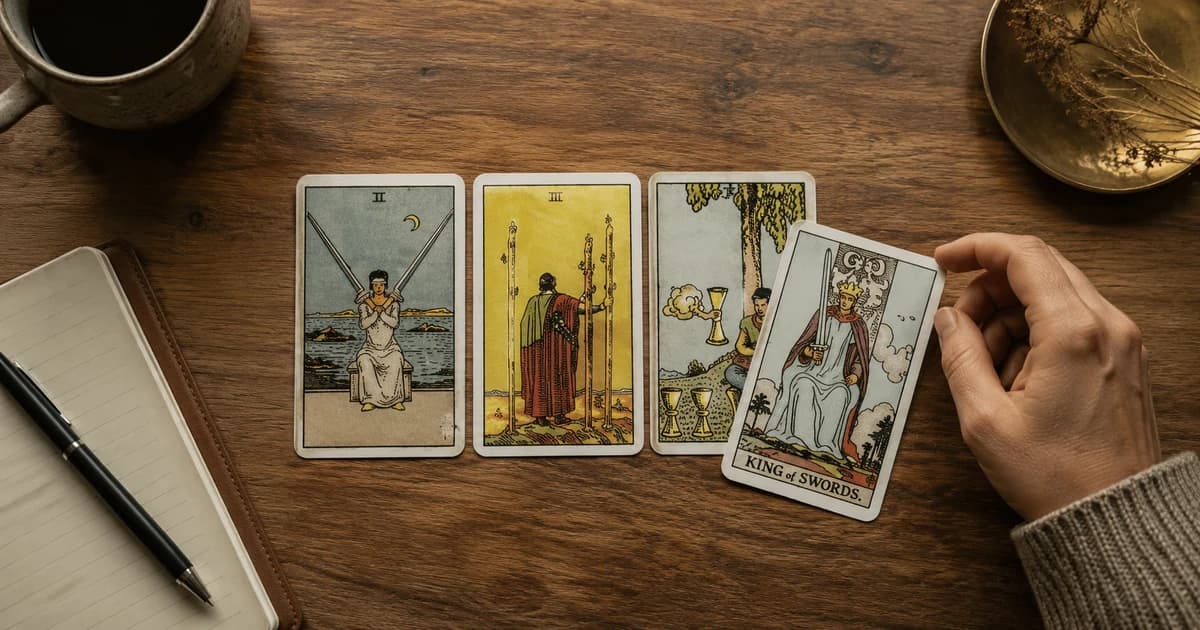
Sometimes another card does exactly what you hoped: it makes one confusing part of a reading easier to place. Sometimes it gives you one more symbol to explain, then another question, then another card.
Before drawing again, give the next card one job:
I need one more card to clarify ______.
If you can fill that blank with one specific ambiguity already inside the reading, a clarifier may help. If the blank becomes “everything,” “what happens next,” or simply “tell me more,” the new card is doing something larger.
Clarification narrows a specific ambiguity. Expansion makes the reading bigger by opening a new question, role, person, time horizon, position, or branch.
If you are still deciding whether a reading needs more than one card at all, the single-card pull is the earlier question. This article starts later, after a reading already exists and something inside it still does not quite fit.
A clarifier needs a place to belong
For this method, a clarifying card is an additional card drawn to narrow one already-defined ambiguity in an existing reading. The reading already has a question and structure; the new card should remain inside them rather than quietly creating a different inquiry.
Suppose a spread includes the position:
What is making this decision difficult?
After considering the question and the position, you can still see two plausible ways to understand the card there. One reading points toward conserving resources. Another points toward reluctance to leave something familiar.
A bounded clarifying question might be:
Which aspect of this hesitation is most relevant to the decision I am considering?
The extra card still belongs to the original position. It has a defined relationship to what is already on the table.
That same principle covers several useful clarifier jobs. You may be distinguishing between two plausible readings after context has been considered, trying to understand the relationship between two existing positions, or narrowing one facet of a broad position. In each case, you can say in advance what would count as clarification.
A defined job does not guarantee that the new card will be simple. It keeps the ambiguity bounded. If the card is difficult to place, you still know exactly which question it is supposed to inform.
Compare that with asking what happens if you choose option A, how another person feels, when the situation will resolve, or what you should do next month. Those may be questions worth exploring. They also change the scope of the reading by adding a new branch, person, time horizon, role, or position.
Expansion is not a mistake. The useful move is to notice when it has happened.
Read the reading you already have
A clarifier is most useful when one specific informational gap remains after you have worked with the material already present. When the difficulty is interpretive, another card can simply increase the amount you now have to interpret.
Start by returning to the original question exactly as you asked it. A reading can become vague because the task has shifted unnoticed. You may have begun with:
What should I understand about my hesitation around this move?
and found yourself trying to answer:
Will the move work out?
The cards did not necessarily become unclear; the question changed.
Then return to the spread positions as jobs. What is the unclear position actually supposed to examine? What is the card doing in that position? How is that job different from the neighboring positions? Two cards that look contradictory may simply be answering different parts of the spread.
Before another draw, use this short sequence:
- Restate the original question and the unclear position.
- Summarize what the reading already supports in one sentence.
- Name the exact gap: “What I still do not understand is ______.”
- Give the new card its job: “I need one more card to clarify ______.”
The synthesis can be provisional. Its purpose is to expose the real gap. If you cannot yet say what the reading supports at all, more cards may only give you more material to integrate. If you can summarize it and then add, “The only part I cannot place is ______,” the reason for another card becomes much clearer.
When that last sentence is specific, draw one card and read it only in relation to the ambiguity you named. Then return it to the original position or relationship and ask: did this make the reading narrower?
Expansion can look like clarification
Some expansions are easy to miss because the new question feels adjacent to the old one.
“Tell me more” is open-ended by design. If that is what you want, you can give the exploration a new position or a separate follow-up question. Calling it a clarifier does not make the scope smaller.
The same is true when the object of attention changes. A reading may begin with your own decision and then drift toward what another person secretly thinks. A present-tense choice may turn into a question about a future timeline. The new question may matter, but it is no longer simply clarifying the existing position.
Future certainty creates another boundary. A reading can be coherent and still leave the situation open. If the unresolved point is “I still do not know what will happen,” another card has no bounded interpretive job that can convert real-world uncertainty into an objective guarantee.
A clarifier can also become a replacement card without being named as one. If the newer card is allowed to erase the first whenever the first interpretation is inconvenient or hard to place, the lineage of the reading is lost. Write down what remains difficult about the original card first: its meaning, its relevance to the position, or the uncertainty it leaves behind. The next card should clarify that problem, not make the earlier card disappear.
The clearest sign of expansion is recursive branching. If one extra card creates two new ambiguities, and each seems to require another draw, the reading is moving in the opposite direction from clarification. Return to the original spread, summarize what it already supports, and name the branch separately. You can decide later whether that branch deserves its own reading.
One reading, two different kinds of next card
Suppose a three-card reading is about a work decision:
- What is drawing me toward the change?
- What makes me hesitate?
- What deserves the most attention before I decide?
Positions one and three make sense. Position two does not. After rereading the original question and the job of that position, two interpretations still seem plausible: the hesitation may be about conserving resources, or it may be about leaving a familiar structure.
Now the next card has a bounded job:
I need one more card to clarify which aspect of the hesitation is most relevant here: conserving resources or staying with what is familiar.
Draw one card. Read it back into position two rather than treating it as a fourth general message. Then update the original three-card synthesis only where the clarification actually changes it.
Now imagine the three-card reading is coherent enough to summarize, but another question appears:
What will my manager think if I leave?
That may be worth exploring, but the object of attention has changed. The cleanest description is:
This is a follow-up question, not a clarifier.
You can give it a new position, save it for another reading, or leave it alone for now. None of those choices retroactively changes what the original three cards were asked to do.
Stop when the reading stops narrowing
There is no useful universal number of clarifiers. A functional rule is more reliable: add one bounded clarification at a time, then check what happened to the ambiguity.
- Narrower: integrate the card and return to the reading.
- Unchanged: another card may not solve the interpretive problem.
- Broader: name the expansion instead of continuing to call the new material clarification.
A practical stopping signal is when you can no longer explain what each added card is clarifying relative to the original spread. Once that lineage is lost, the reading becomes harder to reconstruct and harder to revisit without rewriting what happened.
One bounded clarifier can still be ambiguous. That does not automatically justify a second. Return to the job you assigned it, the original position, and the synthesis. If the next draw would need a new job, you have reached a new branch.
Unclear and unfinished are different
Some readings are unclear because you have not yet found a coherent interpretation. Others are clear enough about the present and unfinished because the situation itself is unfinished.
A reading might make a tension visible without resolving it. It might show two competing priorities without deciding which one will win. It might clarify your own boundary while leaving another person’s future choice unknown. In those cases, the missing element belongs to real-world uncertainty rather than interpretation.
That is not necessarily missing information. A useful reading can end with what the current cards support, what remains ambiguous, what the cards cannot establish, and what depends on future events or information you do not yet have.
Sometimes the most disciplined ending is to leave the reading open.
If the unresolved point still matters, preserve it instead of forcing closure. A compact note can hold the thread:
Current reading: ______ What remains unclear: ______ What would make this a different question later: ______
In Liminal Tarot, saved readings remain available in Reading History. Card-level notes can hold what remains difficult to place, while reading-level notes can preserve the current synthesis and the question that is still open. Those tools do not make an interpretation automatically better or more correct; they preserve the context you actually had at the time.
You do not have to make the reading finish the situation. Another card is useful when it has one precise job inside the reading already in progress. When it does not, the cards already on the table may still yield more through interpretation than another draw could add.