Justice & Judgement

What Justice and Judgement Mean Together
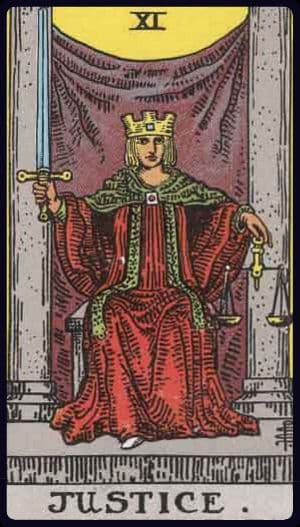
This pair can feel like standing in front of the evidence and realizing it is also a mirror. Justice brings truth, fairness, and the facts of what has happened; Judgement brings reckoning, reflection, and the pressure to respond to those facts in a more conscious way. Together, they often reflect moments of moral inventory, legal or relational consequences that become personally transformative, or the dawning realization that honesty alone is not enough unless it changes how you live. The tone here is serious, but not empty. It asks for an answer.
What This Pair Reflects
You may be seeing a situation clearly enough now that the deeper question is how you will relate to that truth. This combination invites you to consider whether accountability is becoming a burden you resent or a wake-up call you are finally ready to use.
Begin your practice
Your readings, notes, and questions in one private place.
Start a readingIn Different Situations
Relationships
You may have talked about what happened and still feel that something remains unresolved. Justice is concerned with an honest account of actions and consequences; Judgement asks what that account changes about the relationship now. An apology, a boundary, or a clear explanation can matter without automatically restoring trust. Equally, facing an uncomfortable truth need not mean the connection is beyond repair. These cards hold a harder question than who was right: whether both people can relate differently to what has been acknowledged, rather than returning to the same argument with better words.
Career
Knowing the facts about your work situation may no longer be enough. Justice wants a clear account of what you've done, what was promised, and what the consequences have been. Judgement turns that assessment inward: what has the experience taught you about the kind of professional you want to be? This could follow a disappointment or a success that feels less satisfying than expected. The pairing doesn't announce a career change. It shows the moment when an honest review stops being merely about fairness or performance and begins to affect what you're willing to stand for next.
Decisions
You may be looking for a decision you can justify, while sensing that the real issue is what you can live with afterward. Justice lays out the facts, competing claims, and likely consequences. Judgement asks for a more personal reckoning with what those facts mean and what they reveal about your priorities. The fairest available option may still carry regret; regret alone doesn't make it wrong. Together these cards describe a choice where accountability matters beyond having a defensible explanation. The decision becomes part of how you understand yourself, not just an answer to the immediate problem.
Burnout
When you're worn down, looking honestly at how you got here can sound like another accusation. Justice separates what has actually been asked of you from what you've assumed you must carry. Judgement makes that account harder to leave as a list of facts: it touches the beliefs about usefulness, duty, or worth that have kept the pace in place. There may be real responsibilities you cannot simply put down. Still, a reckoning with exhaustion needn't become a verdict against yourself. It can expose the standard that never allowed being tired to count as evidence.
Feeling Stuck
Sometimes feeling stuck means you've become very good at explaining why you are where you are. Justice can lay out every reason, consequence, and piece of evidence; Judgement asks why that accurate account has yet to change your sense of what is possible. This isn't necessarily a failure to act. You may still be carrying an old judgment about yourself, treating a past outcome as a permanent definition. The facts deserve honesty, but they do not automatically settle who you are becoming. Repeating the same account can leave that distinction unheard.
New Beginnings
Starting again doesn't always feel like a clean slate. Something about the past may be clearer now, and its consequences may still travel with you. Justice keeps the record honest: what happened, what belonged to you, and what did not. Judgement gives that clarity a different weight, asking how it has changed what you recognize as important. This beginning needn't be a dramatic reinvention or a way to prove you've learned enough. You can carry an accurate account of what came before without allowing it to prescribe every part of what comes next.
Grief and Loss
After a loss, the mind can keep returning to the record of what happened, searching for a different conclusion. Justice wants to know what was true and what responsibility genuinely belonged where. Judgement reaches further, toward how the loss has altered your understanding of yourself and the life around it. Those are not the same inquiry. You may find facts that deserve acknowledgment without finding a judgment that explains the loss or makes it acceptable. A reckoning can remain unfinished; it doesn't have to become a sentence passed on the person who is grieving.
Reversed Variations
Both reversed
Clarity and reckoning both falter here. You may dodge accountability while also feeling quietly haunted by the sense that the lesson has not actually passed.
Justice reversed
Justice reversed weakens the factual or ethical base of the awakening. Judgement may still stir, but it can be shaped by distortion, bias, or incomplete honesty.
Judgement reversed
Judgement reversed blocks the deeper response to what is true. The facts may be plain, yet you may hesitate to let them alter your self-understanding or direction.