How to Read Tarot Card Combinations Without Memorizing Thousands of Meanings
Read unfamiliar tarot card combinations by using context, spread positions, relationship verbs, and one useful pattern instead of memorizing fixed pair meanings.
Aurora @ Liminal Tarot
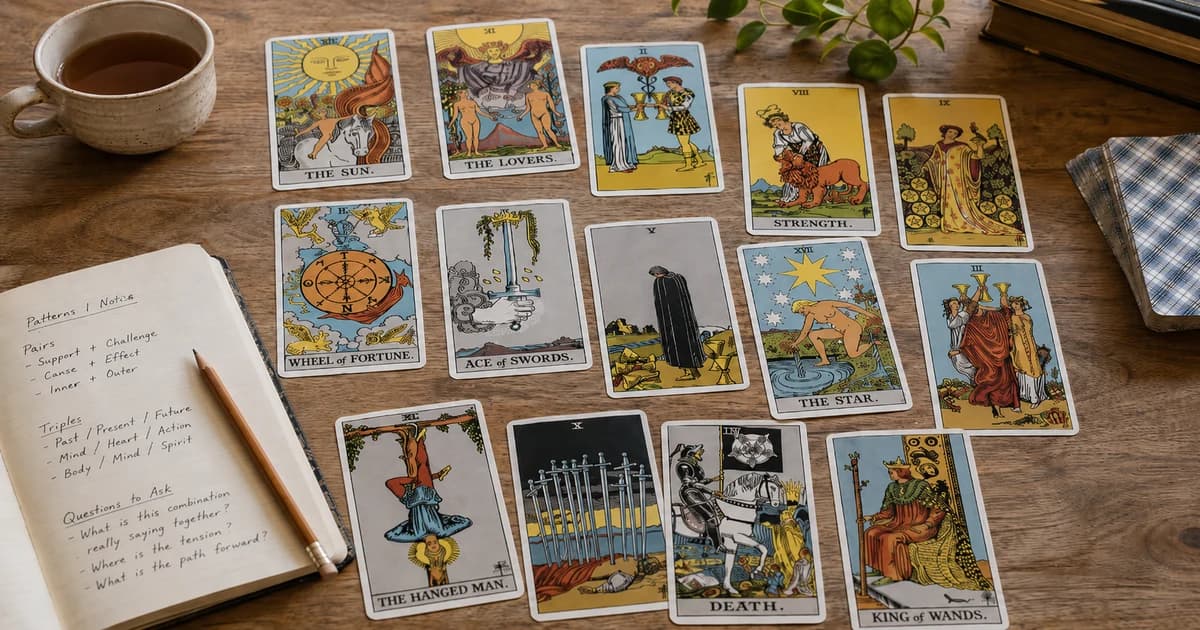
The difficult part of reading several tarot cards together is rarely a lack of meanings. It is knowing what to do with several meanings at once.
A card can already carry more associations than one reading needs. Add a second card, then a third, and it is easy to feel as though you now need a separate dictionary for every possible pair and trio.
You do not.
A combination becomes readable when you stop asking only “What does each card mean?” and start asking “What is happening between these cards in this question, in these positions?”
That shift gives you an order of reasoning you can use on combinations you have never seen before: read the question and spread positions first, reduce each card to one relevant meaning, name the relationship between the cards, add a pattern only when it changes the synthesis, then compress the combination into one coherent proposition.
The aim is coherence, not certainty. A useful combination reading makes the cards relate clearly to one another without pretending there is one fixed answer.
Start with the spread before you combine the cards
The spread already gives each card a job.
A card in What is helping? is doing different work from the same card in What am I overlooking? A card in What is changing? does not automatically carry the same emphasis as that card in What is outside my control?
Before interpreting a combination, reduce every position to a functional label:
- What is helping? — support
- What is complicating this? — friction
- What am I not seeing? — blind spot
- What is changing? — movement
- What needs attention? — focus
- What can I influence? — agency
- What is outside my control? — limit
Now the cards have grammar.
One may describe support while another names friction. One may describe movement while another qualifies what that movement can realistically look like. Two cards that seem contradictory as isolated definitions may make immediate sense once their positions are clear.
A practical test is to complete this sentence for every card:
In this reading, this card is answering this part of the question.
If that is still unclear, another layer of combination technique will usually add more noise.
Give each card one meaning for this reading
A card does not need to contribute its whole catalogue of associations. Choose the smallest interpretation that answers its position: one phrase, tension, condition, or action tendency.
For example, using conventional shorthand rather than claiming fixed definitions, Strength in a support position might become steady self-command, while the Eight of Swords in a complication position might become a narrowed sense of available options.
That gives you two manageable units:
support = steady self-command
complication = narrowed sense of options
You have not decided what the pair “always means.” You have decided what each card is doing here. That is enough to begin combining them.
Read the relationship, not a fixed pair meaning
The useful question is not “What does Card A + Card B equal?” Ask what one card does to the other in this reading.
Sometimes the cards reinforce one another: both place weight on the same theme, even though repetition does not prove one interpretation is objectively true. Sometimes they contrast or hold a tension—movement against pause, possibility against limitation, desire against what is currently available. The tension can be the interpretation; you do not have to force agreement.
In a spread built around process, one card may develop or progress the emphasis established by another. That sequence can describe the logic of the reading without becoming a prediction about what will happen next. In other layouts, one position may explain another or suggest a cause-and-consequence relationship, but only when the spread itself supports that reading. Two adjacent cards do not prove causality on their own.
One card can also modify or constrain another by changing its weight, range, or practical expression. A card associated with movement may read differently beside a position about capacity; a card associated with choice may narrow when another position names a hard boundary.
Sometimes the relationship is primarily positional. Support beside obstacle, what is stable beside what is changing, or what can be influenced beside what cannot be controlled already tells you what kind of comparison to make. You do not need to invent a separate symbolic bond merely because the cards share the spread.
And sometimes a card reframes another. What first looked like “movement” may become less about whether movement exists and more about what kind of movement is realistic under a stated constraint.
This is the core of combination reading: the meanings do not merely sit beside each other. Their relationship changes how you understand them.
Add one pattern only if it earns its place
Once the question, positions, card meanings, and main relationship are clear, you can scan for a cross-card pattern. Possible lenses include suit or element, number or rank, Major versus Minor Arcana weighting if you use it, repeated symbols, the direction figures appear to face, or another correspondence already established in your own practice.
These are lenses, not entry requirements.
Contemporary tarot teachers use several of them when discussing combinations. Biddy Tarot, for example, teaches combination reading through interactions plus optional attention to keywords, numbers, symbols, suits, Major and Minor Arcana, and visual flow. That is one useful teaching approach, not a universal rule.
Elemental dignities offer a more formal example. Labyrinthos describes elemental relationships in terms such as strengthening, supporting, weakening, or remaining relatively neutral. Tarot Elements presents a Golden Dawn-based version and explicitly notes that different systems and variations exist.
If you use elemental dignities, they can help you notice how cards modify one another. If you do not, the combination method still works.
A good restraint rule is:
Add a pattern only when removing it would materially change the synthesis.
A noticeable pattern is not automatically a useful one.
The four-pass method
For an unfamiliar pair or trio, work in four passes.
Pass 1: Context
Read the question and each spread position. Give every card one relevant meaning for the job it is doing.
Output: one short phrase per card.
Pass 2: Relationship
Choose the most useful relationship between the cards. It may reinforce, contrast, develop, explain, constrain, modify, redirect, mirror, complicate, reframe, or answer a paired position.
You only need one primary relationship to begin.
Pass 3: Pattern
Ask whether one cross-card feature sharpens the reading.
If no pattern materially helps, skip this pass. A combination does not become better because you used more correspondences.
Pass 4: Synthesis
Write one sentence before you write a paragraph.
For two cards:
In this spread, [card/position A] describes ___, while [card/position B] complicates or modifies it by ___.
For three cards:
The sequence moves from ___, through ___, toward a practical tension around ___.
These are training frames, not formulas. Their purpose is to force composition. If the cards still read like three separate definitions, the relationship is not clear enough yet.
Worked example: Strength + Eight of Swords
Suppose the question is:
What should I pay attention to as I decide whether to take on a demanding new project?
The positions are:
- What is helping me? — Strength
- What is complicating this? — Eight of Swords
This reading is not trying to predict whether the project will succeed or decide whether you should accept it.
Start with context. Strength, in the support position, can be reduced for this example to steady self-command; capacity to respond without forcing. The Eight of Swords, in the complication position, becomes a narrowed sense of options; constraints that may be partly shaped by assumptions. The positions have already separated their jobs.
The strongest relationship is contrast, more precisely capacity versus perceived constraint. Strength does not cancel the Eight of Swords, and the Eight of Swords does not make the capacity shown by Strength irrelevant. The spread is holding both at once. There is no need to add numerology, elemental dignities, visual direction, or another correspondence; the relationship is already doing enough work.
The compressed synthesis is:
The reading places steady capacity on one side of the decision and a narrowed view of the available options on the other, making the useful question less “Can I handle this?” than “Which constraints are actually fixed?”
No memorized “Strength + Eight of Swords” definition was required.
Now change the positions. If Strength becomes What am I relying on? and the Eight of Swords becomes What am I not acknowledging?, the pair asks a different question about self-reliance and an unexamined limit or assumption.
The cards are the same. Their relationship is not.
Worked example: three cards without turning them into a prediction
Consider the question:
What is changing in how I relate to my work?
The positions are:
- What am I carrying? — Four of Cups
- What is opening? — Ace of Wands
- What needs practical attention? — Two of Pentacles
For this example, the Four of Cups in the first position becomes disengagement or difficulty responding to what is already available. The Ace of Wands becomes a new spark of interest or initiative. The Two of Pentacles becomes capacity, juggling, and the cost of adding another demand.
Read separately, those could turn into three mini-readings. Read relationally, they form a sequence. Four of Cups into Ace of Wands is a contrast or movement from disengagement toward renewed interest. Ace of Wands into Two of Pentacles is a modifier or constraint: enthusiasm meets the practical question of capacity.
That sequence does not claim the future will unfold in that order. It describes the shape supplied by these positions. No additional pattern is required. A reader who already uses elemental correspondences could add that lens, but the positions and relationships already carry the reading.
The compressed synthesis is:
A return of interest does not automatically solve the earlier disengagement; the reading shifts the focus toward whether the new spark can fit inside the reader’s actual capacity.
That is one proposition, not three mini-readings placed next to one another.
With three or more cards, think in shapes
A larger combination does not require you to read every possible pair. Three cards can take several useful shapes:
- Sequence: A → B → C changes or develops the emphasis.
- Centre + modifiers: one focal card is qualified by the cards around it.
- Tension triangle: three positions hold competing demands or conditions.
- Two against one: two cards reinforce a theme while a third complicates it. This is not a vote; the interrupting card may carry the most useful friction.
- Bridge: one card shows how two apparently separate themes belong in the same reading.
- Shared motif: a repeated suit, number, symbol, or conceptual theme becomes strong enough to affect the synthesis.
The useful shape usually comes from the spread before it comes from a correspondence system.
Joan Bunning’s Learning the Tarot is described by its publisher as moving from individual cards into card pairs and the creation of a reading’s story. That broad progression is a useful reminder: the point of combining cards is an integrated reading, not a larger stack of definitions.
Scale the method to a larger spread
A ten-card spread does not create an obligation to read forty-five separate pairs. A larger spread needs hierarchy.
Begin with one relevant phrase for each card in its position, then look for the relationships the layout already supplies: situation ↔ challenge, self ↔ environment, support ↔ constraint, option A ↔ option B, what is stable ↔ what is changing. These built-in pairs and clusters are more useful than arbitrary combinations invented simply because two cards are visible together.
Next, look for a hinge card: the position or card that changes how several others are understood. It might be the central position, the clearest constraint, a repeated theme, or the card that explains an important relationship elsewhere in the spread. The hinge is not necessarily the most dramatic card.
Only after that structure is clear should you scan for one or two spread-wide patterns—perhaps suit concentration, repeated ranks, several Major Arcana if that matters in your system, strong visual repetition, or a repeated tension such as movement versus restraint. A pattern still has to change or sharpen the synthesis to earn its place.
Then compress each cluster before combining the whole spread. Write one sentence per cluster, then combine those sentences.
cluster → compress → combine
This keeps a larger spread from collapsing into a catalogue of individual card meanings.
A practice drill for learning combinations
Use three cards with positions that create clear jobs:
- What is present?
- What complicates it?
- What changes the frame?
Then:
- write one short phrase for each card;
- choose one relationship verb between card 1 and card 2;
- choose one relationship verb between that pair and card 3;
- notice at most one cross-card pattern;
- write one sentence that contains all three cards without listing three separate definitions;
- only then expand into a paragraph.
Do the first pass without a pair reference.
If the sentence is difficult, reduce the card meanings further. The problem is often not that you need more tarot knowledge. Each card may simply be carrying too many possible meanings at once.
Pair references still have a place
A pair page, book, or teacher’s example can be useful after you have formed your own reading. It can show an interpretation you missed, let you compare how another reader relates the symbols, widen the range of plausible interactions, or help you study one system in more depth.
The sequence matters:
compose first, compare second.
A reference works best as another lens on an already structured reading, not as a ruling that overrides the question and spread positions.
That is also the useful way to approach Liminal Tarot’s Card Pairs reference: compare what two cards can reflect together, then return to the specific question and roles in the reading in front of you.
What usually gets in the way
Fixed pair formulas remove the question and spread by treating “Card A + Card B” as though it always equals the same thing. A remembered association can still be a hypothesis, but it has to survive the context.
Fully interpreting each card before combining creates a different problem: once every card already has its own paragraph, synthesis becomes an editing exercise. Start smaller. The same restraint applies to correspondences. Astrology, numerology, elemental dignities, visual symbolism, reversals, and other systems may all be useful, but using every available lens usually makes it harder to tell which relationship actually matters.
A coherent reading also does not require harmony. Cards can remain in tension. Nor should a repeated suit or another attractive pattern override the position that gives each card its immediate job. In a larger spread, resist the urge to read all possible pairs when clusters, hinges, and spread-wide patterns already provide a clearer hierarchy.
Ambiguity is not a failure of the method. Two interpretations can both fit the same context. Keeping that distinction visible is more useful than manufacturing one “correct” answer.
The deeper skill is deciding what not to combine
A spread contains more possible connections than a useful interpretation can hold. Combination reading is partly selection.
Three filters help. Relevance: does this connection answer the question or clarify the position? Strength: is the relationship clear enough to matter, or are you finding one because you feel obliged to? Consequence: if you remove this pattern, does the synthesis change?
If removing a connection leaves the synthesis unchanged, it may be decorative rather than useful. You are not demonstrating how many correspondences you know. You are choosing the smallest set of relationships that makes the reading coherent.
A compact checklist for any unfamiliar combination
When a pair or trio appears that you have never studied before:
- What is the question?
- What job does each position perform?
- What is the one relevant meaning of each card here?
- What is the strongest relationship verb between the cards?
- Is there one optional pattern that changes the reading?
- Can you express the combination as one sentence?
- What remains ambiguous?
If you can answer those questions, you can read the combination without a memorized entry.
Reference material can still help afterward. The difference is that it enters an interpretation you have already structured instead of supplying the structure for you.
Several combination-reading traditions arrive at this relational move in different ways. Biddy Tarot’s combination guides offer contemporary pattern and interaction techniques; elemental-dignity approaches offer a more formal modifier system; Bunning’s course structure moves from single-card work toward pairs and story. They do not need to become one doctrine.
The useful discipline is simpler: read the context, name the relationship, keep only the patterns that matter, and make the cards form one thought.
Sources behind the method
This article combines several legitimate approaches without treating any one of them as the universal system for reading combinations:
- Joan Bunning, Learning the Tarot — publisher description — supports the broad progression from individual cards to pairs and the story of a reading.
- Biddy Tarot, “How to Read Tarot Card Combinations” — offers keyword, number, symbolism, and visual-flow techniques.
- Biddy Tarot, “Tarot Card Combinations” — discusses reinforcement, opposition, suits, numbers, symbols, figures, and other card interactions.
- Labyrinthos, elemental dignities — presents one elemental interaction model.
- Tarot Elements, “Elemental Dignities Dictionary” — presents a Golden Dawn-based approach and notes that other systems and variations exist.
The relational mechanics are useful here; predictive, supernatural, divine-guidance, and client-future framing from external sources is not part of the Liminal Tarot approach. Elemental dignities remain optional, as do the other pattern lenses above.