How to Read Repeating Suits and Numbers in One Tarot Spread Without Turning Them Into Omens
When one tarot spread contains repeated suits, numbers, court ranks, or Major Arcana, use the pattern as a second-pass weighting layer instead of a separate omen.
Aurora @ Liminal Tarot
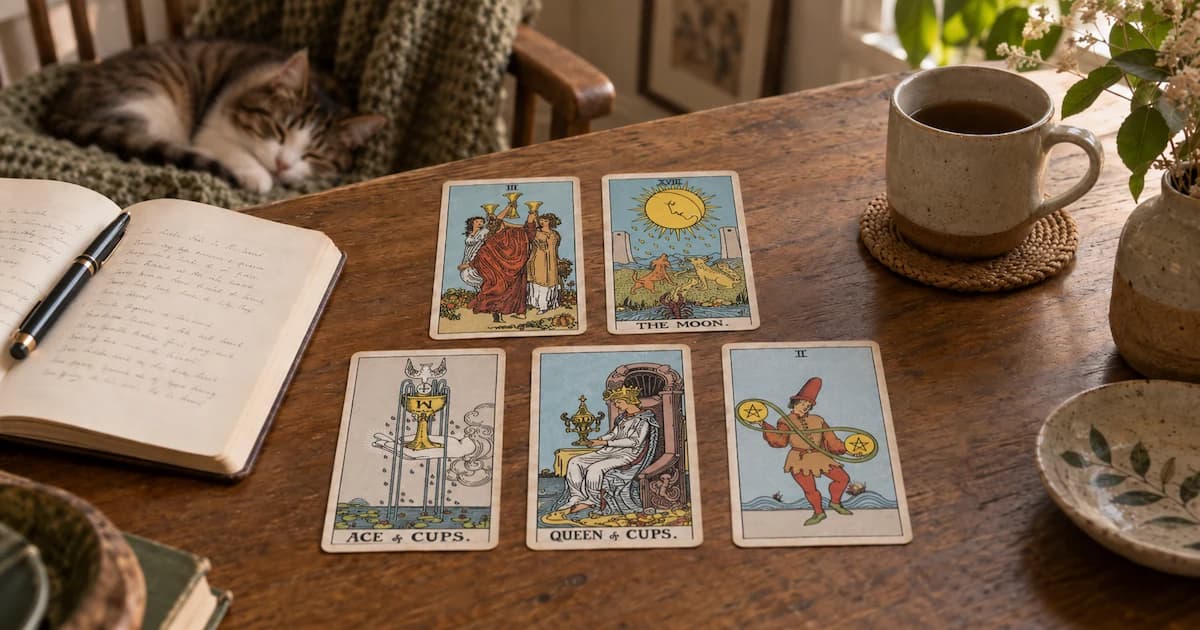
You finish a spread and something else becomes visible.
Three of the cards are Cups. Two are Fives. Maybe two Queens appear in positions that seem to answer each other, or four of six cards are Major Arcana.
Noticing the pattern is easy. Deciding how much weight it deserves is harder.
Tarot teaching traditions use suits, numbers, court ranks, Major and Minor Arcana, elemental correspondences, repeated symbols, and other cross-card patterns as interpretive lenses. They do not all use them in the same way. A visible pattern can sharpen a reading, but it can also be incidental, redundant, or distracting.
The useful question is not “What does it mean that I pulled three Cups?”
It is “What changes in this reading because three of these cards are Cups?”
If the answer is “nothing important,” the pattern can stay out of the final interpretation.
That is the basic discipline: read the cards first, then decide whether the pattern deserves to modify the reading.
Read the spread before you read the pattern
Pattern reading becomes unreliable when it starts too early. If you notice three Fives before you have read the positions, it is easy to make the entire spread prove whatever you already associate with the number five. If you notice four Cups, you may start translating every position into an emotional theme before the cards themselves have earned that interpretation.
Start with the ordinary reading:
- Read the question or intention.
- Read the job of each spread position.
- Give each card one relevant interpretation in that position.
- Form a basic synthesis of the spread.
- Only then scan for structural repetition.
- Keep a pattern only if it changes or clarifies that synthesis.
This order matters because patterns are second-pass evidence inside the reading, not a separate message floating above it.
A repeated feature can do several useful jobs. It might strengthen a theme that is already present. It might reveal imbalance: one suit dominates while another kind of concern is nearly absent. It might connect two positions that seemed separate. Or it might make you revisit a weak first interpretation because the spread has more internal coherence than you noticed.
But a pattern should not force every card into the same meaning.
If three Cups appear in a spread about a work decision, that does not automatically turn the reading into a relationship reading. The Cups still have to answer the jobs of their positions. They may point toward morale, values, collaboration, disappointment, belonging, or the emotional cost of a decision. The repetition can increase the importance of that layer without replacing the question.
Use a simple weighting test
When you notice a repeated suit, number, rank, or Arcana type, test it with three questions:
1. Is the pattern actually unusual enough to notice?
Two cards sharing a feature may matter in a three-card spread. The same repetition may be less striking in a twelve-card spread. You do not need to calculate formal probability to use this distinction. Just avoid treating every duplicate as exceptional.
2. Does the pattern reinforce something the individual cards already suggest?
If several cards independently point toward emotional processing and most of them are Cups, the suit pattern may strengthen that synthesis. If the cards point in unrelated directions and only share a suit, the repetition may deserve less weight.
3. Does noticing the pattern change the interpretation in a useful way?
A pattern earns space when it changes emphasis, reveals contrast, connects positions, or makes the reading more precise. If it only gives you an extra fact to mention, you can leave it out.
You can reduce that to one sentence:
Notice → compare → test → keep only if it changes the reading.
This is enough for most spreads.
Repeating suits: look for emphasis, not destiny
Suits are one of the easiest patterns to notice because they create visible clustering.
A spread with several Cups may place more weight on emotional experience, relationships, receptivity, imagination, or whatever suit framework you actually use. Several Swords may increase the importance of thought, communication, conflict, analysis, or mental pressure. Wands and Pentacles can create their own clusters of emphasis depending on your system.
The important move is to say “this area may carry more weight in the spread” rather than “the universe is sending a message about this suit.”
Suppose a five-card decision spread contains:
- Two of Pentacles in “what I am balancing”
- Eight of Cups in “what I may need to leave”
- Three of Pentacles in “what supports me”
- Queen of Pentacles in “what I can embody”
- The Chariot in “likely direction if I commit”
Three of five cards are Pentacles.
Read the positions first. You may already have a story about juggling commitments, leaving something emotionally depleted, relying on practical collaboration, taking a grounded approach, and moving decisively once the choice is made.
Now add the suit pattern.
The repeated Pentacles might tell you that the practical layer deserves more weight than you initially gave it. Money, workload, physical capacity, routine, resources, or long-term sustainability may be central to the decision.
That does not mean “Pentacles = money, therefore choose the higher-paying option.” The pattern modifies the reading. It does not solve it for you.
Also notice what is missing
Absence can sometimes be useful, but it is easier to overstate than repetition.
If a spread about a relationship contains no Cups, you do not need to conclude that love is absent. The cards may be addressing communication, boundaries, practical circumstances, or action because those are the parts of the question that matter most in this particular spread.
Treat missing suits as a prompt:
Is there a dimension of this situation that the spread is not emphasizing?
That is safer and more useful than turning absence into a verdict.
Repeating numbers: compare the cards before assigning a number theme
Numbers invite fast generalization. Two Fives appear, and suddenly the reading becomes “about change.” Three Twos appear, and everything becomes “about partnership.”
That can flatten the cards.
Start by comparing what the repeated number is actually doing in each card.
Imagine a spread contains:
- Five of Pentacles in “current pressure”
- Five of Wands in “what complicates it”
- Nine of Pentacles in “what becomes possible”
Before using any general meaning for five, read the two Fives in position.
One may describe scarcity, exclusion, or material strain. The other may describe competition, friction, or too many competing demands. Their shared number becomes interesting because both positions contain instability or difficulty, but the difficulty takes different forms.
You might then say:
The repeated Fives make the spread’s unstable middle more prominent: one pressure is material, the other is competitive. The Nine of Pentacles stands out because it shifts away from that repeated structure toward greater independence or sufficiency.
That is more precise than “double five means big change is coming.”
A practical rule for number patterns
Use this sequence:
- Interpret each numbered card in its own position.
- Identify what the cards actually share besides the numeral.
- Compare where their meanings diverge.
- Decide whether the shared number clarifies the spread’s structure.
- Only then add any numerological framework you intentionally use.
Different tarot traditions assign different significance to numbers. If you use a specific numerological system, name it as part of your method rather than presenting it as the one inherent meaning of the number.
Repeating court ranks: compare roles and styles
Two Queens, two Knights, or several Pages can be especially tempting to turn into literal people.
Sometimes court cards do refer to people in a reader’s chosen method. Sometimes they describe roles, postures, developmental stages, communication styles, or ways of engaging with the situation. Repeating ranks can be useful without requiring you to decide that two specific people are about to appear.
Suppose a spread includes the Queen of Swords and Queen of Cups.
Instead of jumping to “two women,” compare the positions and qualities.
Maybe one appears in “what boundary is needed” and the other in “what needs care.” The repeated Queen rank could make mature stewardship or how you hold responsibility more important, while the suits show two different ways of doing that: clarity and emotional responsiveness.
Or the Queens may represent two people. The spread context has to support that reading.
A useful comparison table is:
| Card | Position | What the rank contributes | What the suit changes | |---|---|---|---| | Queen of Swords | boundary | mature authority or discernment | clarity, analysis, directness | | Queen of Cups | care | mature holding or responsiveness | emotion, receptivity, compassion |
The repeated rank creates a relationship between the cards. It does not decide what kind of relationship that is.
Major Arcana concentration: increase weight, not certainty
A spread with several Major Arcana cards often feels significant. The imagery is visually distinct, the archetypes are broad, and many tarot traditions give the Majors more structural weight than the Minors.
You can honor that without escalating the reading into fate.
If four of six cards are Major Arcana, you might ask:
- Are the positions containing Majors the most consequential positions in the spread?
- Do the Majors share a developmental tension or sequence?
- Are the Minor Arcana showing how the larger themes appear in ordinary life?
- Does the concentration change how much weight I give the spread’s central conflict?
You do not need to conclude:
This is destined.
A more grounded formulation is:
Several positions are carrying broad, high-level themes in the interpretive system I use, so I want to give those positions more attention than I would if the spread were mostly situational Minors.
The pattern affects weighting. It does not guarantee an outcome.
Mixed patterns: do not stack every layer at once
Sometimes a spread contains several visible patterns:
- three Cups
- two Fives
- two Queens
- three Major Arcana
- repeated colors or symbols
- several cards facing the same direction
If you interpret all of them, the reading can become a pattern catalogue instead of a synthesis.
Rank the patterns.
A simple method is:
Pattern:
How many cards participate?
Which positions participate?
Does it reinforce the first-pass reading?
Does it introduce a useful contrast?
Would the reading materially change if I ignored it?
Keep / Mention lightly / Drop
You might end with:
Three Cups → KEEP
Strengthens the emotional-cost theme already present in positions 2, 4, and 5.

Two Fives → MENTION LIGHTLY
Both occur in challenge positions, but they do not change the final synthesis.

Two Queens → DROP
Interesting visual repetition, but the positions and meanings do not create a useful relationship here.
This prevents interpretive inflation.
More patterns do not make a reading deeper. Better weighting does.
A worked example: three Cups and two Fives in one spread
Consider a six-card spread about whether to stay in a demanding creative collaboration.
The positions are:
- What is working
- What is draining me
- What I may be overlooking
- What needs to change
- What supports a decision
- What to carry forward
The cards are:
- Three of Cups
- Five of Cups
- Five of Pentacles
- Queen of Cups
- Justice
- Eight of Cups
First pass: ignore the patterns
Read each card in position.
Three of Cups — what is working
The collaboration may contain genuine creative exchange, camaraderie, celebration, or mutual encouragement.
Five of Cups — what is draining me
Disappointment, attention fixed on what has not worked, or emotional depletion may be consuming more energy than the collaboration’s successes restore.
Five of Pentacles — what I may be overlooking
There may be a practical scarcity issue: money, capacity, access, support, or a feeling of being left to carry too much alone.
Queen of Cups — what needs to change
The situation may require more emotionally sustainable boundaries, more honest attention to capacity, or a less reactive way of holding the relationship.
Justice — what supports a decision
Clear agreements, proportional responsibility, explicit criteria, and an honest accounting of what each person is contributing may help.
Eight of Cups — what to carry forward
The card may support willingness to leave an emotionally unsustainable arrangement, or at minimum to stop remaining solely because of prior investment.
At this stage, the spread already has a coherent reading: the collaboration contains real connection, but disappointment and practical strain are accumulating. The decision benefits from clearer terms and an honest assessment of whether the relationship remains sustainable.
Second pass: scan for patterns
Now notice:
- Three of six cards are Cups.
- Two cards are Fives.
- The Cups occupy positions 1, 2, 4, and 6 if you count the Eight of Cups as well: actually four of six cards are Cups.
That correction matters. Pattern reading should be based on the cards in front of you, not the pattern you expected to see.
What does the Cup concentration change?
It strengthens the idea that the emotional experience of the collaboration is not a side issue. The question may look practical — stay or leave — but the spread repeatedly returns to connection, disappointment, emotional boundaries, and departure.
The Pentacles card still matters. Justice still matters. The Cups do not erase them.
Instead, the concentration changes the weighting:
Practical scarcity is part of the problem, but the emotional sustainability of the collaboration appears to be the more persistent layer across the spread.
What do the two Fives change?
The Five of Cups and Five of Pentacles occupy “what is draining me” and “what I may be overlooking.” Their shared number creates a useful bridge between emotional disappointment and practical scarcity.
You do not need a universal meaning of five to see the structural relationship. Both cards occupy the difficult middle of the reading and describe different forms of lack.
That makes the combined interpretation more precise:
The strain is not only emotional and not only practical. The two reinforce each other.
What should stay out?
You could calculate elemental dignities, assign a numerological meaning to every card, analyze visual direction, count color frequencies, and search for repeated symbols.
But the reading already has enough structure.
The Cup concentration and the paired Fives materially improve the synthesis. Additional pattern layers may only add noise.
Do not use pattern counting to rescue a preferred answer
Pattern analysis becomes especially unreliable when it is used after the reading has produced an unwanted answer.
You read the spread. The result is ambiguous. Then you notice three cards contain yellow, two numbers add to seven, several figures face left, and the deck contains exactly the symbol you were hoping to find.
That is no longer neutral second-pass interpretation. It is answer shopping.
The same discipline that helps when you keep asking tarot the same question applies here: if you keep adding interpretive layers until the answer changes, stop and compare what has actually changed.
A useful constraint is:
Do not add a new pattern system after seeing the answer unless that system was already part of your normal reading method.
If you routinely use numerology, use it. If you routinely read elemental balance, use it. If you have never counted directional gazes before but suddenly need them to overturn the spread, that is a reason to pause.
Pattern frequency is not probability of an outcome
A spread containing repeated symbols can feel statistically meaningful even when you have not actually calculated how unusual the pattern is.
You do not need formal probability for ordinary tarot practice, but keep the categories separate:
Frequency inside the spread tells you how often a feature appears.
Interpretive weight is the importance you choose to give that feature within your reading method.
Probability would require a defined random process and a mathematical calculation.
Outcome likelihood would require evidence about the real-world situation, not only the cards.
Those are not interchangeable.
Three Cups in a five-card spread may deserve interpretive attention. It does not mean an emotional outcome is “60% likely.” Four Major Arcana do not make an event four times more destined.
The spread is a symbolic reading system, not a probability meter.
Keep a pattern log if you want to improve your weighting
If pattern reading is part of your practice, record what you noticed and whether it actually helped.
A compact note is enough:
Spread:
Question:

First-pass synthesis:

Patterns noticed:
- repeated suits:
- repeated numbers:
- repeated court ranks:
- Major/Minor balance:
- other normal method:

Pattern kept:
Why it changed the reading:

Pattern dropped:
Why it did not add enough:

Final synthesis:
Over time, this gives you something more useful than a growing list of correspondences. You start learning which pattern signals actually improve your readings and which ones mostly tempt you to over-interpret.
That is also one reason to keep a stable personal method. When your method changes every time the cards become uncomfortable, you cannot tell whether a pattern was informative or merely convenient.
A compact pattern-reading checklist
Before you include a repeated feature in the final reading, ask:
Have I read every card in position first?

Is the pattern clear enough to deserve attention?

Does it reinforce, contrast with, or reorganize the first-pass synthesis?

Can I explain what changes because of the pattern?

Am I using a framework that is actually part of my reading method?

Am I treating repetition as emphasis rather than certainty?

Would the reading still make sense if I dropped this pattern?
If you cannot explain what the pattern changes, you probably do not need it.
A spread does not become more meaningful because you found more correspondences inside it. The useful pattern is the one that helps the cards relate to each other more clearly without turning repetition into a separate omen.