Tarot Card Meanings: How to Use What You Look Up in an Actual Reading
A looked-up tarot meaning gives you a range, not an answer. Use the question, spread position, imagery, surrounding cards, and known facts to decide what fits.
Aurora @ Liminal Tarot
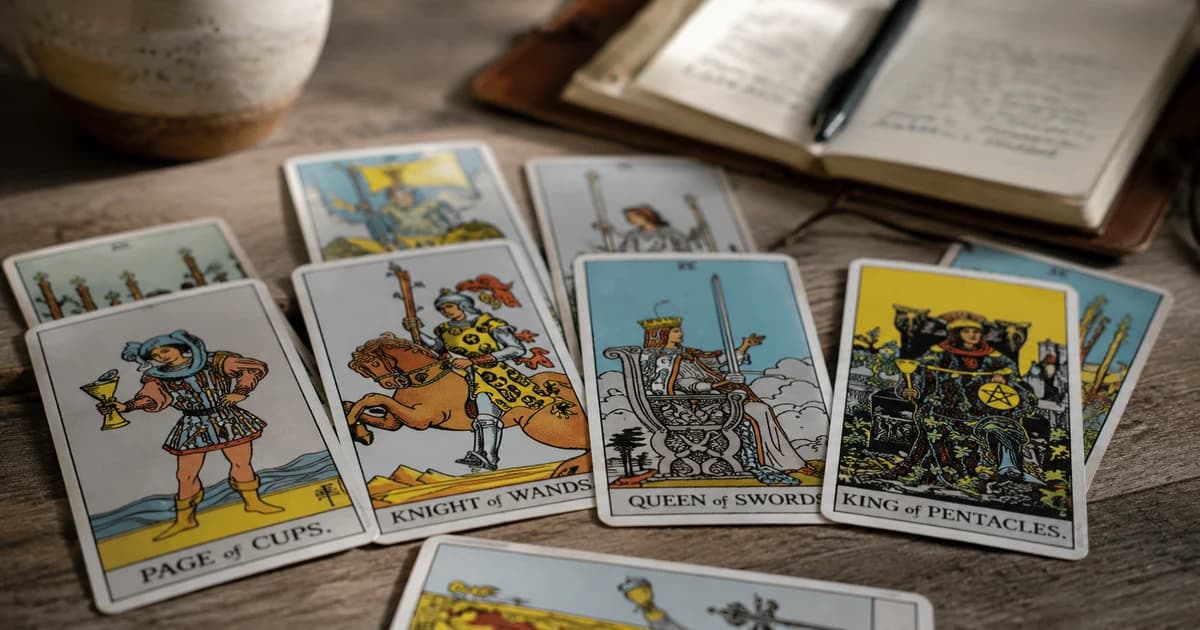
You look up a tarot card and find a page of meanings. Some lines fit immediately. Others feel unrelated. One sounds important, but you are not sure whether it belongs to this question or whether you simply noticed it because it was dramatic.
That is the point where a reference can either sharpen the reading or flatten it.
A card meaning is useful because it gives you a range of possibilities you did not have to invent from scratch. It can remind you of a theme you forgot, point out an aspect of the imagery you missed, or challenge the interpretation you reached too quickly. What it cannot do is finish the reading for you.
The reference does not automatically know your exact question, the job the card has in the spread, the details that stood out in this draw, the cards around it, or the facts you already know outside the reading. Those things are part of the interpretation, not decoration added afterward.
The practical skill is learning how to move from what this card can mean to what this card is doing here.
A meaning page gives you a range, not a verdict
A guidebook, card-meaning page, booklet, or app is doing useful work when it widens the field.
It might give you recurring associations for the card, a compact set of keywords, distinctions between related themes, or details specific to the deck you are using. It can also interrupt a habit. If you always read a familiar card the same way, looking it up can remind you that the card has more range than your favorite interpretation.
That is different from treating the entry as an answer key.
Suppose a reference gives you themes such as movement, opportunity, enthusiasm, haste, and incomplete preparation. All five may belong to the card's possible range. Your reading still has to determine which of them matter now.
The reference supplies possibilities. The reading supplies constraints.
Those constraints usually come from four places: the question you asked, the position the card occupies, the image in front of you and the cards around it, and the facts you already know. A useful interpretation survives contact with all four.
Preserve the reading before you open the reference
Before looking anything up, keep hold of the question and the card's job.
If the spread position is What is helping me?, that is not the same interpretive task as What is complicating this? or What deserves attention before I decide? A general meaning can sound relevant to all three while doing very different work in each.
Write down the exact question and position, or restate them to yourself. If the position is vague, clarify what it is asking the card to describe before the reference starts supplying polished language.
Then make one short observation about the card you actually drew. Notice a detail in the image, the immediate tone, a contrast with a neighboring card, or the first interpretation that came to mind. Keep it tentative.
This is not a test of whether intuition is better than study. It simply preserves information that already belongs to the reading. Once you have read a smooth guidebook paragraph, it becomes much easier to see only what confirms that paragraph.
Looking first gives you something concrete to compare with the reference. The reference is then allowed to widen or correct your first impression instead of replacing a blank space.
Use the lookup to widen the field
When you open the reference, do not search for the one sentence that is supposed to be the answer.
Treat the entry as a set of candidate interpretations. Ask which parts fit the question and position, which connect with the image in front of you, and which are reinforced or challenged by the rest of the spread.
Also ask whether the reference added something you had missed.
That last question matters. Reader judgment does not mean protecting your first impression at all costs. Sometimes the guidebook is the thing that exposes an interpretation as too narrow, too familiar, or too convenient.
A first impression can be limited for ordinary reasons. You may remember only the most common keyword. You may be carrying a meaning from another deck. You may have repeated a personal association so often that it now feels universal. You may simply have overlooked part of the image.
If the reference introduces a facet that better fits the question, position, and card, change the reading. The reference has done its job.
Keep only what this reading can support
A guidebook paragraph does not have to apply as a package.
Return to the earlier example: movement, opportunity, enthusiasm, haste, incomplete preparation. If the card sits in a position asking What deserves closer examination before I decide?, haste and preparation may carry more weight than the broad theme of opportunity. In a position asking What is helping me?, the emphasis could shift.
The unused parts are not wrong. They are simply not doing useful work in this reading.
This is especially important when a card meaning feels as though it "doesn't fit." The problem may be that you are trying to make every line of a general entry fit one specific situation.
A better test is narrower: Which part of this meaning range actually helps me read this card in this position?
Spread positions matter because they change the function of a meaning without requiring the card to become a different card. The same theme can operate as an obstacle, a resource, advice, background, or a possible outcome condition. If that distinction is where your reading keeps getting stuck, the position-first method in this guide takes that problem further.
Surrounding cards can narrow the range too. One card may repeat a theme, introduce a competing concern, or keep two interpretations alive at once. Context should change emphasis without erasing the card itself. In a multi-card spread, the next step is not to let one dramatic card overwrite everything nearby, but to see how the positioned meanings relate. This three-card synthesis method shows one way to do that without turning the spread into three separate dictionary entries.
Known facts set a harder boundary
Symbolic interpretation should not outrank information you already have.
If you know a job offer has no confirmed salary, a card cannot create one. If another person has explicitly told you something, a hopeful relationship keyword does not cancel the message. If a decision depends on information that has not arrived, the reading should preserve that gap rather than fill it with symbolism.
This is where a reading can become less trustworthy very quickly. A broad card association can feel emotionally compelling, especially when it points toward the answer you wanted. But the stronger the external evidence is, the less room there is to treat the symbolic possibility as a competing fact.
Sometimes the useful interpretation is about your response to what is known. The card may help you notice where you are resisting, rushing, hoping, avoiding, or holding back. It does not need to rewrite the facts to be useful.
Tarot can organize attention around a situation. It does not turn missing evidence into known information.
When only one line fits, use one line
Partial fit is normal.
A general reference has to serve many questions and many reading contexts. It may cover several facets of a card precisely because no single reading needs all of them at once.
If one part fits well and the rest does not, identify why that part fits. Check it against the image, the position, the neighboring cards, and known context. Leave the rest unused.
There is no requirement to make the whole paragraph relevant.
Forcing every facet into the reading often creates retrospective fitting. Once you decide that the entire entry must matter, almost any detail can be stretched until it sounds connected to the situation.
The cleaner reading usually keeps less.
When the reference changes your mind, let it
A useful lookup can correct you.
Imagine that your first reaction to a card is "opportunity." The reference reminds you that the same card can also carry haste and poor preparation. In the position What deserves closer examination?, those neglected facets may fit better than the one you reached for first.
Changing the interpretation is not surrendering judgment to the guidebook. It is judgment working properly.
The question is not whether the book or your intuition wins. The question is whether the interpretation is better grounded after you have considered both your observation and the reference range.
Deck-specific guidebooks deserve particular attention when they explain something about the artwork or the creator's treatment of a card. That kind of information can help you understand what the image is doing. It still does not automatically answer the question you brought to the reading.
Leave two meanings open when the reading cannot choose
Sometimes two interpretations survive every check.
Both fit the question. Both fit the position. Neither conflicts with the imagery, surrounding cards, or known facts. The difference between them depends on information you do not have.
Keep the ambiguity.
You can ask whether a neighboring card favors one interpretation, whether the position makes one more relevant, whether a known fact rules one out, or whether the two meanings can coexist. If none of those resolves the difference, forcing one meaning to win only creates false certainty.
An honest reading can say that the card may be pointing toward either of two related dynamics and that the current reading does not establish which is primary.
That is still useful. The shared concern between the two meanings may be clearer than the distinction between them.
Ambiguity is not a procedural failure. It does not automatically require another card.
What this looks like in practice
Suppose you ask:
What should I pay attention to before deciding whether to accept this opportunity?
The card appears in a position labeled:
What deserves closer examination?
Before looking anything up, you notice that the image feels energetic and forward-moving, but one detail gives that movement an unsettled quality.
The hypothetical reference entry gives you a range: a new opening, enthusiasm, movement, risk-taking, haste, incomplete preparation.
You already know the opportunity is real, but some practical terms have not been confirmed.
A weak use of the lookup would be to choose new opening and conclude that the opportunity will work out. That ignores both the spread position and the missing information.
A stronger interpretation keeps the opportunity and energy in view, then gives more weight to haste and incomplete preparation because of the card's job in the spread:
The opportunity may be genuinely energizing, but this position puts the emphasis on what has not been checked yet. Enthusiasm is part of the picture; it is not a substitute for confirming the terms before committing.
The reference mattered. It broadened the range beyond the first impression. The reading still had to decide which part of that range fit the position and the facts.
If another card later emphasized planning or documentation, that could reinforce the interpretation. If it emphasized excessive caution instead, the reading might need to hold a more complicated tension between moving too quickly and delaying too long.
The lookup remains one layer of the reading. It is not the mechanism that settles it.
Five checks before you keep a looked-up meaning
After consulting a reference, run the interpretation through five checks:
- Question: Does this meaning answer the question I actually asked, or has it pulled me toward a different one?
- Position: Is this the right job for the card in this spread?
- Image and surrounding cards: Does the actual draw support this emphasis, complicate it, or leave another interpretation equally plausible?
- Known facts: Does the interpretation respect what I already know and preserve what I do not know?
- Confidence: Am I stating the result more strongly than the reading supports?
If the interpretation survives those checks, the meaning has been integrated rather than copied.
If it fails one of them, you know where to return. You do not need a more dramatic keyword. You need a reading that still makes sense once the whole context is back in view.