How to Read a Past Position Without Rewriting What Actually Happened
A past-position card can change how you examine an earlier event without changing the event itself. Use this method to separate known facts, interpretation, and present relevance.
Aurora @ Liminal Tarot
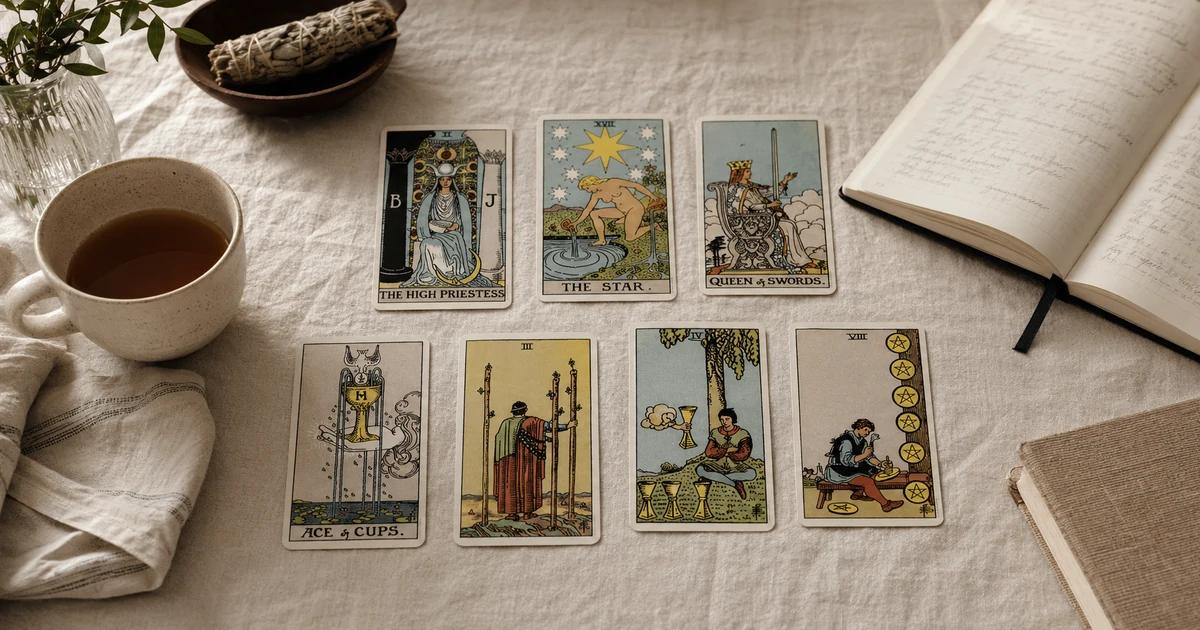
A card in a past position can feel awkward when the event itself is already clear. You know why the relationship ended. You know when the move happened. You know that leaving the job was your decision. Then the card seems to describe something else entirely.
That mismatch does not make the card useless, but it does change the job of the interpretation. A past-position card does not become a second historical record. It can help you examine what part of the known past still matters to the question in front of you: an influence, consequence, assumption, unresolved concern, or meaning you are carrying forward.
A useful rule is simple:
Keep the historical record and the interpretive layer separate.
That gives the card room to be useful without asking it to establish facts it cannot establish.
Key points
- Define the period and purpose of a past-position card before drawing conclusions about how earlier events matter now.
- Preserve established facts while treating card imagery as hypotheses about present influence, consequences, or meanings carried forward.
- Allow a weak fit to remain unresolved when making the card work would require invented events, private motives, or contradicted records.
Give the past position a specific job
“Past” is too broad to interpret well on its own. Before reading the card, decide what period and function the position is meant to cover.
In one reading, the past position may refer to the weeks immediately before the current situation. In another, it may point to an earlier event that shaped the question. It might be about an attitude the reader still carries, an influence that began earlier and remains active, or the reader's present understanding of something that already happened.
Those are different jobs.
If a spread gives the position a fuller question, use it. If the slot is labelled only “Past,” set a reasonable boundary from the question before interpreting the card. For a reading about whether to accept a new role, the relevant past might be recent work experience rather than childhood, every previous job, or an unspecified hidden event.
A position becomes more useful when it has a defined task. The same principle applies beyond past positions; this guide to how the same tarot card changes across spread positions looks at that position-first approach in more detail.
Without a time boundary, almost any symbol can be made to fit something. Defining the position first makes the reading harder to stretch into whatever story seems convenient afterward.
Keep facts, interpretations, and unknowns in separate lanes
When a past-position card feels wrong, it helps to separate three things that can easily blur together.
Known facts are what can be stated without relying on the card: what happened, when it happened, what was said or decided, what records or direct observation establish, and what remains genuinely documented.
Interpretation is the meaning attached to those facts. This can change over time, especially when you return to an old reading. An event that once felt like a clean choice may later look more complicated. A conflict that seemed minor at the time may now appear more influential. That shift in understanding does not alter the underlying event.
Unknowns are the parts that evidence does not settle. A hidden motive, an unrecorded conversation, or someone else's private reasoning may remain unknown even when a card seems to fit a compelling explanation.
The card belongs primarily in the interpretive lane. It can direct attention toward what feels relevant now, what consequence is still active, what assumption the reader carried forward, or what pattern the earlier event resembles in the present situation.
Suppose you know that you resigned from a job after accepting another offer. A card should not turn that into “I was actually rejected and did not realize it.” It could, however, prompt you to examine whether the transition also involved insecurity, loss of belonging, financial pressure, or a fear that is showing up again in the current question.
Those are possible lines of reflection. They are not replacements for the record.
Turn a mismatch into hypotheses
When the symbolism appears to conflict with known history, resist the pressure to make the card “right” by inventing a hidden event. Translate the card into several possible questions first.
Imagine a card you associate with isolation, scarcity, rejection, or being left out. The known history is that you voluntarily left a stable role for a better opportunity.
An unsupported historical claim would be:
“The card shows that the old company secretly wanted me gone.”
Nothing in the known facts establishes that. The card has been promoted from symbol to evidence.
More useful hypotheses stay closer to what can actually be examined:
- Did leaving involve a loss of belonging even though the choice was voluntary?
- Was financial insecurity part of the transition?
- Did an earlier experience of exclusion influence how the new offer was evaluated?
- Is the current career question bringing an old fear of being unsupported back into focus?
- Is the card simply a weak fit for the position as currently defined?
That last possibility matters. A reading does not need every card to resolve into a satisfying story. Sometimes the disciplined answer is that the fit remains unclear.
When the card conflicts with memory or records
A direct conflict needs a clear hierarchy.
If a fact is well established, keep it fixed. If the disagreement concerns an interpretation, feeling, or meaning attached to the event, the card can invite reconsideration. If the evidence is incomplete, keep that uncertainty visible rather than using symbolism to close the gap.
A practical order is:
- Established event facts stay fixed.
- Personal interpretations can be examined.
- Unknowns stay unknown unless other evidence resolves them.
- The card can suggest questions about relevance, meaning, influence, or pattern.
This becomes especially important when the tempting interpretation requires an event that exists only because the card appears to imply it: a betrayal nobody observed, a forgotten incident, an undisclosed motive, or a conversation for which there is no evidence.
The point is not that such events are impossible. The point is narrower: the card does not establish that they occurred.
A reading can leave a factual question open.
A worked example: returning to a city you once left
Suppose a three-position reading asks whether to move back to a city where you once lived. The positions are past influence, present consideration, and what deserves attention before deciding.
The history is clear. Your fixed-term contract ended. You liked living there and wanted to stay, but the next suitable job was elsewhere.
Now imagine that the card in past influence is one you read through themes of conflict, defeat, or difficult separation. It would be easy to turn the card into a new explanation for the move:
“Maybe I actually left because the city defeated me, or because people pushed me out.”
That adds facts the history does not establish.
A more careful reading begins by preserving the record: the contract ended, you wanted to stay, and the available work was elsewhere. Then define the position. This is past influence, not “the hidden truth of why I left.”
From there, translate the card into possible present relevance. Perhaps the departure felt unresolved. Perhaps leaving felt like losing an argument with circumstance. Perhaps disappointment from that period still affects how attractive returning feels now.
Then bring the interpretation back to the current decision. If part of the desire to return is really a desire to repair how leaving felt, that is useful to notice. It does not change the historical reason for the move.
And if none of those readings fits, leave the fit weak. There is no need to manufacture a conflict to make the card feel successful.
The useful distinction is between “I want to live there now” and “I want to correct what leaving meant to me then.” A past-position card can help surface that distinction without rewriting why the departure happened.
Separate what happened from what it means now
Three questions keep the interpretation grounded.
What happened?
Answer this from evidence, records, direct knowledge, and appropriately bounded recollection. If something is not established, name it as uncertain.
How did I understand it then, and how do I understand it now?
This is interpretive territory. Meanings can change while the event stays the same. You can look back on a voluntary choice and notice that fear influenced it without concluding that the choice was involuntary. You can decide that an old conflict mattered more than you recognized at the time without inventing a new incident.
Why might this matter to the current question?
This is where the tarot position can contribute most. The card can direct attention toward a consequence, assumption, unresolved tension, or repeated framing that deserves examination now.
Keeping those questions separate prevents a change in meaning from quietly becoming a change in history.
When the past is genuinely uncertain
Some events are not fully documented, remembered, or agreed upon. That calls for more caution, not more certainty.
A card can still help you ask what interpretation you are currently relying on, whether the historical uncertainty actually matters to the present decision, what evidence could be checked, and whether you can move forward without resolving every ambiguity.
What it cannot do on its own is convert incomplete evidence into a factual answer.
If the current question depends on a fact that matters outside the reading, use the appropriate real-world source: documentation, a direct conversation, records, or other evidence relevant to the situation. If the fact cannot be resolved, the reading can work with the consequences of uncertainty rather than pretending the gap has disappeared.
A compact method for reading the past position
At the table, the full approach can be reduced to six moves:
- Define the period. Decide what part of the past this position covers.
- Write down the known facts. Keep them separate from the card.
- Translate the card into possible themes. Phrase them as hypotheses, not hidden events.
- Connect those themes to the present question. Look for influence, consequence, interpretation, or pattern.
- Test the fit. Reject readings that require contradicting established facts or manufacturing history.
- Allow a mismatch. If the card still does not fit, leave it unresolved or give it less weight.
The method protects both sides of the reading. The past stays anchored, while the card can still change what you notice about its relevance now.
A past-position reading is strongest when it produces a better question about your relationship to earlier events rather than a more dramatic account of what secretly happened. The historical record answers what happened as far as the evidence allows. The reading can help you examine what part of that history matters here, what meaning you are carrying forward, and what deserves attention in the present question.