Why the Same Tarot Card Means Different Things in Different Spread Positions
Spread positions change the job a tarot card is doing, not the card itself. Here is a grounded way to read one card across obstacle, advice, attitude, past, and outcome.
Aurora @ Liminal Tarot
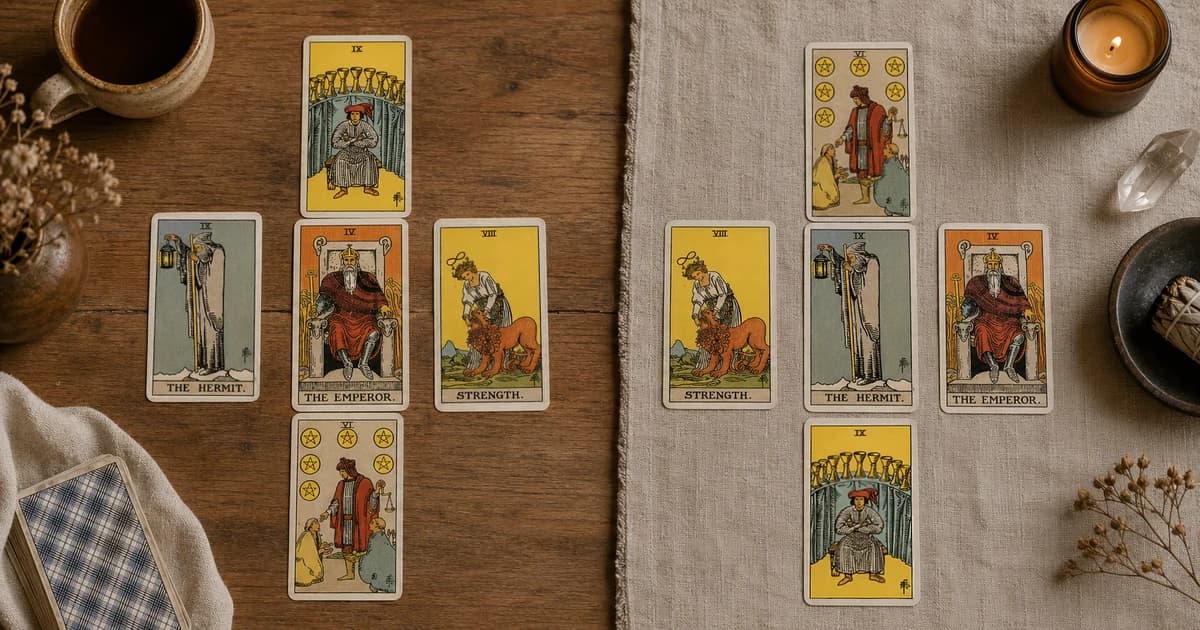
Pull the same tarot card twice and it can seem to say two different things.
In one spread, The Emperor lands in The Obstacle. In another, it lands in The Next Step. If you give the card exactly the same interpretation in both places, the position is barely doing any work. If you rewrite the card until it says whatever the position seems to demand, the card stops doing any work either.
A useful reading sits between those two extremes.
The card supplies a bounded range of themes. The position tells you what job those themes are being asked to do. The interpretation comes from the intersection.
That is why the same card can read differently as an obstacle, advice, a past influence, your attitude, or an outcome without becoming arbitrary.
The position is part of the question
A spread position is easy to mistake for a label beneath the card. "Present." "Challenge." "Advice." "Outcome." You draw the card, retrieve its familiar meaning, then add the position name afterward.
That usually produces a reading where every card sounds like a small dictionary entry.
The position is more useful when you treat it as a second question inside the larger reading question.
If the overall reading is about a work transition, a position called The Obstacle might be asking, What is creating friction or limiting movement here? A position called The Next Step might ask, What action or shift would serve this situation now? Your Attitude asks where the card belongs in your own stance rather than in the external situation. The Outcome asks about direction under current conditions, not a guaranteed event.
Liminal Tarot's own spreads make this distinction explicit by pairing position names with questions. In Career Path, The Obstacle asks what stands between where you are and where you want to be, while The Next Step asks what action or shift would serve your path right now. In the Celtic Cross, Your Attitude asks how you are showing up, while The Outcome asks where the path leads if the current energy continues.
The short title names the category of work. The full question tells you what the card must actually do.
One card, five different jobs
Take The Emperor. Its bounded range in Liminal Tarot includes structure, responsibility, authority, stability, boundaries, control, and rigidity.
Keep the card upright. Keep the overall situation broadly the same:
What is making this work transition difficult, and what deserves my attention?
Now change only the position.
The Present. Here the card is descriptive. The Emperor may point to structure as the dominant reality of the situation: formal expectations, defined responsibility, hierarchy, or a strong need for stability. The position is not asking whether that structure is helpful or harmful yet. It is asking what is active now.
The Obstacle. The same themes now have to explain friction. Rules may have become too rigid for a changing situation. Control may be concentrated in a way that blocks adaptation. A need for certainty may be making experimentation harder. The Emperor has not turned into a different card; structure and authority are still central. The position asks what happens when those themes are operating as a constraint.
The Next Step or Advice. The role changes from diagnosis to direction. The same card can now point toward clarifying a boundary, defining ownership, creating a process where repeated improvisation is failing, or stabilizing the part of the transition that actually needs consistency. "The Emperor as advice" does not mean "do something decisive" in the abstract. The advice still has to come from the card's recognizable material.
Your Attitude. Now the card belongs primarily to the reader's stance. You may be trying to stay composed through structure, taking responsibility for more than your share, or approaching the transition as something to control rather than something to learn from. The important shift is location. The card is no longer automatically "the boss," "the company," or "the system." The position asks what you are bringing.
The Outcome. Here the same material becomes a conditional trajectory. The situation may be becoming more formalized. Responsibilities may become clearer and less negotiable. A stable structure may emerge, or rigidity may become more pronounced if the controlling pattern continues. The wording matters: this is a direction to consider under present conditions, not a prediction that a fixed event will happen.
Across all five positions, the semantic family stays recognizably The Emperor. What changes is the relationship between that family and the question.
Position changes relation, not evidence
Some position names can make a reading sound more certain than it really is.
A position called The Other Person can tempt you into treating a card as direct access to someone else's private thoughts. External Influences can tempt you into claiming facts you cannot observe. Future and Outcome can slide into prediction. Advice can start sounding like an instruction with more authority than the reading has earned.
The position changes the topic of reflection. It does not change what the reading can responsibly know.
A card in a position about another person can help you examine the relationship dynamic as you perceive it, the behavior you have observed, or the interpretation you are making from it. It cannot prove a hidden motive or feeling. A future-facing position can help you consider what appears to be emerging if the present pattern continues. It does not establish what will happen. An advice position can frame an approach, adjustment, question, or boundary to consider. It does not become medical, legal, financial, mental-health, or other high-stakes instruction simply because the spread calls the slot "Advice."
This boundary does not weaken the reading. It keeps the interpretation attached to what the cards can actually be used for: reflection, not external evidence.
When a card seems to clash with the position
Sometimes the position makes the card harder to read, not easier.
Suppose the position is Advice and the card is the Eight of Cups. The immediate reaction might be: Does this mean I have to leave?
The position does not require the card to become a command.
Start by clarifying what "Advice" means in this spread. If the position question is What action, attitude, or approach would serve you best here?, then the slot permits more than one kind of response.
Then return to the card's bounded range. In Liminal Tarot's card-reference material, the Eight of Cups centers on leaving what no longer reaches you, disappointment, withdrawal, the point where something no longer satisfies, and the difficulty of deciding whether to remain or go.
Translated through an advice role, the card might ask you to notice where your emotional investment has already changed, identify what you are trying to keep alive, or create enough distance to see the choice more clearly.
That is different from saying, "The Eight of Cups means you must leave."
A position is a constraint on interpretation, not a command generator. When a reading only works by turning the card into an order, a prediction, or the opposite of its recognizable range, the fit deserves another look.
The overall question still comes first
The position narrows the card's job, but the overall reading question sets the domain.
The Emperor in The Obstacle could mean different things in different readings without losing its core themes. In a group project, the friction might involve concentrated control, unclear authority, or too many rules. In a personal routine, it might be a system so rigid that one missed day makes the whole practice feel broken. In a role negotiation, it might point toward a formal hierarchy or an expectation that is not easily changed.
The position is the same. The card is the same. The surrounding question changes what is actually plausible.
A useful hierarchy is:
- Overall question: What situation are you examining?
- Position question: What job is this card being asked to do inside that situation?
- Card range: What themes can this card legitimately contribute?
- Known context: Which interpretation fits without inventing facts?
If an interpretation answers the position but has little to do with the overall question, it is still off-task.
A position-first method you can use at the table
You do not need a separate definition for every card in every possible spread position. You need a repeatable way to combine the card with the role in front of it.
- Read the overall question again. State the situation or uncertainty the spread is actually examining.
- Turn the position title into a full question. If the spread already gives you one, use it. If it only says "Obstacle," try What is creating friction here? If it says "Outcome," try If the current pattern continues, what direction may become more prominent?
- Name a small card range. Two to four connected themes, tensions, actions, or relationships are usually enough. Do this before hunting for a meaning that conveniently fits the slot.
- Translate the card through the role. A simple frame can help: As the obstacle, this card's theme of ___ may show up as ___. As advice, this theme may invite attention to ___. As a past influence, it may describe how ___ shaped the present.
- Run a fit test. Does the interpretation answer the overall question? Does it perform the actual job of the position? Can you trace it back to the card? Does it require facts you do not know? Have you turned direction into prediction?
- Synthesize only after each card-position pair can stand on its own. In a multi-card spread, surrounding cards can reinforce, qualify, or complicate an interpretation. They should not erase the distinct job of the position.
Compactly:
Question → position question → card range → position-fit interpretation → fit test → synthesis.
If the difficulty starts earlier — choosing a layout that actually fits the question — choosing the right tarot spread is a separate step. Once the spread is chosen, position clarity is what keeps its cards from collapsing into one undifferentiated pile of meanings.
Larger spreads make position discipline more important
A vague three-card spread can sometimes survive because there are only three moving parts. In a seven- or ten-card layout, vague position reading compounds quickly.
A spread may contain a Present, Challenge, Past, Attitude, External Influences, Hopes & Fears, and Outcome. If those roles blur together, the reading becomes a list of card themes with no clear reason one idea belongs in one place rather than another.
Keeping the roles distinct also prevents one dramatic card from taking over the whole spread. An Outcome card should not rewrite the Present as though the future has already happened. A Challenge card should not make every other card a problem. A Hopes & Fears card is not automatically an objective description of the situation.
Interpret each card-position pair first. Then look at how the cards relate.
This matters even when two positions sound similar. Future, Near Future, Potential, What's Emerging, and Likely Outcome all point ahead, but they do not necessarily ask the same question. Challenge, Obstacle, What Is Being Tested, and Watch For can all describe friction while still emphasizing different kinds of friction.
Use the spread's actual wording. If the wording is vague, define the position question before you draw when possible. Deciding what a slot means after seeing the card makes it too easy to move the goalposts toward the interpretation you prefer.
The card stays itself; the relationship changes
"The same card can mean different things in different positions" is true, but it can sound more flexible than the practice needs to be.
A more precise way to put it is this:
A spread position changes the relationship between the card's material and the question.
The card may be asked to describe what is happening, what shaped it, what blocks it, what you bring to it, what approach may help, or what direction appears to be emerging. That is enough variation to create substantially different interpretations without severing the card from itself.
Good constraints make a reading more specific, not more certain.
You do not need thousands of position-specific card definitions. You need to be able to say why this card is being read this way, in this position, for this question — while still recognizing the card when it appears somewhere else.