How to Read a Tarot Card When Its Usual Meaning Does Not Fit the Question
When a tarot card's familiar meaning does not fit, use the question, position, imagery, and a fit test to build a grounded interpretation without forcing it.
Aurora @ Liminal Tarot
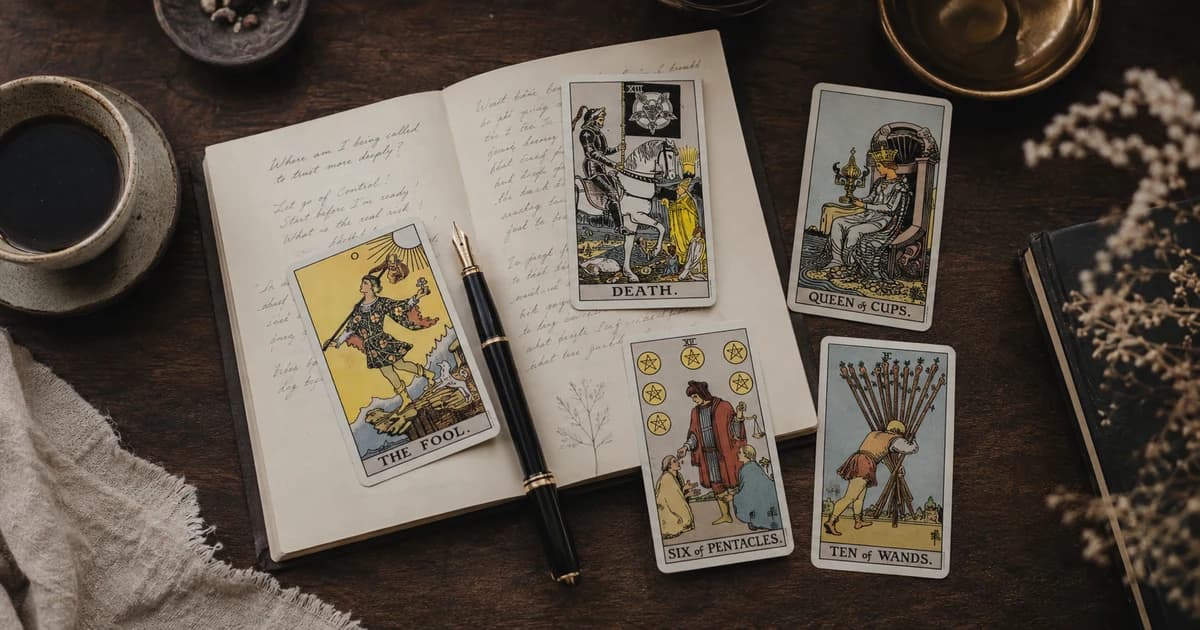
A tarot card can be perfectly familiar and still feel wrong for the question in front of you.
You ask what you are overlooking in a job negotiation and draw The Lovers. You ask what is making a project difficult to continue and draw Death. You ask what you are bringing into a conversation and draw The Emperor.
If your first association is romance, catastrophe, or a boss, the reading can seem broken. The card may be familiar. The definition may even be reasonable. It simply has not become an answer yet.
That distinction matters. A memorized meaning is starting material. The reading still has to connect the card to the exact question, the position it occupies, and the context you actually know.
When a card seems not to fit, try this sequence before replacing it:
Question → position → range → image → hypotheses → test → stop.
The aim is flexible interpretation with clear limits. The card should be able to change emphasis with context without becoming capable of meaning anything.
The usual meaning is only the starting material
Short card meanings are useful because they are easy to remember. They also become restrictive when one keyword starts standing in for the whole card.
The Lovers can be approached through relationship and attraction, but also through choice, values, alignment, and what a choice reveals. Death can hold ending, release, transition, and the point where an old form no longer continues as before. The Emperor can be read through order, structure, responsibility, authority, boundaries, control, and the rigidity those qualities can produce.
Different tarot references and traditions emphasize different parts of a card. You do not need one master dictionary for this method. You need a bounded range that keeps the card recognizably itself.
That range creates two useful limits at once. It gives you more than one keyword to work with, and it prevents free association from carrying the reading somewhere the card no longer supports.
So when the first definition fails, change the question from:
What does this card mean?
to:
Which part of this card's reasonable range actually answers what I asked?
That is a smaller problem, and usually a more useful one.
Return to the exact question and give the card a job
Readers often remember the topic of a reading more easily than its wording. "This is about work" is much broader than "What am I overlooking in this negotiation?" Those questions ask a card to do different things.
Suppose you ask:
What am I overlooking before accepting this job offer?
and draw The Lovers.
"Romance" does not help much. Return to the question and the card's wider range. The reading is asking what deserves attention before a choice.
Now several interpretations stay close to both card and question:
- the role may be attractive without matching the values that matter most to you;
- two priorities may require a real choice instead of an attempt to maximize both;
- the quality of agreement and mutual expectations may matter more than one headline benefit.
None of these requires turning The Lovers into a different card. The question has selected the part of the range that can do useful work.
A spread position narrows the job further. The Emperor in The Obstacle might point toward excessive structure, concentrated control, or rules that make adaptation difficult. The same card in The Next Step might point toward clearer structure, a boundary, or taking responsibility for a decision. In Your Attitude, it may describe the reader's own need to keep the situation orderly.
The underlying material stays recognizable. The grammatical role changes.
A simple check is to finish this sentence:
In this position, this card is being asked to describe ______.
If you cannot fill the blank clearly, work on the question or the position before adding another meaning.
In a single-card pull, the question carries most of that positional work. One card still benefits from a defined job: what exactly are you asking it to help you examine?
When keywords stall, look at the image literally
A card image gives you more material than a headline keyword. You can use that material without treating the image as a supernatural message.
Start with description before symbolism.
Notice what is visibly happening. Look at direction of movement, posture, distance, balance, repetition, what is held or released, what faces what, and where the scene seems constrained or open. Then ask which of those observations bears on the question.
This keeps imagery concrete.
A keyword such as "control" can stay vague. An image may help you distinguish between holding something steady, directing movement, restraining force, protecting a boundary, or gripping too tightly. Those are different hypotheses once you return them to a question.
The order matters:
- describe what you can actually see;
- name one or two actions, tensions, or relationships in the image;
- return them to the question and position;
- keep only what helps answer the reading without inventing external facts.
Imagery expands the interpretive material. The question still supplies the constraint.
Build a few hypotheses, then make them earn their place
When the first meaning does not fit, searching indefinitely for another definition creates a new problem. Eventually almost any preferred answer can be found somewhere.
Use a smaller hypothesis set instead.
Imagine the question is:
What am I bringing into this conversation?
and the card is The Emperor.
Three bounded readings might be:
Structure. You may be entering with a strong need for a clear agenda, defined terms, or an orderly outcome.
Authority. You may be assuming that you need to lead the exchange, establish firmer boundaries, or take the decisive role.
Rigidity. Your preference for control may leave less room for information that does not fit the plan.
All three can be traced to the card. All three answer the question about your own stance. None requires the card to reveal another person's private motive.
Now test them.
A useful interpretation should survive several constraints:
- Does it answer the exact question? An interesting interpretation that answers a different question is still off-task.
- Does it respect the position? An obstacle, next step, attitude, influence, or cost asks for a different kind of sentence.
- Can you trace it back to the card? If the association chain becomes so long that the original card disappears, the reading has lost its anchor.
- Does it require information you do not have? A card does not establish what another person secretly thinks, what will definitely happen, a diagnosis, or a legal, financial, or other external fact that needs direct evidence.
- Does it preserve the card's friction? A difficult card should not be softened automatically because a more comfortable interpretation is available.
The last check is easy to miss. Death does not have to become "positive transformation" every time an ending feels uncomfortable. The Emperor does not have to become "healthy boundaries" every time control is inconvenient. The Lovers does not have to become "good alignment" every time a choice has a cost.
Fit matters more than comfort.
Take Death in this question:
What is making this project hard to continue?
A bounded range might include ending, release, transition, an old form that cannot continue unchanged, and resistance to letting something finish.
That could support interpretations such as:
- the current version of the project may have reached its limit;
- one feature, role, assumption, or commitment may need to end before the work can continue differently;
- the difficulty may come from trying to preserve continuity when the situation now requires a transition.
The card can remain serious without becoming a prediction of catastrophe. The scale of the interpretation comes from the scale of the question.
A clarifier should have a defined job
A clarifying card can help when you know what remains unclear. It is less useful as an automatic response to discomfort.
If the first card seems wrong and you immediately draw another, the original interpretive problem is still there. Now you have two cards to explain.
Before pulling again, try to complete this sentence:
I understand that this card may be describing ______, but I need clarification about ______.
A useful second blank is specific.
You might ask which part of an ending is most relevant, what makes a need for control an obstacle rather than a support, or which value is in tension in a choice.
"What does this card really mean?" is not yet a clarification job. Neither is "Is this good or bad?"
A second card should narrow a defined uncertainty. It should not erase the first card because the first answer was inconvenient.
Several interpretations can remain open
Sometimes the problem reverses: more than one interpretation fits.
The Emperor may describe structure that is necessary and rigidity that is costly. The Lovers may describe attraction to an option and a values-based choice at the same time. Death may describe an ending and resistance to that ending together.
You do not always need to collapse those tensions immediately.
Rank them by support:
- Best supported: directly answers the question and matches the context you already know.
- Possible: fits the card and question, but there is not enough context to prefer it.
- Unsupported for now: depends on prediction, hidden information, or assumptions the reading cannot establish.
This makes room for an honest result that is partly unresolved.
You might end with:
I can see that The Emperor may be about structure or control here, but I do not yet have enough context to tell whether that structure is supportive or rigid.
That is still a reading. A confident sentence is not automatically more useful than a bounded uncertainty.
Leaving the ambiguity visible also protects the original moment. If new real-world information appears later, you can return to what you actually knew then instead of rewriting the earlier card as though its meaning had always been obvious.
The recovery sequence to keep beside your deck
When a familiar meaning seems useless, use the short version:
- Read the question again. What exact thing is this card being asked to help you examine?
- Name the position's job. If there is a spread position, turn it into a clear sentence.
- Expand the card into a small range. Use two to four related themes, tensions, actions, or relationships instead of one headline keyword.
- Look at the image literally. Describe what is happening before deciding what it symbolizes.
- Generate two or three hypotheses. Each one should connect the card, question, and position.
- Run the fit test. Remove readings that drift from the question, lose the card, require unsupported facts, or flatten the card for convenience.
- Stop where the evidence stops. Keep the strongest reading, preserve two possibilities, or leave the card unresolved.
Pull a clarifier only when you can name the exact uncertainty the next card is meant to clarify.
The compact formula is:
Question → position → range → image → hypotheses → test → stop.
Context does not make card meaning arbitrary. It helps decide which part of a recognizable range is active in this particular reading.
That is the shift from retrieving a definition to making an interpretation. A card does not have to become immediately legible to be useful. Sometimes the skill is staying with the friction long enough to find the reading the question can actually support.