How to Read Tarot Cards You Drew Without Assigned Spread Positions
Already drawn several tarot cards without choosing positions? Learn how to read them as a set, keep the original draw clear, and use later roles without rewriting what happened.
Aurora @ Liminal Tarot
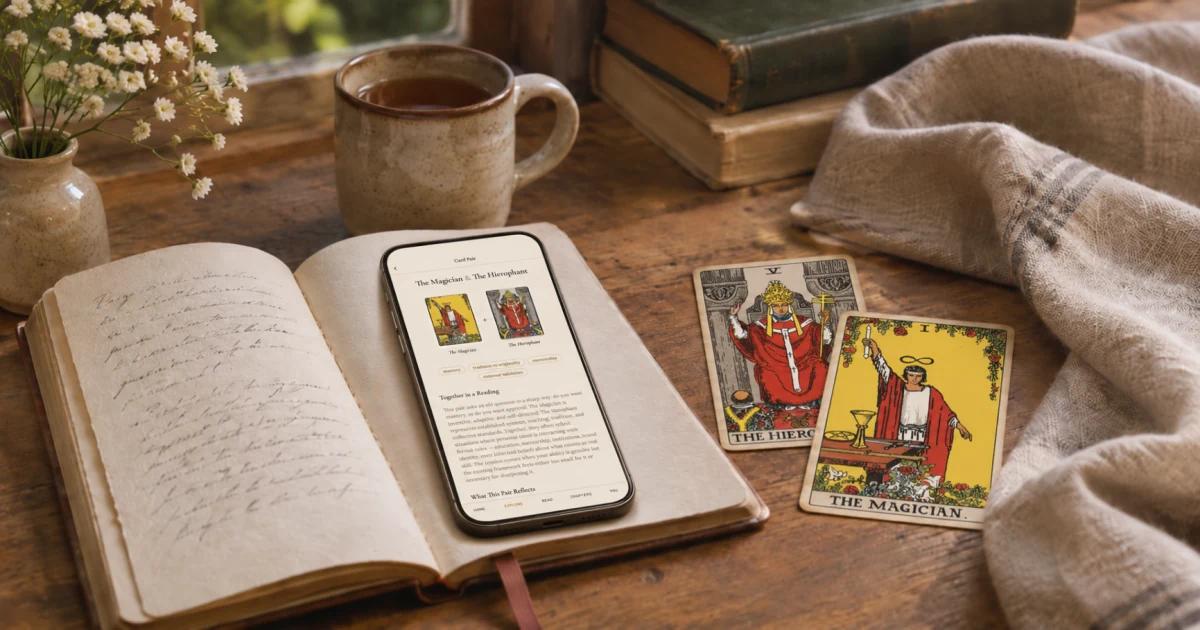
Three cards are face up on the table. You had a question in mind when you drew them, but you never decided that the first card would mean the past, the second an obstacle, or the third advice. Now that you can see the cards, assigning those roles seems like the easiest way to make sense of the reading.
You can still read the cards without doing that. A spread's positions are one way to give a reading structure, not a requirement that every draw must satisfy. The important distinction is simple: what you decided before seeing the cards is different from how you choose to interpret them afterward. Both can be useful, as long as the record does not confuse them.
Key points
- Record the original question, cards, observed order, and the fact that no individual positions were assigned before the draw.
- Compare the cards under the same question, noticing shared themes or tensions before deciding whether to give them separate roles.
- If you add positions after seeing the cards, label that as a second interpretation rather than rewriting the original draw.
What you have when you draw without positions
In a positioned spread, each place has a job before its card is revealed. You might decide that one card will explore a pressure you are under, another a resource you have, and a third a next step within your control. Those questions shape how you read the cards that land there.
An unpositioned draw has no individual jobs assigned in advance. It may still have a clear question, a known draw order, an arrangement on the table, or an image that immediately caught your attention. These are details of the draw, but none of them silently creates a position. Drawing three cards from left to right does not, by itself, make them past, present, and future.
This can be intentional. Some people prefer to look at the cards together before deciding what stands out. It can also happen by accident. Perhaps you intended to set positions and forgot, or began drawing before you had worked out the layout. You have not lost the ability to interpret the cards. You only need to avoid filling gaps in the original procedure with details you decided later.
Keep the original draw intact
Before you try to make the cards fit a pattern, write down what you actually know. The record can be brief. Include the original question or intention, the cards that appeared, and their order if you observed it. Note orientation and arrangement if you noticed them and they matter to your approach. A first reaction is worth keeping if you genuinely remember it; a thought you have only now belongs to the present interpretation.
Most importantly, say that no individual positions were assigned at draw time. That one sentence protects the distinction you will need later.
Suppose you drew three cards while thinking about another commitment you might take on. You remember the cards but not the sequence. There is no need to reconstruct an order that feels plausible now. You can read them as an unordered group. If two original positions were assigned but you forgot the third, record the two you remember and leave the third uncertain. Forgetting a detail is different from never having chosen it.
A useful habit is to keep two kinds of note separate: observed when drawing and chosen during interpretation. You are not trying to prove that one meaning is correct. You are keeping track of where each part of the reading came from.
Read the cards together before giving them jobs
Start with the question you actually asked. Look at each card as one possible response to that same question, rather than rushing to give each card a different question of its own.
Notice one specific image, contrast, or familiar association in each card. Then compare the cards. Two might circle the same concern from different angles. One might introduce a useful caution or possibility. They may also pull in different directions, leaving a tension that is more revealing than a neatly agreed conclusion.
For instance, if one card evokes movement and another evokes rest, there is no need to appoint the quieter card as the “obstacle.” Both may be relevant to a question about taking on something new. The contrast could be between interest in a fresh opportunity and the time available for it. That gives you a grounded question to examine without claiming the cards have established what will happen.
If you recorded the reveal order, you may choose to read it as a sequence: one theme giving way to another. Mark this as a narrative reading of the observed order, not as a past-present-future spread that you had set beforehand. If the order is unknown, compare the cards by theme instead.
Aim for one useful synthesis rather than three separate pronouncements. It may be as modest as: “These cards bring my curiosity about the opportunity into tension with my existing commitments. I need to check what accepting it would displace.” If a card does not contribute much to that reading, you do not have to force it to deliver a dramatic message.
An example: the same three cards, two honest readings
Imagine someone wondering whether to agree to another commitment next month. Before drawing, they ask, “What should I pay attention to before I say yes?” They draw Two of Pentacles, Four of Swords, and Page of Wands, in that observed order, without assigning individual positions. This is a hypothetical example. The card associations are possible interpretive choices, not facts about a real person's situation.
On a first, positionless pass, the Two of Pentacles brings to mind balancing demands. The Four of Swords introduces the idea of pause, rest, or space to think. The Page of Wands suggests curiosity about something new. Taken together, these do not give a prediction about the commitment. They put available capacity and new interest side by side.
That contrast leads somewhere practical. What is already on the calendar? Which obligation would have to move? Could the person test the new interest on a smaller scale before agreeing to everything? The cards have helped shape questions, but the answers still depend on the person's circumstances.
Because the reveal order was observed, the reader might also notice a story that moves from juggling responsibilities, through pause, toward experimentation. That is a legitimate way to organize a reading. It is still a story assembled from the sequence, not proof that the first card represented the past and the last represented a future event.
Now imagine the reader looking at the same cards again and deliberately giving them three roles: current pressure, possible resource, and small experiment. In this second pass, the Two of Pentacles becomes a lens on pressure, the Four of Swords a lens on a pause that might help, and the Page of Wands a lens on trying something without a full commitment.
The two interpretations are similar, but their histories are different. The first arose from comparing a group of cards under one question. The second used positions invented after seeing the cards. A faithful note could say:
First pass: unpositioned draw; compared themes across all three cards. Second pass: assigned pressure / resource / experiment roles after the reveal to explore another interpretation.
If those later roles make the reading feel more coherent, they may be worth keeping. They do not become the original spread by being convincing. Seeing the cards first may even have influenced which jobs felt natural. Naming that influence makes the second pass clearer, not less useful.
When to choose positions next time
Sometimes you want distinct answers to distinct parts of a question. If so, write those parts down before revealing the next set of cards. For a decision about time, you could use “What demands are already present?”, “What do I need to protect?”, and “What small action could I try?” The roles then belong to that new draw from the start.
This is the difference from the method for reading a three-card spread as one coherent reading: that method begins with positions that already have functions and then combines their meanings. Here, you are working with cards whose individual functions were never set.
You do not need to make a new draw just to repair an unpositioned one. If the first reading has already brought an important practical question into focus, stopping may be more useful than adding another layer. A structured follow-up is an option when separate positions would genuinely clarify what you want to examine.
Neither free-form reading nor preassigned positions is the universally correct method. What matters is knowing which method you used, and letting the real question determine whether structure helps.
A small note you can keep
For a positionless draw, a paper journal or simple private note is enough. The record might look like this:
Original question or intention:
Cards drawn (and observed order, if known):
Positions assigned before the reveal: none
Details I actually observed:

Themes or tensions across the cards:
One question to check against real circumstances:

Optional roles assigned after the reveal:
What changed in this second interpretation:
What I still do not know:
The format keeps observation and interpretation visible without turning a reading into paperwork. It also leaves room for uncertainty. You may have found a useful way to think about the question without yet knowing what to do.
The cards can offer a frame for reflection. Your next decision still belongs to you, and it still needs the ordinary facts: time, obligations, conversations, consent, and any expertise the situation calls for. You do not need to claim that the cards had positions all along for the reading to be worth keeping.