How to Choose the Right Tarot Spread for Your Question
Learn how to choose tarot spread based on your question, complexity, and desired depth so each reading fits the moment. Start with clarity today.
Aurora @ Liminal Tarot
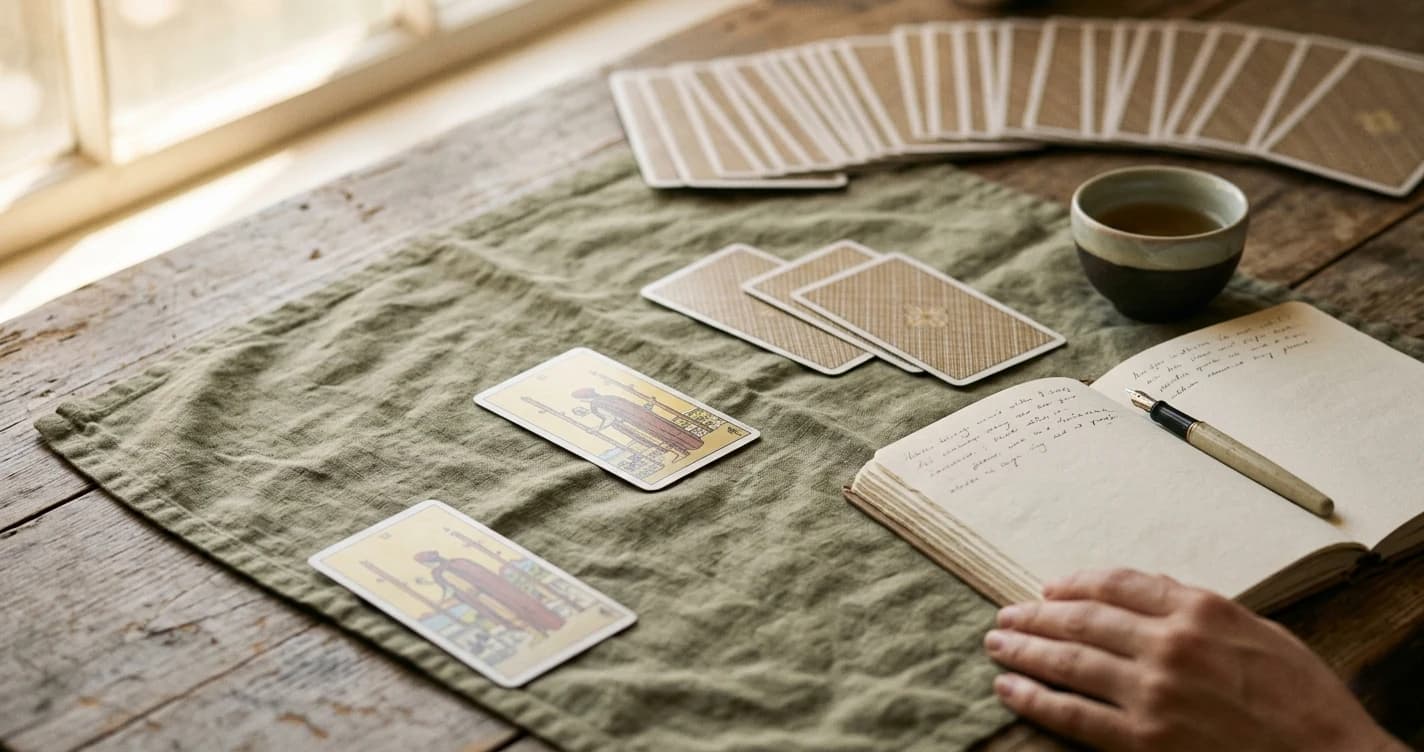
You sit down to read, shuffle your deck, and then stall out at a surprisingly basic point: what spread am I even supposed to use for this? That hesitation matters more than most guides admit. Knowing how to choose tarot spread isn't about picking the fanciest layout. It's about choosing a structure that matches the kind of thinking you need.
A spread does not make a reading more serious just because it uses more cards. In practice, the right spread gives your question enough room without turning it into mush. Too small, and the reading feels thin. Too big, and you end up generating complexity you didn't actually need.
This guide gives you a simple framework for choosing well. You'll learn how to tell whether your question is open or directed, when to use one card versus a multi-card layout, and how to avoid the very common mistake of picking a spread because it looks impressive instead of because it fits. If you want a reference point while you read, the full tarot spread library is a useful place to compare layouts.
What you're really choosing when you choose a spread
Most people think they are choosing a layout. What you are actually choosing is a container for attention.
A one-card pull asks for focus. A three-card spread introduces relationship and movement. A Celtic Cross gives you a wider system: pressures, patterns, context, internal state, likely direction. The spread shapes the kind of answer you can hear.
That is why the first question is not, "What spreads exist?" It is: what kind of help do I need right now?
Usually, your need falls into one of these buckets:
- Clarity: You feel foggy and need one clean prompt.
- Exploration: You sense there is more going on and want to open the question.
- Decision-making: You need to weigh factors, tensions, or options.
- Pattern-seeing: The situation has history, contradictions, or repeating loops.
When practitioners choose badly, they usually mismatch the need and the format. They want clarity but pull ten cards. Or they need nuance and insist on one card because they want the reading to be fast.
Try this before you pull anything: write one sentence that starts with, "What I most need from this reading is..." If your answer is "one honest nudge," go simpler. If your answer is "help me untangle why this situation keeps snagging," choose a spread with enough positions to hold that complexity.
A practical example: say you're debating whether to send a difficult message to someone. If the real need is emotional honesty, one card or three cards may be enough. If the real need is understanding the whole dynamic, including your fear, their role, and the likely consequences, a fuller spread makes more sense.
How to choose tarot spread based on the type of question
The easiest way to decide is to sort your question into one of two categories: open or directed.
Open questions need room to reveal something
Open questions sound like this:
- "What am I not seeing about this situation?"
- "What wants my attention right now?"
- "What is this season of my life asking from me?"
These questions are not asking for a verdict. They are asking for perspective. A spread with a little breathing room works best here, often three to five cards.
This is where a lot of readers reach too quickly for a yes/no frame when what they really need is language. A three-card layout can show what is emerging, what is blocking, and what would help. That is often enough to shift your thinking.
Exercise: Take your original question and remove any hidden demand for certainty. Change "Should I quit?" to "What is making this work situation feel unsustainable?" Then ask whether the rewritten version needs one card, three cards, or something broader.
Directed questions need structure, not just more cards
Directed questions sound like this:
- "What should I understand before making this decision?"
- "How do these two options differ in what they ask of me?"
- "What is the real conflict underneath this choice?"
These questions benefit from defined positions. You are not trying to "see what comes up." You are trying to compare, clarify, or understand a system.
This is where your tarot spread guide mindset matters. You want positions that do actual work. Not filler. If your question has two options, use a spread that compares. If your question is about a tangled situation, use a spread that separates external pressures from internal narratives.
A composite example: Maya has two job options and keeps asking friends what they would do. The problem is not lack of advice. The problem is that her excitement and fear are fused together. A structured spread helps her see what each path demands, what she is projecting onto each one, and what kind of growth each option actually invites.
Exercise: Underline the nouns in your question. If you see multiple moving parts — option A, option B, fear, timing, outside pressure — choose a spread with clearly distinct positions.
Match the spread size to the complexity of the moment
Once you know the question type, the next decision is size. This is where people often ask, which tarot spread to use as though there is one correct answer. There isn't. There is only fit.
Use one card when the question is honest and narrow
One card is ideal when you are checking in, interrupting a spiral, or trying to stay close to a daily practice. It works best when the question is simple and emotionally specific.
Good examples:
- "What energy am I bringing into today?"
- "What am I avoiding in this conversation?"
- "What would help me stay grounded right now?"
One card is not "basic." It is disciplined. Many readers would get better readings if they stopped assuming more cards equals more truth. Our guide on when a single-card tarot pull is enough goes deeper on this.
Exercise: If you can state your question in one sentence without using "and," "but," or "or," try one card first.
Use three cards when you need movement, contrast, or context
The three-card spread is the workhorse because it introduces relationship without overwhelming the reading. You can map it as situation / obstacle / advice, known / hidden / next step, or option / tension / guidance.
This is often the best tarot spread for my question when the situation has more than one layer but does not need a full diagnostic. You want shape, not a novel.
A second example: Andre keeps replaying an argument with his partner and wants to know if the relationship is doomed. That is not actually the useful question. A three-card spread around "what I brought, what I missed, what the conversation needs next" gives him something more grounded than prediction.
Exercise: Write three position labels before you shuffle. If you can't define three positions that genuinely differ from one another, drop back to one card.
Use a larger spread when the situation is multi-threaded
A bigger spread earns its keep when the question involves history, contradiction, competing forces, or a major decision with real consequences. This is where the Celtic Cross guide becomes useful. Not because the Celtic Cross is inherently superior, but because it helps when you need to read across a system rather than isolate one feeling.
Larger spreads are helpful when:
- the situation has been unfolding for a while
- you keep asking the same question and getting nowhere
- you need to distinguish your fear from the actual conditions
- timing, internal state, outside influence, and likely direction all matter
Use caution here. Bigger spreads are not for moments when your nervous system is already overloaded. If you are dysregulated, a 10-card reading can turn into intellectual camouflage. You feel busy, but not clearer.
Exercise: Ask yourself, "Am I choosing more cards because the situation is complex, or because I am scared one clear answer will confront me?" Be honest. That answer alone can change the spread you choose.
A simple pre-reading filter that saves you from bad spread choices
When readers ask, "What tarot spread should I use for this question?" they often skip the most important step: refining the question before choosing the layout.
Use this four-part filter.
1. Name the real subject
What is the reading actually about? The job? The breakup? The indecision? Your fear of being seen? Sometimes your first version of the question is only the socially acceptable one.
Prompt: "Under this question, what am I really asking?"
2. Decide whether you want reflection or resolution
Some readings are meant to open insight. Others are meant to support a choice. Confusing these goals creates muddy spreads.
Prompt: "Do I need understanding, or do I need a decision framework?"
3. Check your current capacity
Your energy matters. If you are tired, activated, or tempted to overread, choose a smaller format. A spread should support the reading, not become a performance of seriousness.
Prompt: "How much complexity can I honestly hold well right now?"
4. Choose the smallest spread that can do the job
This is the rule that improves most readings fastest. Start with the simplest structure that matches the question. You can always do another reading later. What usually weakens a reading is not lack of cards. It is lack of precision.
Prompt: "What is the minimum structure this question needs?"
This filter also makes digital reading tools more useful. You are not browsing layouts at random. You are making a deliberate choice in the reading flow, which usually leads to cleaner interpretation and better journaling afterward.
A quick spread-selection framework you can actually remember
If you want one rule of thumb, use this:
- One card for a focused check-in or one honest reflection point
- Three cards for contrast, movement, or moderate complexity
- Larger structured spread for layered situations, major decisions, or recurring loops
That is the whole framework. The nuance comes from matching the spread to the question, not from memorising endless layouts.
In practice, people who get the most out of tarot are rarely the people using the most elaborate spreads every time. They are the ones who respect the moment in front of them. Some mornings, one card is enough. Some crossroads deserve a full table and real time.
If you're choosing right now, open the spread library, pick the smallest layout that genuinely fits, and let the question lead. Or, if you want the simplest possible starting point, pull today's daily card on Liminal Tarot — it's free, no account needed. What would change if your next reading used less force and more fit?