The Case Against Outsourcing Your Tarot Reading to ChatGPT
Tarot on ChatGPT can feel helpful, but it rarely becomes a real practice. Learn what general AI misses and what actually helps. Try it free.
Aurora @ Liminal Tarot
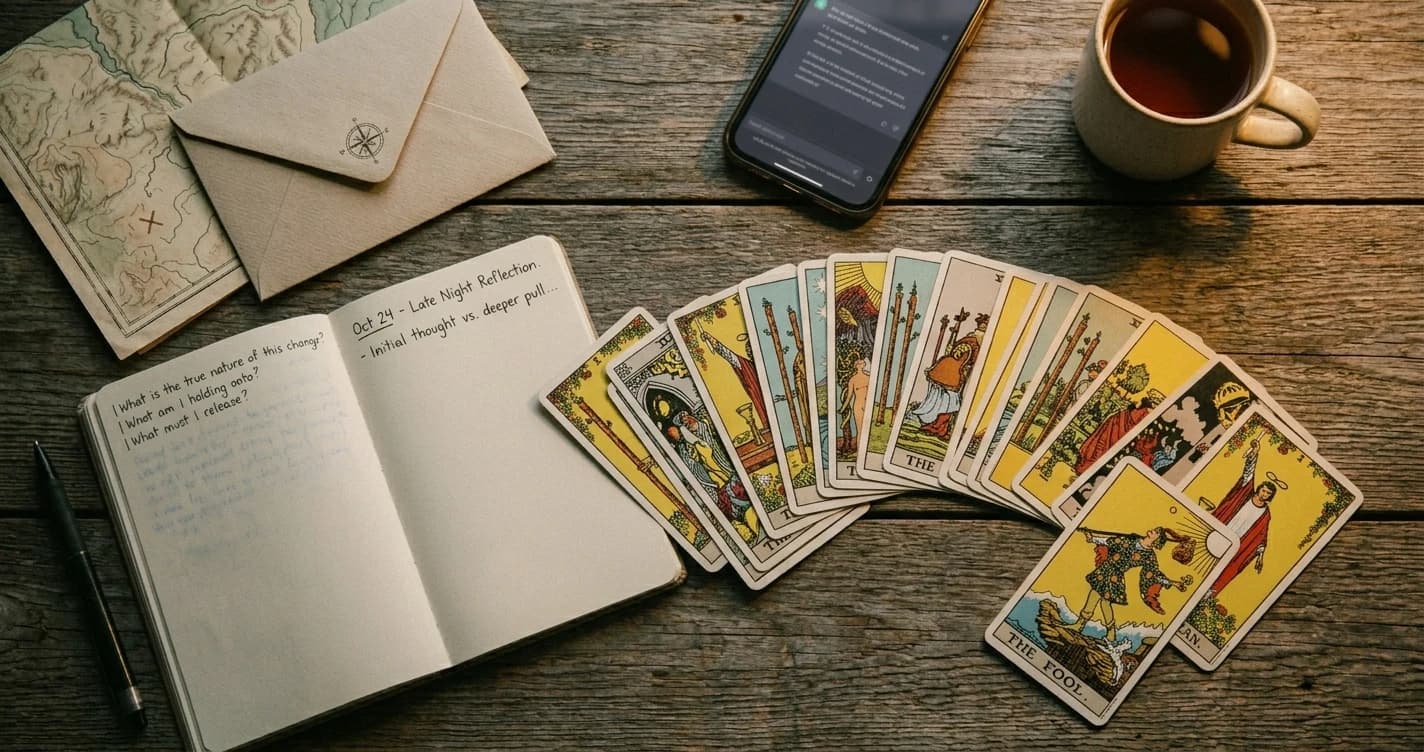
Plenty of people have tried tarot on ChatGPT already.
It makes sense. You have a question, you want language fast, and opening a general AI chat is easier than setting up a full ritual or deciding which spread to use. You type something like, "Give me a tarot reading about my job," and a thoughtful-sounding answer appears in seconds.
So this is not an argument that using AI for tarot is wrong. The better question is: what do you actually get from that experience, and what do you lose?
A general chatbot can be a useful conversational mirror. But a tarot practice asks for more than a fast interpretation. It asks for continuity, ritual, and a record of what has been unfolding over time. That is the difference this article is really about.
Why tarot on ChatGPT feels useful in the first place
There is a real reason people reach for a chatbot when they want reflection.
It removes blank-page paralysis. It gives you language when you feel foggy. It is private, immediate, and available at the exact moment your mind starts looping.
Imagine someone in the middle of a career pivot. They do not want prediction. They want a way to sort through fear, timing, identity, and the nagging feeling that their current work is over. A chatbot feels attractive because there is no setup cost and no pressure to do tarot "correctly."
Or think of someone who owns a deck but has not touched it in months. They still want insight, but the ritual feels farther away than the need. A chat window is simply closer.
A reflective tool you can actually reach for is better than an ideal practice you never begin.
But convenience is not the same thing as depth.
Try this: ask yourself what problem the chatbot is solving for you in that moment: speed, privacy, structure, or language.
What general AI does well in tarot
Used carefully, a general chatbot can do a few things genuinely well.
It can help beginners brainstorm card meanings. It can suggest spreads. It can rephrase a vague question into something more usable. If you already pulled your own cards, it can act like a study partner and offer symbolic angles you had not considered.
That is not nothing. For many readers, it lowers the intimidation barrier enough to begin.
Even experienced readers can benefit from that kind of interruption. Sometimes the value is not that the AI is right. It is that it says something sideways enough to reveal where you agree, where you resist, and what the card is really stirring up.
So yes, you can use ChatGPT for tarot. You can have a meaningful moment doing it.
The problem begins when that moment gets mistaken for a whole practice.
Try this: if you want to use AI with tarot, pull the cards yourself first. Then ask the AI to help you reflect on those exact cards instead of asking it to invent a reading from scratch.
Where tarot on ChatGPT starts to break down
The weakness of a general chatbot is not that it is unintelligent. It is that it is general.
Most people do not come to tarot with only one question. They come with recurring themes: the same work dilemma, the same relationship pattern, the same exhausted uncertainty about whether a chapter of life is ending. A strong reading is often less about one interpretation and more about where that reading sits in a longer sequence.
That is where tarot on ChatGPT starts to thin out.
If you ask for a reading today and another one three weeks from now, you may get two decent conversations. But unless you build your own careful system around them, those readings do not live together in a meaningful way. The earlier cards are not held in an organized history. The question does not stay inside a named life chapter. Repeating symbols do not naturally surface as patterns.
Picture someone moving through burnout over several months. In April, their reading circles exhaustion. In May, it highlights resentment. In June, the same card appears again. Those repetitions matter. If each reading lives as a standalone chat moment, the practice keeps resetting to zero.
There is another loss too: ritual gets flattened.
When you type, "Do a tarot reading for me," the chatbot compresses the whole process into output. But much of tarot's reflective value lives earlier than that. It lives in choosing the question, selecting a spread, touching your deck, and laying the cards down one position at a time.
That is why your physical deck still matters in a digital tarot practice. It is not about nostalgia. It is about participation.
Try this: after any AI-assisted reading, ask, "What part of this came from me, and what part was simply fluent language?" If you cannot tell, the reading probably needs more of your own contact with the cards.
What a real practice needs that a general chatbot rarely provides
A real practice needs continuity.
Not just casual memory. Practical continuity: a way to revisit readings, compare them, keep related questions together, and notice what keeps returning.
That means a solid tarot practice benefits from four things:
1. A usable reading history
One reading can be insightful. Twenty readings can reveal a pattern.
Without a stable record, you cannot easily tell whether a card is truly repeating or whether your questions are evolving.
2. A container for life chapters
Big questions unfold across seasons, not evenings. Career change, grief, burnout, rebuilding after a breakup — these are chapters. A practice works better when related readings stay together instead of scattering across tabs and screenshots.
3. Respect for physical ritual
Many people do not want AI to replace their deck. They want help interpreting the deck they already trust. That means the ideal tool is one that can support a physical reading rather than override it.
4. Guidance that returns agency to you
A good practice should make you more articulate with yourself over time, not more dependent on one more answer. That is also why tarot as a pattern-recognition tool matters so much. The compounding value is in the record, not just the latest interpretation.
Try this: look back at your last three readings on the same issue. If they are scattered across notes, screenshots, and half-remembered chats, that is not a small inconvenience. It is the thing keeping your practice from compounding.
A better way to use AI without outsourcing the whole reading
The real alternative is not "use AI" or "avoid AI." That is a false choice.
A better model is to let AI support the reflective process while keeping the practice architecture intact.
That might mean pulling your own cards and using AI only for interpretation prompts. It might mean choosing a spread intentionally instead of asking for a generic reading. It might mean logging every reading in one place so next month's version of you can see what this month's version was actually wrestling with.
Say you are considering a career change. In a general chatbot, you might ask for an AI tarot reading ChatGPT-style and get a polished answer about risk and new beginnings. Helpful, maybe. But in a real practice, that reading would sit beside the one you did two weeks ago and the one you do next month. You would notice whether the same cards keep showing up. You would remember what question you were actually asking. You would see whether your fear is changing shape.
That is what people usually mean when they say they want something deeper than a chatbot reading. They do not necessarily want more mystical language. They want more continuity.
Liminal Tarot is built around that distinction. You can read with a digital deck or your own physical one, keep readings connected inside the same chapter, and build a history that becomes more useful the longer you practice. AI is still there, but it serves the ritual instead of replacing it.
Try this: next time you combine AI and tarot, keep one part of the experience deliberately human and embodied. Shuffle your own deck. Write your question by hand. Record the reading in the same place you recorded the last one.
Conclusion
The case against outsourcing your tarot reading to ChatGPT is not that general AI cannot say smart things about the cards. It can.
The case is that a real tarot practice needs more than smart output. It needs ritual, continuity, structure, and a way to see your own patterns over time. A general chatbot can assist that process, but it rarely provides the container by itself.
So use AI if it helps. Just do not confuse fast interpretation with a durable practice. If you want a tarot workflow that keeps the ritual in your hands while giving your readings somewhere to live, try a free reading on Liminal Tarot.