What Is Tarot Journaling? (And Why It's Different From Just Keeping a Journal)
Tarot journaling turns a card pull into structured reflection you can revisit over time. Learn how it works and build a practice that lasts.
Aurora @ Liminal Tarot
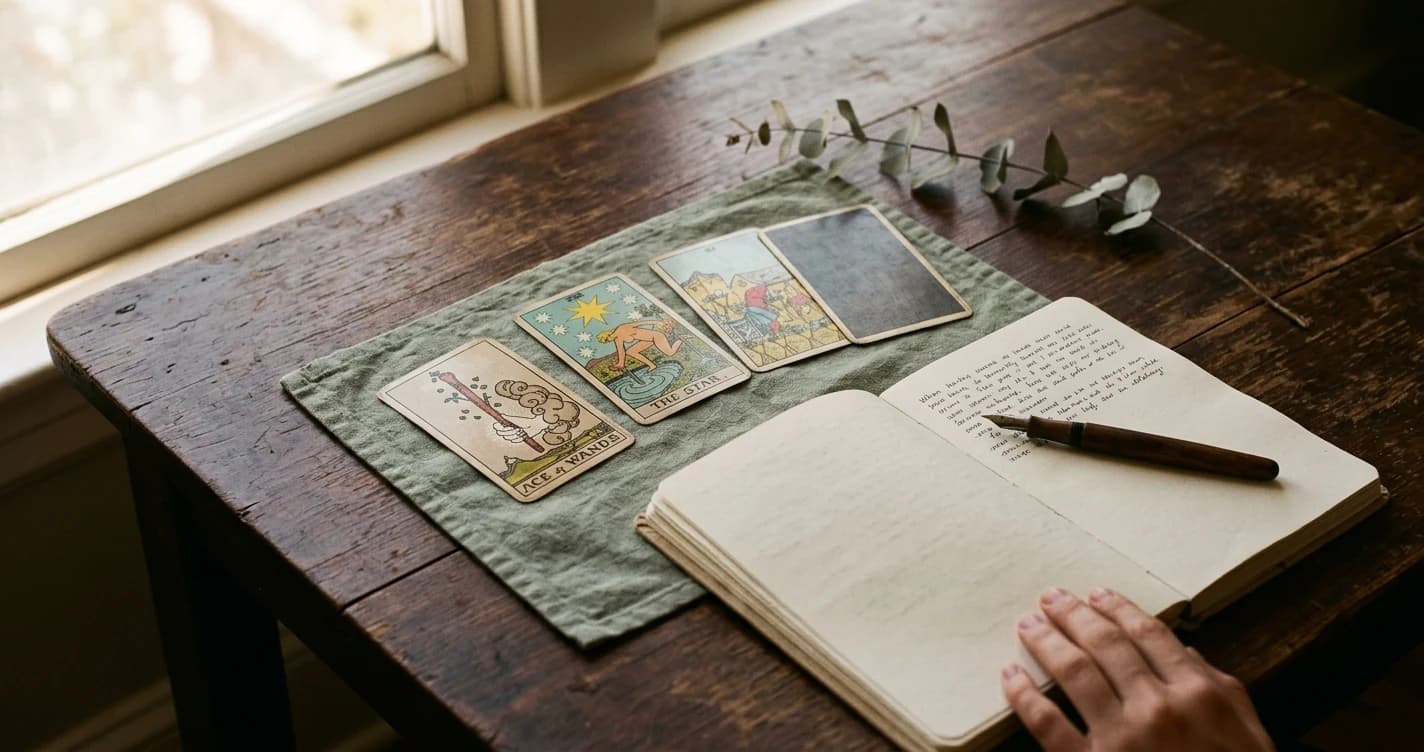
You pull a card, stare at it for a minute, have a few thoughts, then move on with your day. By evening, the insight is fuzzy. By next week, you barely remember what the question was.
That gap is exactly where tarot journaling becomes useful. It is not just "keeping a journal, but with cards nearby." It is a structured way to turn a reading into reflection you can record, revisit, and actually learn from over time.
If ordinary journaling asks, "What am I feeling?" this practice gives you a prompt to answer. The card becomes a starting point, the writing becomes the meaning-making, and the record becomes the part that compounds. In this guide, you'll learn what it is, how it differs from freewriting, why it helps people who freeze in front of a blank page, and how to build a practice that is simple enough to keep.
What tarot journaling actually is
At its core, it is a four-step loop: draw, reflect, record, revisit.
You draw a card or spread. You reflect on what it might be inviting you to notice. You record the reading in a way your future self can understand. Then, later, you come back and look for patterns, shifts, and unfinished questions.
That last step is what makes it different from a passing tarot moment. A reading can feel meaningful in the moment and still disappear from memory. A journaled reading becomes something you can work with later.
A simple example: imagine you pull the Hermit during a week when you feel socially drained. In a normal journal entry, you might write, "I feel off and want to be alone." In a logged tarot practice, you might record the card, the question, your interpretation, and what changed after you sat with it. Two months later, if the Hermit appears again during another stretch of withdrawal, you have context rather than just a vibe.
That is why this practice works so well for people in transition. One reading is a snapshot. A series of logged readings becomes a map.
Try this: the next time you pull a card, write down four lines only:
- What did I ask?
- What card appeared?
- What feels true right now?
- What do I want to revisit in a week?
That tiny structure is enough to begin.
How this practice is different from ordinary journaling
Regular journaling is open-ended. That freedom is great when you already know what you want to say. It is less great when your mind is crowded, resistant, or blank.
This practice adds an external structure. Instead of waiting for a coherent thought to appear, you respond to a symbol, a question, or a spread position. The card does not do the thinking for you. It gives your thinking somewhere to begin.
For many people, that is the difference between "I should journal" and "I actually wrote something useful."
Journaling starts with the page; this practice starts with a prompt
Blank-page journaling can easily turn into repetition. You circle the same story, complain about the same problem, then close the notebook without feeling clearer.
It interrupts that loop by narrowing attention. If you pull the Two of Swords, you are no longer asking yourself to write about your whole life. You are asking, "Where am I avoiding a decision?" That is a much easier doorway to walk through.
Journaling captures emotion; this practice adds perspective
A standard journal entry often records how you feel. That matters. But it also asks what the feeling might be connected to, what assumption is underneath it, and what theme keeps returning.
For example, someone dealing with work burnout might freewrite three pages about exhaustion. A tarot journal entry might surface something more precise: "Every card this month points to overextension and weak boundaries. I keep calling this a motivation problem when it may actually be a capacity problem."
That is the subtle power here. The cards do not replace your own insight. It helps you access it from a different angle.
Try this: after your next normal journal entry, pull one card and ask, "What does this entry need me to see more clearly?" Write three sentences in response. Compare the difference in tone.
Why tarot journaling helps when you do not know where to begin
A lot of people assume journaling fails because they are inconsistent. More often, it fails because starting feels too vague.
When you sit down with no prompt, no structure, and no container, your brain has to do three jobs at once: decide what matters, find language for it, and organize it into something coherent. That is a big ask when you are already tired, anxious, or emotionally tangled.
It reduces that friction.
The card gives you a focal point. The question gives you a boundary. The record gives you continuity. Instead of inventing meaning from scratch every time, you are responding to something already in motion.
This is especially useful in moments like these:
- You are in a life transition and every issue feels connected to every other issue.
- You keep thinking about the same situation but cannot get new perspective on it.
- You want a reflective practice, but blank pages make you shut down.
- You have done readings before, but they blur together because nothing gets logged.
This method also solves a quieter problem: memory distortion. We are not great at remembering how we felt, what question we asked, or what a reading actually said. We tend to remember the dramatic bits and forget the nuance. Writing creates a more honest record.
Imagine pulling the Tower and immediately assuming disaster. If you journal the reading, you might write that your actual life context was a growing discomfort with an old routine. A month later, the card may look less like chaos and more like overdue restructuring. Without the journal, you may only remember, "That was the scary card week."
Try this: use a three-part entry for one week:
- Situation: what is happening?
- Card: what is standing out?
- Shift: what might this reading be reframing?
Keep it under five minutes. The point is consistency, not performance.
What to include in a tarot journal entry
A good tarot journal entry does not need to be long. It needs to be legible to your future self.
You are not trying to write a beautiful essay. You are building a useful record.
Here is a practical template:
1. The question or intention
What were you actually bringing to the reading?
This matters because the same card means something different in a burnout check-in than it does in a relationship reading. Without the question, the interpretation floats.
2. The card or spread pulled
Write the cards down clearly. If you use reversals, note them. If a spread has positions, include those too.
3. Your first interpretation
What did you notice immediately? What emotion, tension, or idea came up? Keep this grounded in your current reality rather than trying to sound mystical or definitive.
4. A concrete next step or reflection prompt
Good readings do not end at interpretation. They create movement.
That movement might be external, like setting a boundary or making a call. It might be internal, like noticing a pattern or asking a better question. Either counts.
5. A revisit note
This is the part most people skip, and it is the part that turns this into a practice instead of an event.
Leave yourself a line like, "Revisit in three days," or, "Watch whether this shows up again this month." Now you are creating continuity.
Try this template:
- Question:
- Cards pulled:
- What feels most relevant:
- What this may be asking me to notice:
- One action or reflection for later:
- Date to revisit:
If you prefer digital logging, the same structure works there too. What matters is not the medium. It is whether you can find the reading again and see how it fits into a larger pattern.
The real value is in the revisit
The first benefit is clarity in the moment. The deeper benefit is accumulated perspective.
Once you have a reading history, you can notice things you would never catch from memory alone. Maybe you pull cards about rest every time you are about to overcommit. Maybe your readings around one relationship keep circling the same unasked question. Maybe a chapter of life you thought was random starts to show a very specific emotional pattern.
That is where the practice gets interesting.
A journal entry says, "This is what I felt today." Your record can also say, "This is what I keep returning to, and this is how it is changing." That is a different level of self-observation.
It is also why the practice tends to feel more useful over time, not less. The meaning is not only in the card you pulled today. It is in the conversation between this reading and the last ten.
If you are completely new to tarot, start with the basics in What Is Tarot. If you are curious whether this kind of practice can still be useful without supernatural beliefs, read Tarot for People Who Don't Believe in It.
And if you want a tool that helps you keep the full loop together — draw, reflect, record, revisit — Liminal Tarot is built for exactly that kind of practice. You can start simply, keep your reading history in one place, and follow themes over time as they become clearer.