Tarot as a Morning Ritual: A Practice for People Who Actually Follow Through
Build a tarot morning ritual you can actually keep. Learn a two-minute daily tarot practice that supports clarity, reflection, and follow-through.
Aurora @ Liminal Tarot
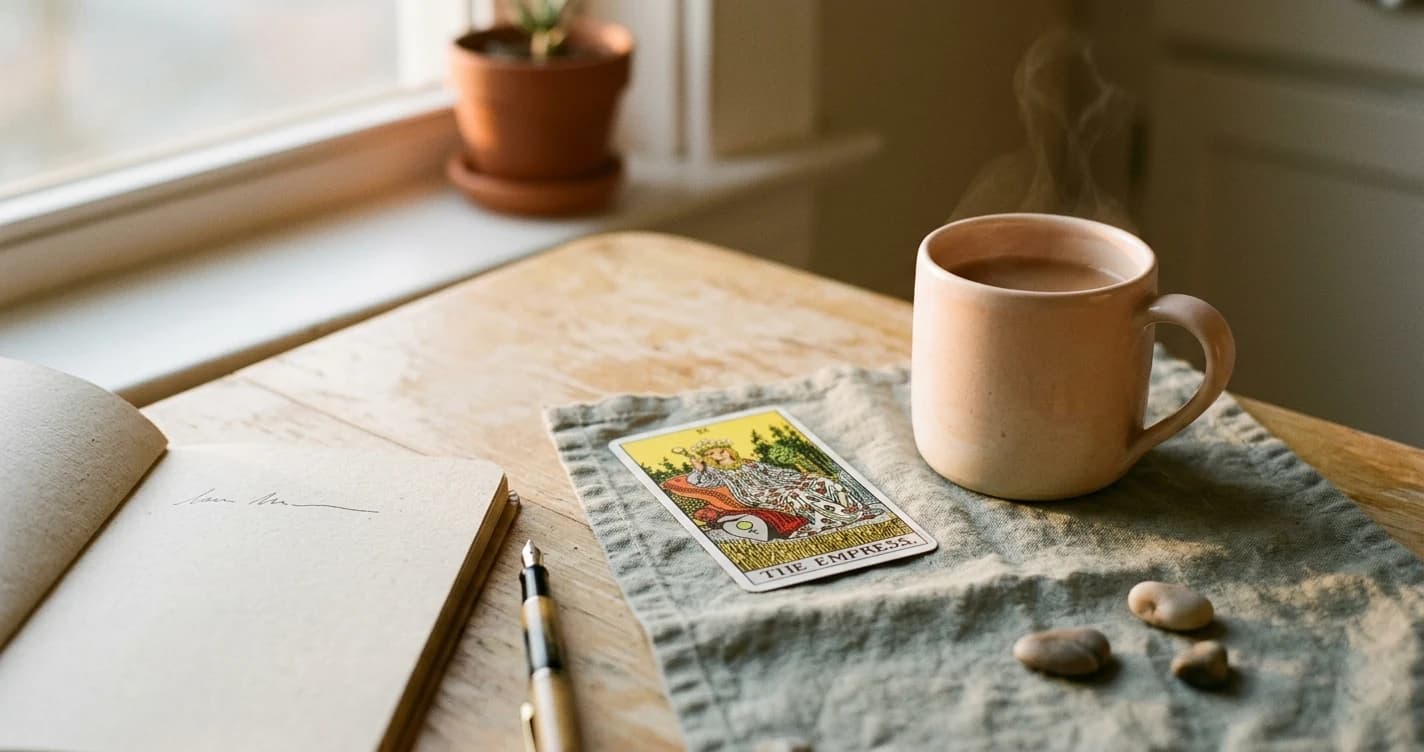
Most advice about building a tarot morning ritual quietly assumes you have a soft-lit apartment, thirty open minutes, and a personality that loves routines for their own sake. Real life is usually less cinematic. You wake up, check your phone too early, remember three things you forgot yesterday, and try to get yourself into the day without already feeling behind.
That is exactly why a small daily practice can help.
A useful tarot ritual does not need incense, a perfect altar, or a deep belief system. It needs one repeatable action that helps you orient yourself before the day starts. For most people, that means a simple daily tarot practice: pull one card, ask one honest question, and write one line about what it brings up. The value is not in predicting the day. It is in interrupting autopilot long enough to notice what kind of day you are stepping into.
Why a tarot morning ritual works better than vague intentions
A lot of morning routines fail because they are too abstract. “Be more mindful today” sounds nice, but it gives your brain nothing to hold onto. A card does.
That is one reason a tarot habit can stick where other self-improvement rituals do not. The card gives you a concrete prompt. It narrows the field. Instead of trying to become a better person before coffee, you respond to one symbol, one tension, or one invitation.
Imagine waking up worried about a conversation you need to have later. You pull Strength. You do not have to decide whether the card is cosmically correct. You only have to ask, what would calm courage look like today? That is enough to change how you walk into the morning.
The same thing happens on messier days. You pull the Seven of Cups when your mind is scattered and suddenly the problem is not “my life is chaos.” It is “I am trying to hold too many possibilities at once.” That is a much more workable insight.
Try this tomorrow morning: before you look at messages, pull one card and finish this sentence: “Today, this card asks me to pay attention to ______.” Keep it to one line.
What a daily tarot practice actually needs
A good tarot morning ritual is smaller than people think. The version that survives is the one with the fewest moving parts.
At minimum, you need:
- one card
- one question
- one short written response
That is it. Not a full spread. Not a twenty-minute interpretation rabbit hole. Not five clarifier cards because your first draw felt “too vague.” The point is to create a morning reflection practice you can repeat even when you are tired, rushed, or not particularly inspired.
A durable ritual usually looks something like this:
- Sit down with your deck or open a daily card tool.
- Take one breath before drawing.
- Ask a simple question such as “What energy am I bringing into today?”
- Pull one card.
- Write one to three sentences about what stands out.
That structure matters because it reduces friction. People often quit reflective practices not because they dislike them, but because the setup gets too elaborate. The more ceremonial your practice has to be, the easier it is to skip on ordinary weekdays.
For someone who wants the ritual but not the prep, the simplest path is often to treat tarot the way people treat brushing their teeth: not profound every time, just steady. Some mornings the card will feel uncannily relevant. Some mornings it will just help you name what is already true. Both count.
If you are completely new to the practice, what tarot is actually useful for gives a grounded overview. If you are still wary of the whole thing, this guide to tarot for skeptics may be the better place to start.
Try this for one week: keep the ritual under three minutes. If it takes longer, simplify it until it feels almost too easy.
How to make the ritual stick when you are inconsistent
Most people do not need more motivation. They need less friction and less self-drama about missing a day.
If you journal inconsistently, meditate occasionally, and keep restarting habits every Monday, you are normal. The fix is not to become a different kind of person. The fix is to make the practice forgiving enough that you return to it quickly.
Here are three ways to make a simple daily tarot practice for busy people actually hold:
Attach it to something you already do
Pair the draw with coffee, tea, breakfast, or sitting down at your desk. Habits stick more easily when they latch onto an existing sequence.
For example, someone might keep their deck next to the kettle. Water on, card pulled, one note written while the mug cools. Now the practice has a home.
Lower the standard for a “successful” day
A successful ritual is not a profound insight. It is showing up.
Some mornings your note might be: “Pulled the Hermit. Need less input before noon.” That is enough. If you only count the big mystical-feeling mornings, you will talk yourself out of the many ordinary ones that actually build the habit.
Do not punish missed days
Nothing kills a practice faster than turning one skipped morning into a personality verdict. If you miss three days, restart on the fourth without ceremony. Ritual works through repetition, not purity.
A lot of people quietly abandon tarot because they think inconsistency means they are “not a tarot person.” In reality, inconsistency is just what trying to build a practice looks like.
Try this adjustment: define the smallest possible version of the ritual for hard mornings. One card. One sentence. No exceptions, no catch-up.
What to write after you pull the card
The writing part is where the ritual becomes useful instead of decorative.
Many people get stuck because they think journaling means producing a meaningful paragraph before 9 a.m. It does not. A morning reflection practice with tarot in two minutes only needs enough language to capture what the card stirred up.
Use one of these prompts:
- What feels true about this card today?
- What does this card make me notice about my mood?
- Where am I being invited to slow down, act, trust, or clarify?
- What would it look like to carry this card well today?
Say you pull the Two of Pentacles on a day packed with errands, deadlines, and emotional spillover. Your note might read: “I can juggle today, but not endlessly. Need to choose what matters most.” That is already actionable.
Or maybe you pull the Star after a rough week. You do not need to write a grand interpretation. You might simply note: “Something in me is tired but still willing to hope.” That one sentence can become the emotional anchor for the rest of the day.
This is also why a rigidly spiritual vocabulary is not required. You are not trying to sound like a tarot reader on the internet. You are trying to notice yourself honestly.
Try this prompt after your next card: “The part of this card I least want to admit is…” That question tends to cut through performance fast.
Physical deck or app? Use whatever makes you return tomorrow
Some people assume a ritual only counts if it involves a physical deck, a cloth, and a fully offline moment. That can be beautiful. It is not mandatory.
A practice is only as good as its repeatability. If your deck lives on a shelf you rarely reach for before work, a digital daily draw may be what keeps the ritual alive. If the tactile act of shuffling helps you settle, your own deck may be the better anchor.
The important thing is that the ritual still feels like a pause, not like more content consumption.
For many readers, the sweet spot is a two-minute structure that preserves intentionality without making the whole morning revolve around setup. That might mean using a physical deck on slower mornings and a guided daily card tool on busier ones. What matters is continuity.
Liminal Tarot’s free daily card pull is built for exactly this kind of low-friction ritual: one card, a moment of reflection, and a place to begin without needing to turn the morning into a production.
A tarot morning ritual should help you meet the day, not delay it. Keep it small enough to survive ordinary life. Pull the card. Notice what it touches. Write one line. Then go make breakfast, answer the email, have the hard conversation, or take the walk. The ritual does not replace your life. It gives you a cleaner way to enter it.